

Last reviewed: August 7, 2026 · Editorial disclosure: This article is published by Phonemax, a rugged-device manufacturer. The Phonemax X5 is used below as a first-party example of a smaller-battery design choice. We do not present an article-specific laboratory comparison of 10,000mAh phones.
Quick answer
A 10,000mAh rugged phone is practical when you regularly spend long hours away from power, run GPS or hotspot functions heavily, work long field shifts or need multi-day endurance. It can be overkill when charging is easy to access and you care more about pocket comfort and low weight.
The better question is not “Is 10,000mAh big?” It is “What recurring problem does the extra capacity solve, and is that problem worth the extra size and weight?”
Why rugged phones often use large batteries
Field phones can spend hours running high screen brightness, navigation, cellular data, Bluetooth accessories, cameras, hotspot functions, PTT and background tracking. Android’s developer documentation identifies display, GPS, cellular, Wi-Fi, camera, CPU and other components as separate sources of device power use, and its location guidance notes that higher-accuracy and more frequent location updates can increase battery drain.
That matters because a rugged phone may be used as an always-on work tool rather than a device that spends much of the day in a pocket near a charger.
What a 10,000mAh-class battery can change
Long navigation sessions
Continuous location, a bright screen and network connectivity can create sustained power demand. More capacity gives motorcycle riders, drivers, hikers and field teams additional margin before charging becomes urgent.
Multi-day travel
When charging is uncertain, additional capacity can reduce the need to manage every percentage point or carry a separate power bank.
Long work shifts
For logistics, construction, security and emergency workflows, remaining operational through the full shift can be more valuable than a slim body.
Hotspot and communication use
Cellular and Wi-Fi radios consume power while active. A phone that regularly shares data, stays connected to accessories or runs communication apps can benefit from additional reserve.
Why capacity alone cannot predict runtime
Two phones with the same battery capacity can last very different lengths of time. Runtime depends on display size and brightness, chipset efficiency, network signal, modem behavior, software, background activity, location use, temperature and the specific task.
Android’s Power Profiler documentation illustrates this directly by measuring power rails for components such as the display, cellular radio, GPS, camera, CPU, GPU and Wi-Fi.
So a capacity number should never be converted into a guaranteed number of days without a controlled usage test.
The unavoidable trade-off: weight and thickness
A larger battery requires physical volume and adds mass. A rugged enclosure can add further thickness around it. That may be entirely reasonable in a vehicle mount, tool vest or backpack and frustrating in jeans or during one-handed use.
Always check the complete phone weight and dimensions. Battery capacity is only valuable if the resulting device is still comfortable enough for the intended workflow.
Charging speed matters almost as much as capacity
A very large battery with slow charging can create a different problem. After a demanding day, recovery time may be long, and a short lunch break or vehicle stop may add only a small amount of usable energy.
Evaluate capacity together with charging wattage, charger compatibility, thermal behavior and whether the phone can maintain or increase charge while GPS, display and network functions are active.
Large battery vs power bank
| Question | Large-battery phone | Normal battery + power bank |
|---|---|---|
| Extra weight | Carried every day | Carried only when needed |
| Cables / separate items | Fewer | More |
| Weather / dirt exposure | One integrated device | Extra connectors and accessories |
| Occasional long trips | May be unnecessary | Flexible |
| Daily high-demand field use | Often more convenient | Can add workflow friction |
If you only need extra endurance a few times per year, a small power bank may be the smarter solution. If you need it every shift, integration becomes more valuable.
Battery health and temperature
Large capacity does not automatically mean a battery will age faster or slower. Lithium-ion aging depends on factors including temperature, state of charge, cycling and charging conditions. NREL research on lithium-ion aging models documents temperature- and state-of-charge-dependent degradation behavior.
For rugged users, this matters because phones can spend time in direct sun, vehicles or other thermally demanding environments. Battery-management software and thermal design matter alongside the headline capacity.
Who should seriously consider 10,000mAh?
- motorcycle navigation users,
- overlanders and remote travelers,
- multi-day hikers or campers,
- construction and field-service teams,
- long logistics or security shifts,
- remote work sites,
- users who run hotspot or tracking functions for hours,
- people who strongly prefer one integrated device to a power bank.
Who probably does not need it?
- users who finish most days with substantial battery remaining,
- people who spend the day near desk or vehicle charging,
- buyers who prioritize minimum weight,
- users who navigate only occasionally,
- people willing to carry a small power bank on rare long days.
A Phonemax counter-example: smaller can be deliberate
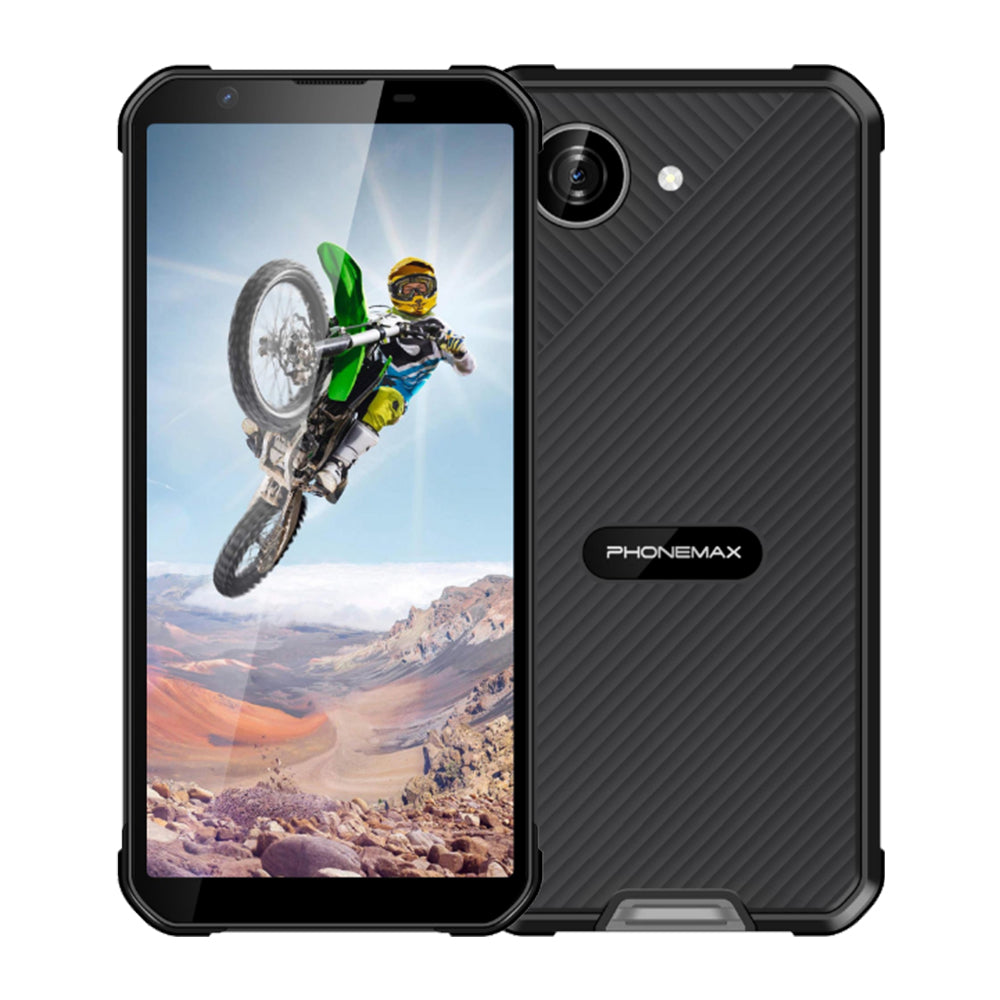
Our current Phonemax X5 listing pairs a 5000mAh battery with a 5.3-inch, 238 g compact rugged design. Because Phonemax publishes this article, this is a first-party example rather than an independent recommendation.
The design illustrates the central point: a rugged phone does not need the largest battery possible. A smaller capacity can be the correct engineering choice when the target user values manageable weight and has access to daily charging.
A better way to evaluate a large-battery phone
- Measure your real daily drain. Note how much battery you use during navigation, work apps, calls and hotspot use.
- Define the charging gap. How many hours must the phone operate without reliable power?
- Check total device weight. Decide what you are actually willing to carry.
- Check recovery time. A large battery is less useful if your routine requires fast top-ups.
- Look for real tests. Prefer controlled battery tests or real-user data that specify brightness, network, GPS and workload.
Limitations
This article does not claim that a 10,000mAh phone lasts a fixed number of days. Exact endurance requires testing a specific device under a defined workload. Battery-capacity labels also do not reveal chipset efficiency, software behavior, charging losses or battery aging.
Bottom line
A 10,000mAh rugged phone is not automatically excessive. It can be a rational tool for users who repeatedly need long navigation, field work or communication away from power. But extra capacity should earn its weight. If a normal battery already covers your day, the more practical rugged phone may be the lighter one.
FAQ
How long does a 10,000mAh phone last?
There is no universal answer. Runtime depends on hardware efficiency, display, network, GPS, software, temperature and workload.
Is 10,000mAh too heavy for everyday use?
It can be for some users. Check the complete phone weight and dimensions rather than judging the battery alone.
Is a 10,000mAh phone better than a power bank?
For daily high-demand use, integration can be more convenient. For occasional trips, a conventional phone plus a power bank may be lighter on normal days.
Does a bigger battery always mean better battery life?
More capacity usually provides more stored energy, but the final runtime still depends heavily on the rest of the device and how it is used.
Sources and verification
- Android Developers — Power Profiler
- Android Developers — background location and battery life
- NREL / Journal of The Electrochemical Society — lithium-ion battery life model and degradation factors
Next step: estimate the number of hours you genuinely need to operate between chargers, then buy the smallest battery that gives you a comfortable safety margin for that workload.

Jätä kommentti
Kaikki kommentit moderoidaan ennen julkaisemista.
Tämä sivu on suojattu hCaptcha-tunnistuksella, ja hCaptchan tietosuojakäytäntöjä ja käyttöehtoja sovelletaan.