
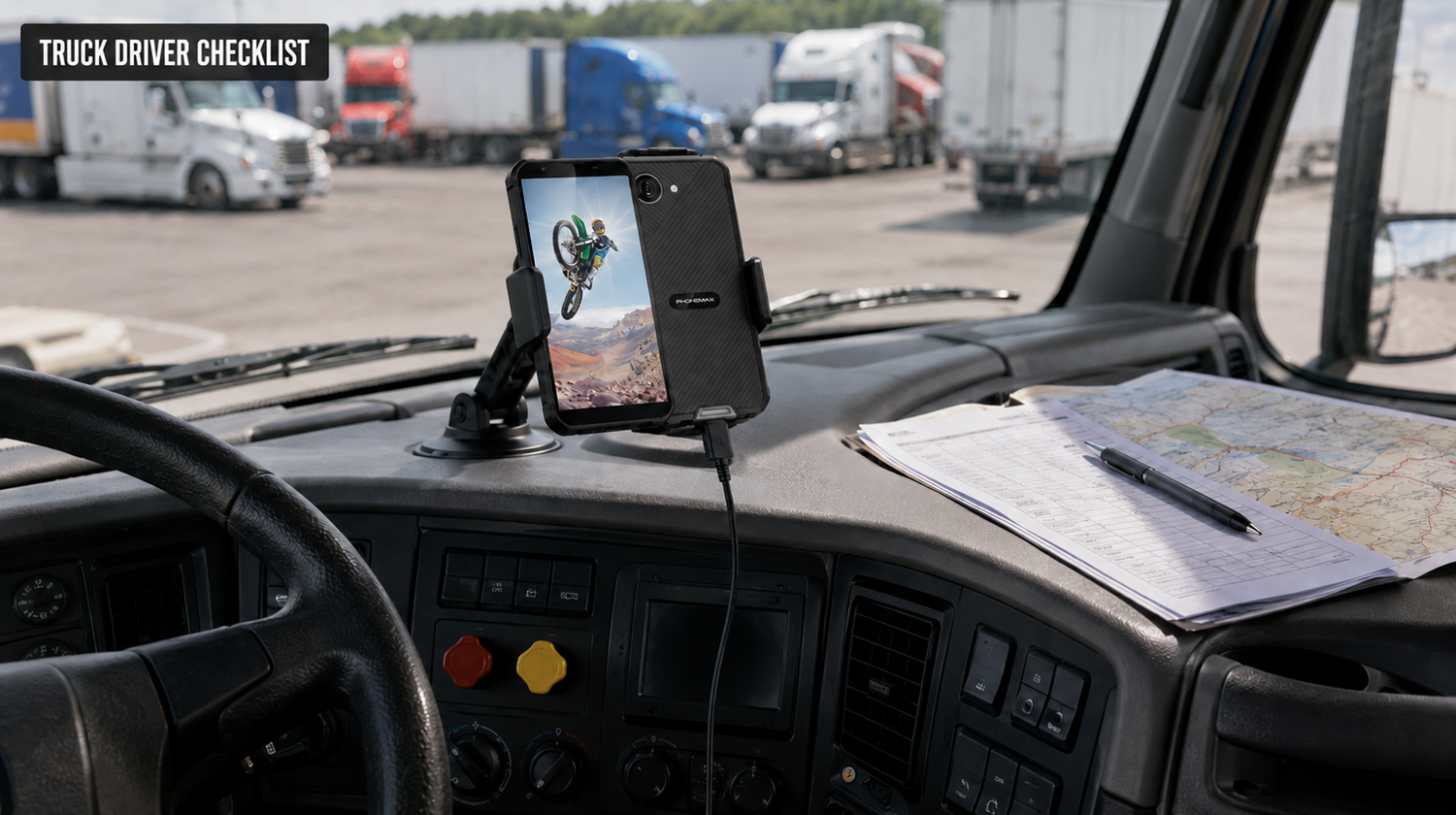
Long-haul drivers should evaluate a rugged phone while the vehicle is safely parked, testing mount position, charging stability, carrier coverage, audio, offline navigation, dispatch apps and end-of-shift battery reserve. The winning device is the one that reduces stops and handoffs without adding visual, manual or cognitive distraction while driving.
Safety sets the design rule
NHTSA warns that phone use while driving creates serious crash risk. A rugged enclosure does not make interaction safe. Build a workflow in which route entry, document review, messages and troubleshooting happen while parked. Use voice or hands-free features only where lawful and permitted, and remember that hands-free interaction can still be cognitively distracting.
| Parked-vehicle test | Record | Reject when |
|---|---|---|
| Mount and view | Obstruction, reach and vibration | Blocks sight line or loosens |
| Power | Charge state during navigation and hotspot use | Battery falls during normal powered operation |
| Coverage | Planned route dead zones by carrier | Critical workflow has no offline fallback |
| Audio | Call and alert clarity in a noisy but parked cab | Alerts cannot be heard or understood |
| Workflow | Taps and time for dispatch task | Requires complex interaction on the road |
| Temperature | Behavior after normal parked-cab exposure | Overheating, shutdown or charging warning |
A one-route pilot
- Confirm carrier bands and service on the exact variant.
- Mount the phone without obstructing the road view, controls or airbags.
- While parked, load the route, offline maps and dispatch tasks.
- Run navigation and normal charging for at least two hours; record temperature and battery trend.
- Test calls, alerts and document capture at scheduled stops.
- Review every moment the driver needed to touch the device. Redesign the workflow rather than normalizing unsafe interaction.
Phonemax X5 variant checks
The X5 is a compact 4G rugged phone with a 5.3-inch display, 238g body and 5000mAh battery. The T615 Full-Band version lists more LTE bands, a large speaker, fingerprint unlock and 4GB+64GB or 6GB+128GB options. The G81 Europe/Asia version has a different processor, standard speaker, 4GB+64GB and no fingerprint sensor.
“Full-Band” is not a universal compatibility guarantee. Use the carrier compatibility checklist, then measure real outcomes with the existing truck-driver downtime method. The product page does not publish mount compatibility, high-temperature operating limits or measured cab audio.
Frequently asked questions
Should a driver operate a mounted phone while moving?
No. Configure routes, messages and work apps while safely parked and follow all local laws and company policies.
Is a bigger screen always better in a truck?
No. Readability, placement and minimal interaction matter. A large screen mounted badly can obstruct sight lines or increase distraction.
Does a full-band phone work on every carrier?
No. Bands, carrier approval, SIM services and local coverage must all be checked.
What should be available offline?
At minimum, critical route data, delivery contacts, emergency instructions and any documents required when coverage fails.
Sources and verification links
Editorial method
Prepared by the Phonemax Editorial Team on 22 August 2026. We checked the current product listing, separated published specifications from field-test requirements, and linked primary sources beside the claims they support. To request a correction, contact Phonemax through the official website.

Jätä kommentti
Kaikki kommentit moderoidaan ennen julkaisemista.
Tämä sivu on suojattu hCaptcha-tunnistuksella, ja hCaptchan tietosuojakäytäntöjä ja käyttöehtoja sovelletaan.