

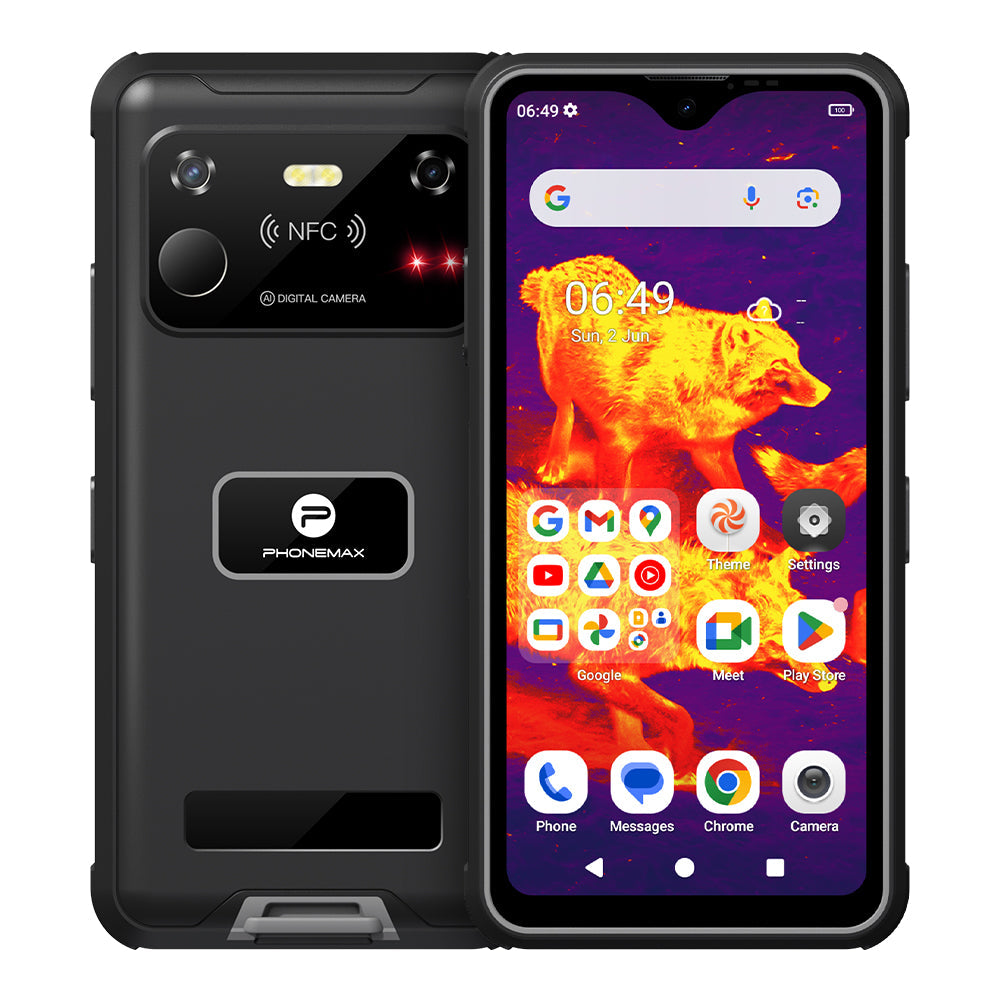
Short answer: start with the Phonemax P1 when battery capacity is the main purchasing priority, because its Phonemax specification lists a 6100mAh lithium-polymer battery. Start with the Phonemax X5 when compact dimensions, a 238 g weight, Android 16 and a 5000mAh battery create the better overall field package.
A higher mAh number does not by itself tell you which phone will last longer in every workload. Google’s Android battery guidance identifies screen use, navigation/GPS, tethering, app activity, camera use and heat as factors that can increase battery drain. Android Developers also explains that wireless network activity can be a major source of battery drain because cellular and Wi-Fi radios consume power while transmitting data and remaining active. For that reason, this article does not present the 6100mAh-versus-5000mAh difference as a standardized endurance result.
What the current Phonemax specifications tell us
| Specification | Phonemax P1 | Phonemax X5 |
|---|---|---|
| Rugged positioning | IP68 rugged smartphone | IP68 / IP69K compact rugged smartphone |
| Battery | 6100mAh lithium-polymer, 4.4V | 5000mAh |
| Dimensions | 166.9 × 81 × 13.9 mm | 140.5 × 67.7 × 15.4 mm |
| Weight | 275 g | 238 g |
| Operating system | Android 10.0 | Android 16 |
| Display | 6.35-inch INCELL, 19.5:9, HD+ IPS, 720 × 1560 | 5.3-inch |
| Memory / storage | 4GB / 128GB | Current X5 configuration per product listing |
| Other listed P1 functions | NFC, fingerprint, smart key | See current X5 product listing |
| Primary decision angle | Larger listed battery and larger display | Smaller, lighter, newer Android platform |
The P1 figures above are based on Phonemax product specifications supplied for this comparison. They replace the earlier “confirm current configuration” placeholders, so the reader is not being asked to resolve missing core specifications independently.
Why 6100mAh versus 5000mAh is not the whole answer
Battery capacity is stored-energy potential, not a standardized real-world endurance score. P1 has about 22% more nominal battery capacity than X5, but it also has a larger 6.35-inch display and a different hardware/software platform. Real runtime still depends on workload and radio conditions.
For field teams, that workload might include continuous navigation, hundreds of photos, periodic hotspot use, Bluetooth peripherals, poor-signal cellular operation, messaging, background sync or work apps. Android Developers notes that network requests can keep cellular or Wi-Fi radios in higher-power states, which is one reason radio behavior and data-transfer patterns can materially change battery use.
Choose P1 when battery capacity and a larger screen are the first filters
If the purchasing brief begins with “maximize battery capacity within this comparison,” P1 is the logical first device to evaluate. Its listed 6100mAh battery is larger than X5’s 5000mAh battery, and its 6.35-inch 720 × 1560 INCELL display also gives it a larger viewing area.
P1 is listed at 166.9 × 81 × 13.9 mm and 275 g, with Android 10.0, 4GB RAM and 128GB storage. That makes it physically larger and heavier than X5, so the battery advantage comes with a different carry profile.
Choose X5 when carry size and newer Android matter
X5 is built around a more compact rugged-smartphone profile. Its current listing specifies a 5.3-inch display, 140.5 × 67.7 × 15.4 mm body, 238 g weight, Android 16 and a 5000mAh battery.
Compared with P1, X5 is 26.4 mm shorter, 13.3 mm narrower and 37 g lighter. For workers who climb, walk long routes, use crowded tool belts, carry a second phone, or repeatedly move the device in and out of a pocket, that difference can matter throughout the day.
How to run a fair battery comparison
- Use the same carrier and similar signal conditions. Weak or unstable signal can increase radio activity and battery use.
- Set comparable screen brightness. Do not test one phone at low brightness and another at maximum.
- Install the same work apps. Include VPN, MDM, messaging, navigation and background sync where relevant.
- Run the real work sequence. Reproduce calls, photos, navigation, uploads, hotspot sessions and idle periods.
- Record remaining charge at fixed checkpoints. This shows where drain occurs rather than relying on one end-of-day number.
- Repeat in the relevant temperature and network conditions. A cool office with strong Wi-Fi may not represent field use.
Do not buy battery capacity you cannot comfortably carry
For an individual user, device ergonomics can outweigh a theoretical runtime advantage. For a fleet, the better question is measurable: does the smaller phone complete the required shift with the required reserve? If yes, the more compact form factor may reduce carry burden without creating operational risk. If no, the larger-capacity P1 deserves consideration or the team should add a charging strategy.
FAQ
Which has the larger listed battery, P1 or X5?
P1 is specified with 6100mAh, while X5 is listed with 5000mAh.
Does that mean P1 always lasts longer?
No. P1 has more nominal battery capacity, but actual runtime still depends on display use, radios, apps, signal, temperature and user behavior.
What are the P1 size and weight?
The supplied Phonemax specification lists P1 at 166.9 × 81 × 13.9 mm and 275 g.
How compact is X5?
The current listing specifies 140.5 × 67.7 × 15.4 mm, 238 g and a 5.3-inch display.
Which is better for a fleet?
Use a controlled pilot. P1 is the stronger starting point when larger battery capacity and a larger screen matter most; X5 is stronger when compact carry, lower weight and Android 16 matter more.
Sources
- Phonemax P1 official product page
- Phonemax P1 product specification: 6.35-inch INCELL 720 × 1560 display, Android 10.0, 4GB/128GB, 6100mAh battery, 166.9 × 81 × 13.9 mm, 275 g, NFC, fingerprint and smart key.
- Phonemax X5 official product page
- Google Android Help — Get the most life from your Android device’s battery
- Android Developers — Optimize network access
Publisher disclosure: This comparison is published by Phonemax and discusses two Phonemax products, P1 and X5. Device specifications are first-party Phonemax information. General battery-drain and wireless-radio behavior are supported separately by Google Android Help and Android Developers documentation. The article does not claim a standardized side-by-side runtime result; real endurance still needs to be tested under the intended workload, signal and temperature conditions.


Yorum yazın
Tüm yorumlar yayınlanmadan önce incelenir.
Bu site hCaptcha ile korunuyor. Ayrıca bu site için hCaptcha Gizlilik Politikası ve Hizmet Şartları geçerlidir.