
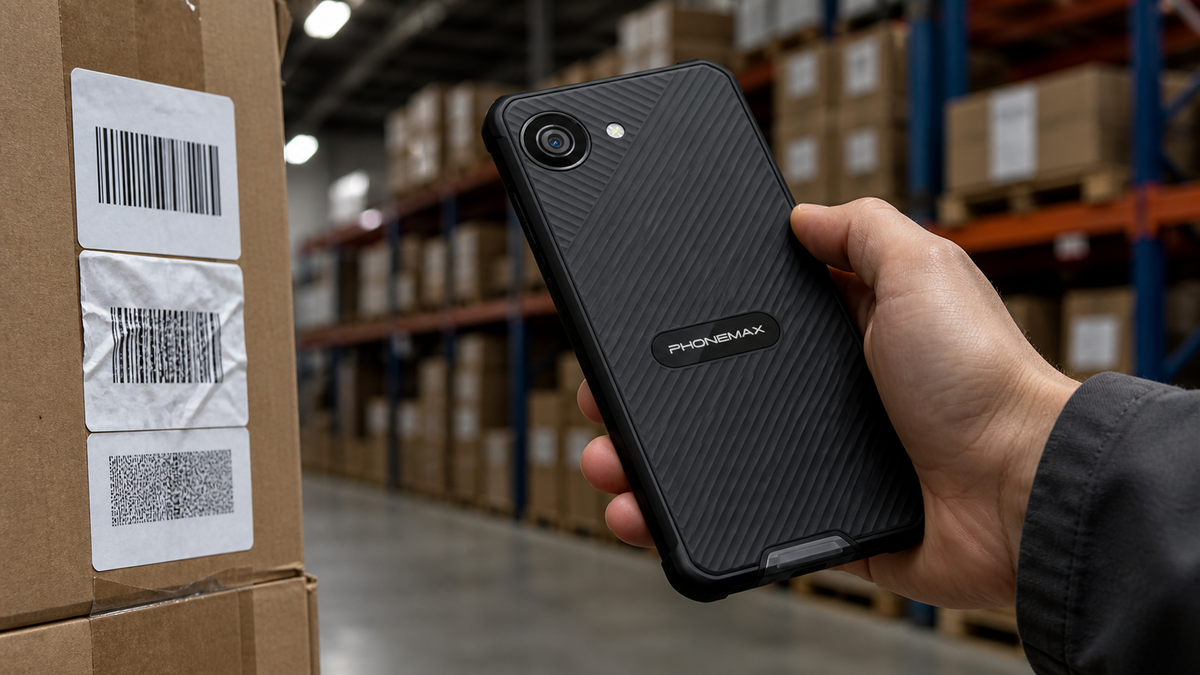
Author and review: Phonemax; editorial review batch B ended on 20 August 2026. The test deck and metrics are an original protocol; the article does not present fabricated scan-rate results. Transparency note: The X5 is included because Phonemax publishes this guide and sells that model. Camera-based scanning suitability remains unverified until the described workflow test is completed.
Pass criterion
A rugged phone can scan barcodes or QR codes reliably only if its camera, focus, software and workflow succeed on the organization’s real labels. Camera megapixels alone do not prove scanning performance. Test code sizes, surfaces, damage, distance, lighting, gloves, network loss and the target business app before deployment.
Build a representative test deck
Include every symbology and label type used at work: small printed labels, glossy packaging, curved surfaces, screens, dirty labels and partially damaged codes. Add known-invalid codes to confirm that the app fails safely rather than accepting the wrong record.
GS1's barcode-quality guidance identifies contrast, quiet zones, symbol size, deterioration, placement and curved packaging as factors that can affect reading. Android's AI/ML overview confirms that barcode scanning can be implemented with prebuilt ML Kit APIs, but an available API does not prove performance in a buyer's app or environment.
The Phonemax X5 is listed as a compact rugged smartphone with Android 16 and a 5000mAh battery. Its public page does not provide an enterprise barcode-engine specification, so evaluate it as a camera-based workflow unless separate hardware documentation says otherwise.
Score the workflow
| Metric | Minimum evidence |
|---|---|
| First-read rate | Successful first scans / total attempts |
| Time to result | Median and slowest acceptable scan |
| False acceptance | Wrong item accepted as correct |
| Offline behavior | Queue, validation and later sync |
| Operator effort | Repositioning, taps and manual entry |
Test at least three users and multiple device samples. Keep brightness, app version and camera settings documented. A strong result on clean desktop labels cannot be generalized to a warehouse or outdoor route.
Scanner-test questions
Do more megapixels mean better barcode scanning?
No. Focus, optics, motion, lighting, software and code size can matter more.
Can a phone replace a dedicated scan engine?
Only if throughput, ergonomics, accuracy and integration meet the real workload.
What is the most important failure metric?
False acceptance is critical because it can silently attach the wrong item or record.
Acceptance action: Pair the scanning protocol with the compact-phone ergonomics test.
Log both results in the fleet pilot. When outdoor shifts are in scope, repeat the scan cycle under cold-weather battery conditions.
Sources: GS1 barcode-quality guidance; GS1 barcode verification guideline; Android AI/ML overview; Phonemax X5 product page

Leave a comment
All comments are moderated before being published.
This site is protected by hCaptcha and the hCaptcha Privacy Policy and Terms of Service apply.