
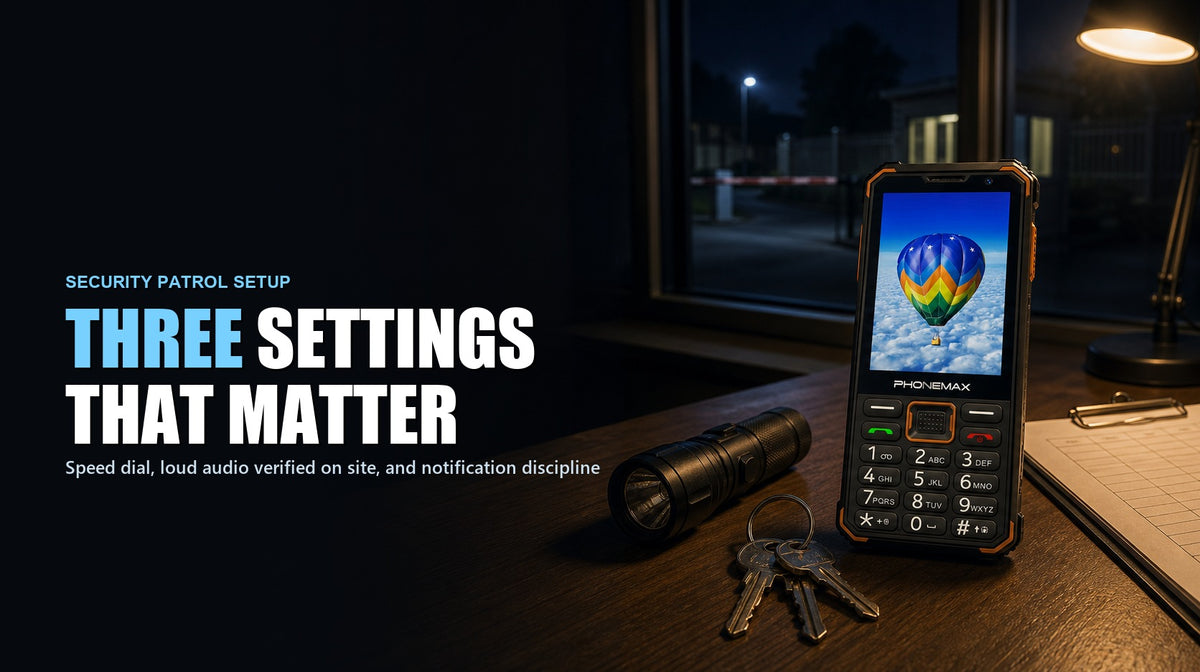
Deploy the Phonemax F4 T for a patrol only after it passes six checks: priority contacts, audibility in the real carry position, required app delivery, handover charging, missed-check-in escalation and environmental fit. A large keypad and loud-speaker claim are useful starting points; the site test decides whether the setup works.
F4 T patrol deployment checklist
| Check | Pass | Fail |
|---|---|---|
| Priority contacts | Control room, supervisor and site contacts each complete a real call | A required number is missing, ambiguous or untested |
| Audibility | The ringtone is noticed at the noisiest normal patrol point with the phone in its actual pocket or holster | The phone is only audible on a quiet desk |
| Required app | The exact app version launches, signs in and sends/receives on the deployed network | Compatibility is assumed from “Android” alone |
| Handover power | A named person, location and charger or compatible optional dock are assigned | Charging depends on whoever notices a low battery |
| Check-in escalation | The team knows who acts, by which channel and after what delay | The phone is treated as the safety procedure |
| Environment | Water/dust exposure stays within documented capability | An unpublished IP rating is assumed |
1. Put job roles at the top of the contact list
Save entries such as “Control Room”, “Night Supervisor”, “Gate 2” and “Site Manager”, then call every number. Role-based names reduce hesitation during handover, but the real call verifies the number, SIM, network and audio path together.
2. Test the 3W speaker claim where noise actually occurs
The current product page lists a 3W high-volume speaker rated up to approximately 120dB under manufacturer test conditions. That figure does not guarantee that a call will be heard through a jacket beside traffic, machinery or a loading dock.
Set the intended ringtone and volume, put the F4 T in the actual carry position, walk to the noisiest normal patrol point and have another team member call. Pass only if the operator notices the call consistently without creating an unsafe listening practice.
3. Keep the Android setup narrow
The F4 T combines large physical controls with a touchscreen and supports compatible Android communication and social apps. The live listing also shows 4G LTE, dual Nano SIM, 2GB RAM + 16GB storage, Bluetooth, PTT and a headphone jack. These are first-party listing claims, not proof that every app or regional service will work.
Install only the applications the patrol needs. Verify the exact app version, permissions, sign-in, notifications and background delivery on the intended carrier before ordering multiple units. For a focused assessment of the controls, see How to Evaluate Large Physical Controls and a Touchscreen on the Phonemax F4 T.
4. Make charging part of the handover
The current listing shows a removable 2500mAh battery and an optional desktop charging dock. Capacity alone does not establish a full-shift runtime. Define the charging point, label the accessory, record unusual drain and make the outgoing shift responsible for returning the phone ready.
5. Write the missed-check-in response outside the phone
Specify the check-in interval, acceptable delay, first callback, supervisor escalation and site response. The F4 T is a communications device. If the risk assessment requires monitored panic, man-down detection or automatic escalation, deploy purpose-built equipment and procedures.
6. Stop at the environmental boundary
No specific IP rating is currently published for the F4 T. Do not infer certified water or dust resistance from its appearance or from other Phonemax models. If patrol exposure requires a documented rating, choose a product whose current listing provides it.
Choose the F4 T for the right patrol role
The F4 T is a sensible candidate when large physical controls, touch access to a small set of Android apps, loud audio and straightforward handover matter more than a large smartphone display. Read When Do Physical Keys Make More Sense Than a Full Touchscreen for Work Calls? for the category decision.
If the patrol needs a built-in torch, compare the Phonemax X2. If infrared night imaging and L1+L5 positioning are central, compare the Phonemax X3. If a conventional larger-screen rugged smartphone is required, compare the Phonemax P2.
FAQ
Is the F4 T waterproof?
No specific IP rating is currently published, so buyers should not assume certified water or dust resistance.
Is the speaker guaranteed to reach 120dB during patrol use?
No. Approximately 120dB is a manufacturer test-condition rating. Real audibility depends on ringtone, noise and carry position.
Can the F4 T replace a lone-worker alarm?
No. It can support calls and compatible apps, but a risk assessment may require a dedicated monitored safety system.
Deployment evidence note
F4 T specifications in this checklist come from the current Phonemax product listing. The pass/fail procedure is practical deployment guidance, not a validated security-industry or lone-worker standard.

Αφήστε ένα σχόλιο
Όλα τα σχόλια ελέγχονται πριν δημοσιευθούν.
Αυτή η τοποθεσία προστατεύεται από το hCAPTCHA και ισχύουν η Πολιτική απορρήτου και οι Όροι Παροχής Υπηρεσιών του hCaptcha.