
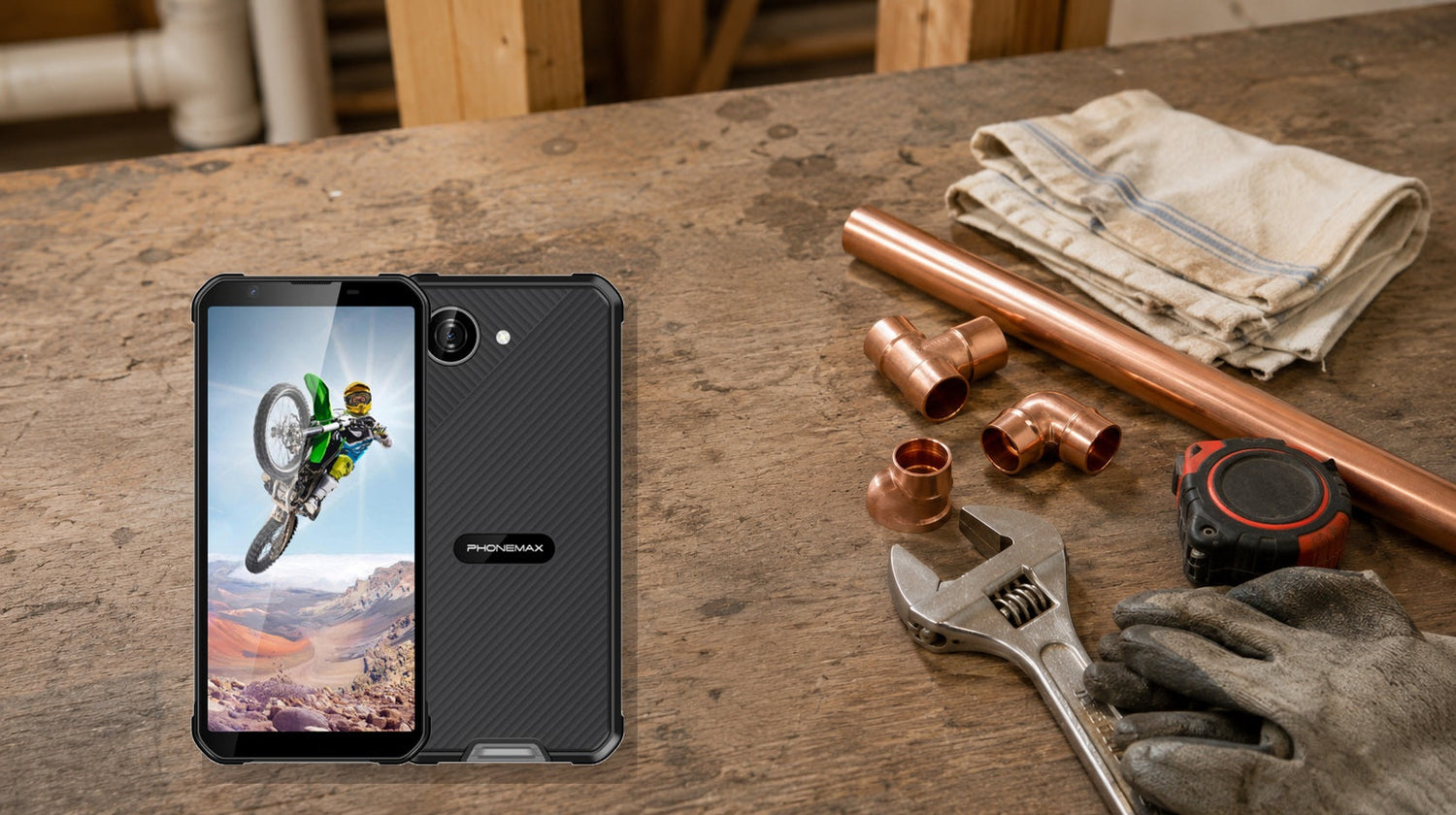
For plumbers, the most valuable rugged-phone features are dependable wet-work handling, secure one-handed carry, clear audio in noisy plant rooms, a screen readable for drawings and photos, enough battery for dispatch and documentation, and ports that can be protected and dried. Ratings matter, but safe workflow and real-app testing matter more.
Feature priorities by plumbing task
Leak diagnosis and documentation
Prioritize quick camera access, reliable focus at practical distances, timestamped notes and storage for before/after evidence. Do not assume a higher camera megapixel number guarantees better photos in dark cabinets.
Dispatch and customer communication
Speaker volume, microphone clarity, network compatibility and one-handed answering may matter more than maximum screen size. Test in a running mechanical room, not a quiet shop.
Plans, manuals and forms
Check PDF legibility, zooming with damp hands, signature fields and the ability to attach several photos without the app restarting. A compact screen is easier to carry but may require more zooming.
Wet and dirty environments
Inspect port covers, screen behavior with droplets and ease of cleaning. Water resistance does not make powered use safe in every wet or conductive location.
OSHA notes that wet and damp locations contribute to electrical hazards and requires suitable protection for electrical equipment in such environments. A phone is not a substitute for lockout/tagout, appropriate test equipment or PPE.
Reproducible plumber workflow test
Wear the glove normally used for non-energized plumbing work. With the candidate phone in its actual case, complete this sequence: receive a dispatch, open a PDF drawing, photograph a pipe label in a dark cabinet, enter a 100-word note, place a speakerphone call beside operating equipment and upload three images. Repeat with dry hands and then with a lightly damp fingertip after the phone is disconnected from power.
Record completion time, glove removals, missed inputs, audio repeats, battery change and any app failure. Stop if testing would create an electrical, confined-space, chemical or machinery hazard.
Decision table
| Work condition | Priority feature | Rejection signal |
|---|---|---|
| Repeated splashes | Documented ingress conditions + intact covers | Vague “waterproof” claim only |
| Gloves | Verified workflow or physical control | Requires unsafe glove removal |
| Noisy room | Tested speaker/microphone | Calls cannot be understood |
| Tight spaces | Secure grip, compact carry, tether option | Device falls from pocket |
| Long shift | Measured workload battery | Cannot retain emergency reserve |
| Hazardous location | Required location-specific approval | Ordinary rugged label presented as approval |
Phonemax X5 as a first-party example
The Phonemax X5 lists a 5.3-inch display, 238 g body, Android 16, 5000mAh battery, 13MP front/rear cameras and IP68/IP69K. Its compact format may suit ladder, crawl-space and tool-belt carry. The T615 Full-Band version also lists a large speaker and fingerprint unlock, while the G81 version does not include those features. Buyers must specify the variant and confirm carrier bands.
Phonemax publishes this article, so X5 is a first-party example rather than an independent recommendation. The page does not establish wet-glove touch, chemical resistance, intrinsic safety, ATEX approval for this model or a measured decibel value. It also instructs users not to charge while wet.
When a rugged phone is not the answer
If the primary need is thermal imaging, borescope inspection or hazardous-gas measurement, use an approved professional instrument. If a technician works mainly in a dry office and makes occasional site visits, a mainstream phone with a suitable case may be more economical. The phone should simplify documentation without distracting from energized equipment, moving machinery or vehicle operation.
FAQ
Do plumbers need IP69K?
Not automatically. Match documented test conditions to actual splash, washdown and cleaning exposure.
Is a compact rugged phone better than a large one?
It can improve pocket carry and one-handed use, while a larger display may show plans better. Test the real workflow.
Can a rugged phone replace electrical test tools?
No. Use qualified equipment, procedures and PPE for electrical work.
Should plumbers charge a phone in a wet work area?
Keep connectors dry and follow manufacturer instructions. Do not interpret ingress protection as permission for wet charging.
Sources:
- https://www.osha.gov/laws-regs/regulations/standardnumber/1910/1910.305
- https://www.osha.gov/sites/default/files/publications/SMALL-BUSINESS.pdf
- https://phonemax.com/products/phonemax-x5-ip68-ip69k-compact-rugged-smartphone-android-16-5000mah-battery
Next step: Test the exact plumbing app, glove, case and work environment while the device is safely disconnected from power.

Jätä kommentti
Kaikki kommentit moderoidaan ennen julkaisemista.
Tämä sivu on suojattu hCaptcha-tunnistuksella, ja hCaptchan tietosuojakäytäntöjä ja käyttöehtoja sovelletaan.