
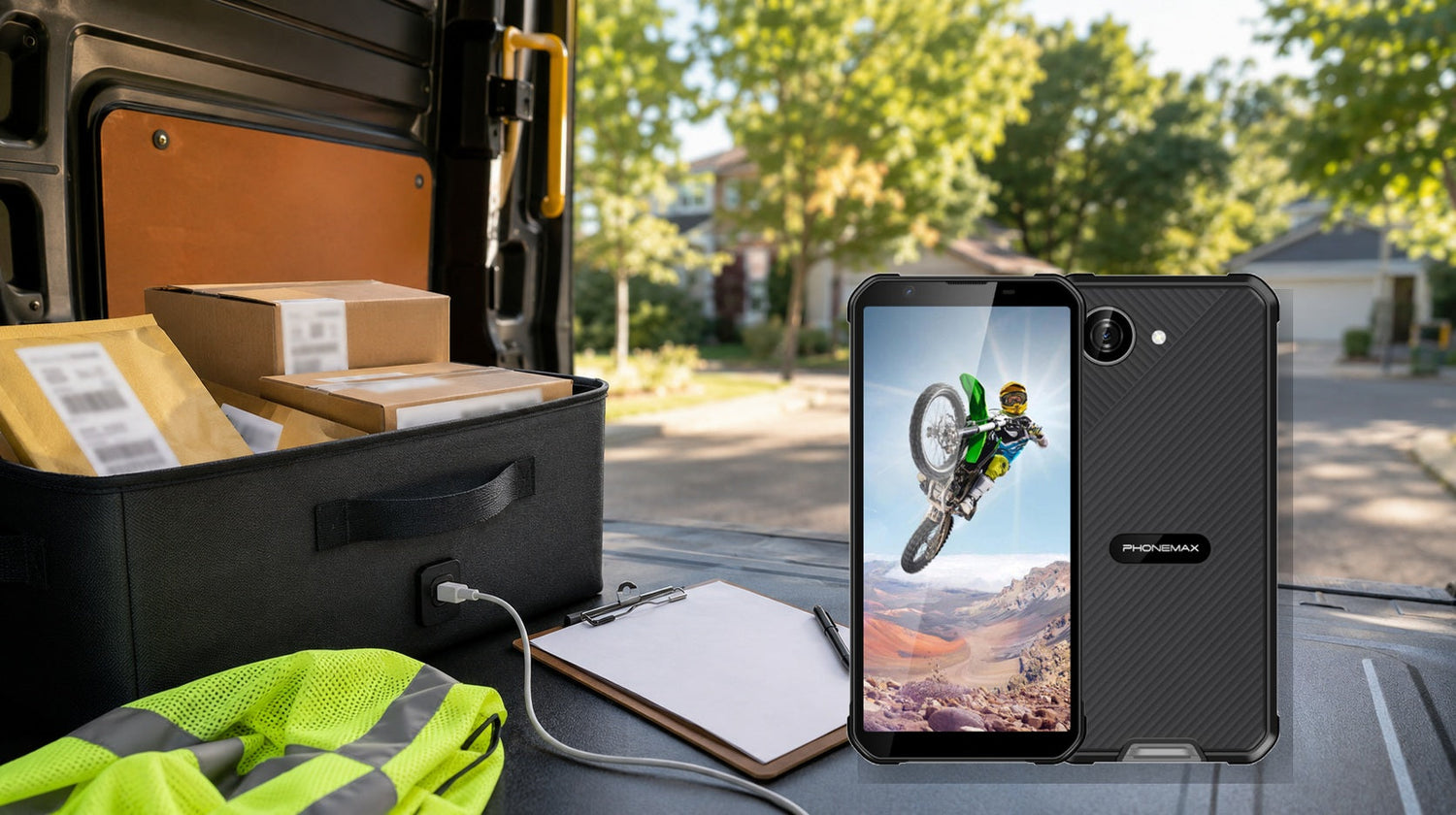
Delivery drivers need rugged phones when repeated drops, rain, dust, temperature changes and all-day scanning or proof-of-delivery work cause measurable failures or downtime. They do not need one merely because “delivery” sounds demanding. Safe mounting, fast workflow, network compatibility and rules against handheld use while driving are more important than a rugged label.
The delivery-day stress pattern
A delivery phone moves between a warm vehicle, cold rain, direct sun, pockets, docks and customer doorways. It may be handled hundreds of times, connected to a charger repeatedly and used for navigation, calls, photos, signatures and barcode workflows. The cumulative handling cycle—not one dramatic drop—often determines reliability.
Yet stronger hardware can create new costs: weight in the hand, mount incompatibility, slower app performance, harder one-handed typing and charging-port wear. Fleet selection must measure the whole route.
Safety boundary: parked use only
NIOSH explains that visual, manual and cognitive distractions all impair safe driving and that employers can act to prevent distracted driving. A rugged phone does not make handheld driving safer. Configure navigation before moving, use an approved secure mount and require drivers to stop legally before reading messages, photographing deliveries or resolving app errors.
Reproducible one-route pilot
Choose one representative route and run two complete phone kits on separate days: current mainstream phone plus case, and rugged candidate. Use the same SIM, app version, mount and charging source where possible.
Record:
- Time from park to completed proof of delivery.
- Failed scans, photos or signatures.
- Screen visibility problems.
- Rain or drop events.
- Mount movement and cable disconnections.
- Battery percentage at lunch and route end.
- Minutes lost to reboot, network or app failure.
- Any attempt to interact while the vehicle is moving; this is an immediate process failure.
Decision matrix
| Fleet evidence | Interpretation | Action |
|---|---|---|
| Frequent cracked screens/case removals | Integrated rugged design may reduce downtime | Pilot rugged candidate |
| Main failures are network/app latency | Hardware toughness will not solve root cause | Fix connectivity/software |
| Drivers cannot safely mount device | Candidate is unsuitable | Reject or change mount |
| Rain causes touch/signature failure | Test wet workflow and app controls | Require pass before rollout |
| Route ends with adequate reserve | Battery size is sufficient | Avoid unnecessary weight |
| Repeated port damage | Review charging cycles/dock design | Consider contactless/dock strategy if supported |
Phonemax X5 example
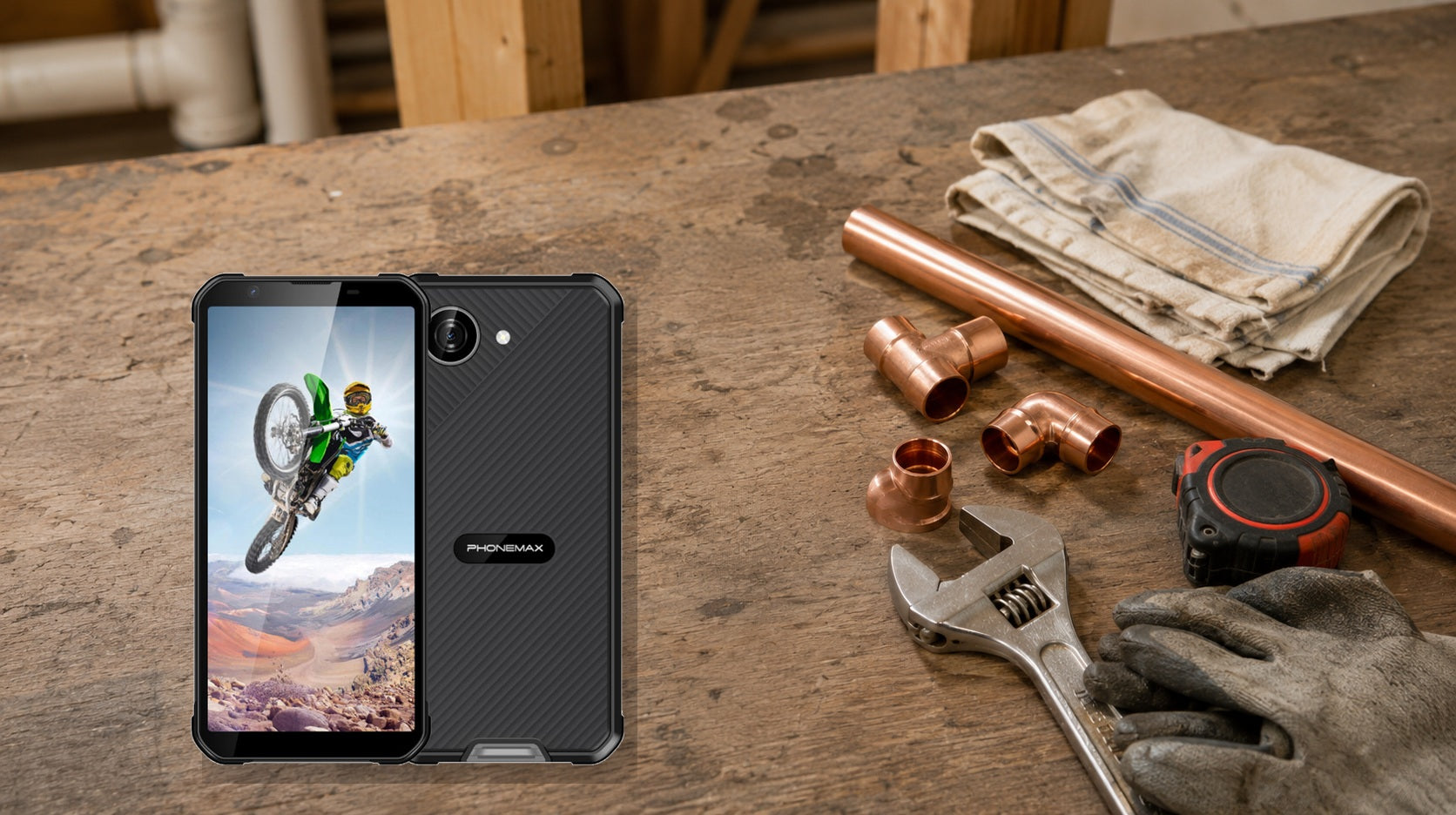
Phonemax publishes this guide. The X5 lists a compact 5.3-inch display, 238 g body, Android 16, 5000mAh battery and IP68/IP69K. Its size could suit frequent pocket-to-hand transitions. The page lists two platform variants with different network positioning and states that carrier bands must be checked; “Full-Band” does not guarantee universal carrier support.
The page does not establish compatibility with a particular dispatch, barcode or proof-of-delivery app, mount, MDM platform or vehicle charger. Those must be validated. It also does not justify handheld operation while driving.
When a regular phone plus case wins
If the route stays mostly inside a climate-controlled vehicle, the existing fleet has low breakage, the delivery app is optimized for a mainstream platform and local same-day repair is available, a regular phone plus a robust case may have lower total cost. A rugged phone adds value only when it reduces the failures that actually occur.
FAQ
Can drivers scan while the vehicle is moving?
No. Fleet policy should require the vehicle to be safely and legally stopped before handheld interaction.
Does a larger battery automatically make a better delivery phone?
No. Navigation, brightness, signal, scanning and temperature determine runtime, while extra capacity may add weight.
Is IP68 enough for rain?
It provides defined ingress evidence, but intact covers, manufacturer conditions and wet-screen usability still matter.
How long should a pilot run?
At least enough representative routes to include rain, sunlight, long shifts and multiple drivers—usually two to four weeks for a fleet decision.
Sources:
- https://www.cdc.gov/niosh/motor-vehicle/distracted-driving/index.html
- https://www.cdc.gov/niosh/motor-vehicle/resources/index.html
- https://phonemax.com/products/phonemax-x5-ip68-ip69k-compact-rugged-smartphone-android-16-5000mah-battery
Next step: Pilot the full mounted kit on representative routes and review safety violations separately from hardware results.

Jätä kommentti
Kaikki kommentit moderoidaan ennen julkaisemista.
Tämä sivu on suojattu hCaptcha-tunnistuksella, ja hCaptchan tietosuojakäytäntöjä ja käyttöehtoja sovelletaan.