
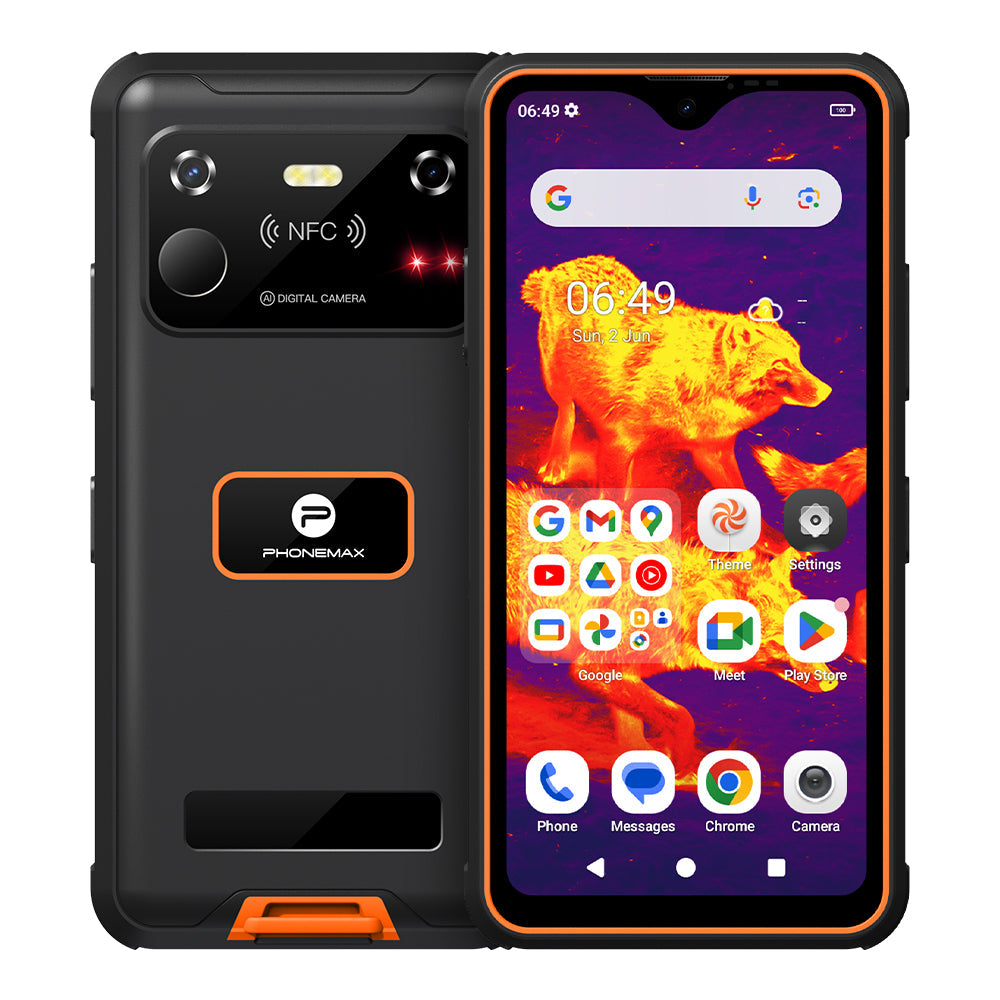
Thermal imaging and night vision answer different questions.
Commercial context: This guide is published by Phonemax, which sells the R4 GT and R4 Mini products discussed below. Official product pages describe the advertised configuration; third-party reviews provide sample-specific observations. Readers should verify suitability independently, especially for regulated or safety-critical work.
Thermal imaging shows differences related to heat; night vision helps reveal visible scene detail in low light. Choose thermal imaging when temperature contrast is the signal you need. Choose night vision when recognizing the scene and objects is more important.

The Phonemax R4 GT combines both functions in a compact 4G rugged smartphone measuring 121 × 59.2 × 18.3 mm and weighing 190 g. It is designed for users who want specialized imaging and mobile communication in one field device.
R4-T, R4 GT or P20 Pro: which imaging phone should you compare?
Start with the image your task needs. The R4-T lists a 20MP night-vision camera and a rear information display. For thermal imaging, compare the compact 4G R4 GT and 5G P20 Pro instead. Night vision should not be treated as a substitute for a thermal sensor.
Use the R4 GT vs P20 Pro comparison to weigh size and connectivity, then review the thermal imaging rugged phone collection. Confirm sensor specifications and the intended workflow before choosing a model.
The difference in one table
| Tool | What it detects best | Useful question | Main limitation |
|---|---|---|---|
| Thermal imaging | Temperature contrast and heat patterns | Where is the unusual warm or cool area? | A heat pattern does not identify its cause by itself |
| Night vision | Visible scene detail in low light | What object or route is in front of me? | It does not provide temperature information |
| Both together | Detection plus visual context | Is something unusual present, and what is it? | Results still require context and appropriate interpretation |
FLIR explains that thermal cameras create images from heat rather than visible light. Its thermal imaging versus night vision guide provides useful technical background on the distinction.

When thermal imaging is the better first choice
Thermal imaging is useful when the first question is about a temperature difference. Potential field applications include:
- Screening electrical or mechanical equipment for unusual heat patterns
- Identifying areas that deserve closer HVAC or building inspection
- Locating people or animals through heat contrast in suitable conditions
- Comparing similar surfaces during a preliminary check
- Recording a visual lead alongside a work note or field report
Treat the result as an inspection lead, not a diagnosis. Distance, reflections, surface material, emissivity, weather and the device itself can influence the image.
When night vision is the better first choice
Night vision is useful when the task depends on visible scene recognition after dark or in low light. It can help with moving through a campsite, identifying visible objects, outdoor observation, checking a work area and capturing context that a heat-only image may not show clearly.

If the task is specifically to identify overheating, cold spots or heat loss, night vision alone is not the right tool. If the task is to recognize a visible object or route, thermal imaging alone may not provide enough context.
What third-party R4GT coverage adds
The Phonemax R4 GT is a specific device, so its product-page feature list should be read alongside model-matched hands-on coverage.
- In its Phonemax R4GT review, Root-Nation discusses the compact form, the thermal imager and night-vision camera, and the practical effect of the small display on tapping and typing. These are observations from the reviewer’s sample, not universal claims about all phones.
- GSMaholic’s R4GT review video demonstrates the device’s thermal-imaging and night-vision functions and shows how the compact body and field-oriented controls are presented in practice. Use it for visible demonstration, not as proof of calibration or safety certification.
- TechRadar Pro’s Phonemax R4GT review includes sections covering design, features, performance and the final verdict. Verify the reviewed sample, date and current product revision before using any specific test finding from that page.
These sources add real-device context without turning one review sample into a universal performance promise.

What the Phonemax R4 GT brings together
The R4 GT combines thermal imaging, night vision and mobile communication in a compact rugged phone. Its official product page lists 4G, 3G and 2G support with model-specific bands; verify those bands with your carrier before purchase.
Carrying one device for communication, ordinary documentation and specialist imaging can simplify a basic inspection kit. The trade-off is that a compact screen may be less comfortable for long text entry or detailed forms. Independent hands-on coverage has highlighted this small-screen adjustment point.
A practical inspection workflow
- Define the question. Are you looking for heat contrast, visible scene detail or both?
- Record the conditions. Note time, weather, distance and equipment state where relevant.
- Scan the wider area. Look for patterns before focusing on one point.
- Compare like with like. Similar surfaces and conditions make differences easier to interpret.
- Capture context. Save an image that shows the target and its surroundings.
- Mark follow-up items. Treat unusual patterns as leads for closer inspection.
- Escalate when necessary. Use qualified personnel or certified equipment for safety-critical decisions.
What thermal imaging cannot tell you by itself
A thermal image does not automatically identify the cause of a temperature difference. A warm area may be expected, caused by reflection or influenced by the surrounding environment. Use precise language: “The image shows a temperature difference that may require further inspection” is more defensible than “the image proves the component is failing.”
What night vision cannot tell you by itself
Night vision can improve low-light visibility, but it does not provide temperature information. It may show an object’s shape or location while missing a heat-related issue that thermal imaging could reveal.
Is a combined imaging rugged phone right for you?
- A compact rugged phone for field communication
- Thermal imaging for preliminary heat-pattern screening
- Night vision for low-light scene context
- Fewer separate devices in a basic outdoor or inspection kit
It may not be the right choice when you only need the lightest phone for calls and navigation, require laboratory-grade or legally defensible measurements, or have not verified carrier support for the selected regional configuration.
Final answer
Use thermal imaging for temperature-related screening, night vision for low-light scene recognition, and both when the task requires detection plus visible context.
The Phonemax R4 GT combines the two functions in a 190 g compact rugged phone. Third-party reviews and videos can help you understand the physical experience and visible demonstrations, but they should be read with their sample, date and limitation context.
Related guides
- Choose a compact rugged phone based on size, battery and specialist imaging needs.
- Check carrier compatibility before selecting a regional phone version.
Frequently asked questions
Is thermal imaging the same as night vision?
No. Thermal imaging detects differences related to heat, while night vision helps reveal visible scene detail in low-light conditions.
Can thermal imaging work in complete darkness?
Thermal imaging does not depend on visible light in the same way as a conventional camera, but the usefulness of an image still depends on the target, environment and device limitations.
What is the Phonemax R4 GT designed for?
It is a compact 4G rugged smartphone with integrated thermal imaging and night vision for field users, technicians, inspectors and outdoor users who need specialist imaging with mobile communication.
Can the R4 GT replace a professional thermal camera?
Not automatically. It can support convenient screening and documentation, but regulated, calibrated or safety-critical work may require certified professional equipment.
Should I choose the R4 GT or R4 Mini?
Choose the R4 GT for thermal imaging and night vision. Choose the R4 Mini when lower weight and compact Android 14 everyday use are more important.
Sources
- FLIR: Thermal Imaging vs. Night Vision - technical background on the difference between the two technologies.
- Root-Nation: Phonemax R4GT review - hands-on observations from a reviewed sample.
- GSMaholic: Phonemax R4GT review video - visible feature demonstration from a reviewed sample.
- TechRadar Pro: Phonemax R4GT review - design, features and reviewed-sample observations.
Editorial note: Third-party reviews describe the tested sample, software version and review conditions. They are not universal performance guarantees, calibration certificates or substitutes for professional equipment.


Commenta
Nota che i commenti devono essere approvati prima di essere pubblicati.
Questo sito è protetto da hCaptcha e applica le Norme sulla privacy e i Termini di servizio di hCaptcha.