
Short answer: do not choose tablet storage from a generic “maps need X GB” rule. Offline-map size changes with the geographic area, map provider, detail level, updates, and the number of regions kept on the device. A better method is to build a storage budget from the actual apps and files your team uses, then keep operating headroom instead of filling the device to its limit.
This matters for rugged tablets because field teams often add several storage-heavy workloads at once: offline maps, route files, inspection photographs, videos, PDFs, forms, cached application data, messaging attachments, and software updates.
Start with three storage buckets
| Bucket | What belongs here | How to size it |
|---|---|---|
| System + apps | Android, required apps, app data, security tools | Measure a fully configured pilot device. |
| Operational content | Offline maps, route files, manuals, forms, photos, video | Load the real regions and files used by the job. |
| Free headroom | Updates, temporary files, new jobs, emergency downloads | Set an internal minimum-free-space policy and alert before the device reaches it. |
The important point is that the advertised storage capacity is a hardware specification, not a guarantee that the same amount is available to user files after the operating system, applications, and existing data are installed.
Offline maps are not one fixed file size
Google Maps allows users to download areas for offline use, but Google also notes that offline functionality has limitations: public-transport, cycling, and walking directions are unavailable offline, and offline driving cannot provide live traffic information or alternative routes. That means a deployment team should budget storage and also confirm that the chosen offline workflow actually supports the required navigation mode.
The correct storage test is therefore geographic. Download the exact work region—or the largest realistic group of regions—on a pilot device and record the resulting footprint. Repeat the test after the map application is updated if the deployment will last months or years.
Why “128GB” still requires planning
The Phonemax N1 and Phonemax T1 are currently listed with 6GB RAM and 128GB storage. That gives a clear hardware baseline, but two teams can consume that capacity very differently.
A rally-navigation deployment may keep multiple route packages, navigation apps, map regions, ride recordings, and media. An industrial tablet deployment may carry large PDF manuals, inspection images, forms, work-order attachments, and cached enterprise applications. The same 128GB specification therefore needs two different storage policies.
A practical storage-budget method
- Build one production configuration. Install every mandatory app, security profile, VPN, MDM client, mapping tool, and work application.
- Download the largest expected map set. Use the actual countries, regions, routes, or service territory.
- Load representative field files. Include manuals, forms, photos, videos, and attachments from a heavy work week.
- Record storage after synchronization. Do not measure an empty app immediately after installation.
- Add update and surge headroom. The tablet should have room for application updates, map refreshes, temporary files, and unexpected jobs.
- Create a cleanup rule. Decide when completed jobs, old media, obsolete maps, and duplicate files are removed or archived.
Should you use a fixed free-space percentage?
A fleet can use a percentage as an internal operational rule, but it should not be presented as a universal Android requirement. A better policy is to choose a minimum free-space threshold after testing the actual software stack. For example, a company might decide that a device is “storage constrained” once free space falls below its own tested safety margin. The threshold should be documented and monitored consistently.
Do not forget update behavior
Offline maps are not “download once and forget forever.” Google says downloaded offline maps need to be updated before they expire, and automatic updates can occur under appropriate connectivity conditions. A field deployment should therefore include an update window, preferably when the device is on reliable Wi-Fi and power.
For remote work, this can be more important than raw capacity. A tablet with enough space but no planned synchronization window may carry stale maps or outdated job data.
N1 or T1: same storage capacity, different data profile
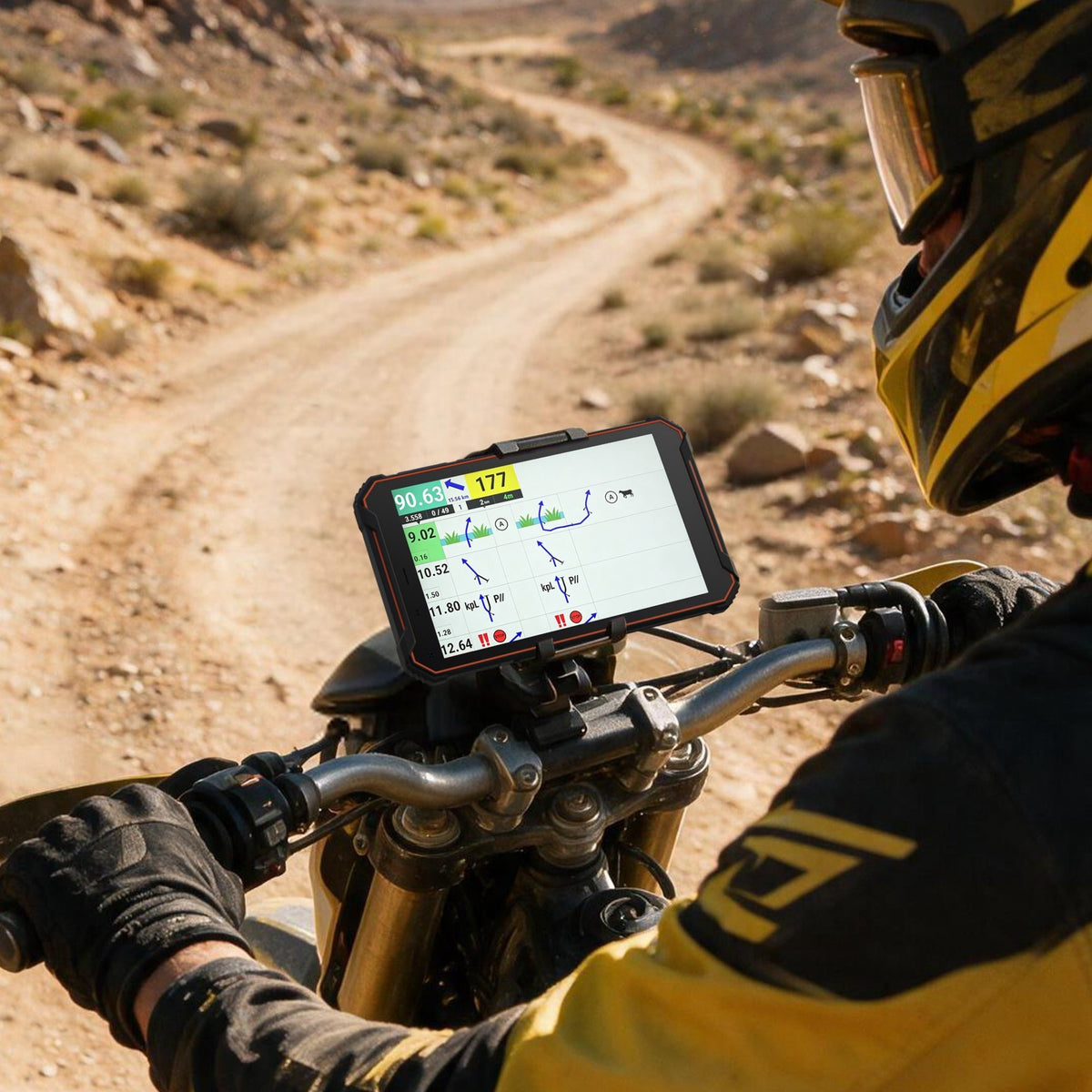
N1 is positioned as a rugged rally navigation tablet, so its storage plan should prioritize maps, roadbook/navigation data, route files and any media generated on trips. T1 is positioned as an industrial rugged tablet, so its storage policy is more likely to be driven by enterprise apps, job records, documentation and field-capture data.
Buyers should evaluate the current product configuration rather than assuming that two tablets with the same memory specification will have the same real-world storage requirement.
FAQ
How much storage do offline maps use?
There is no single reliable number. It varies by selected area, map provider, detail, and update state. Measure the exact regions required by the deployment.
Can Google Maps work without a connection?
Downloaded areas can be used offline where the feature is available, but some navigation functions are limited. Google notes that transit, cycling, and walking directions are unavailable offline, and live traffic and alternative routes are unavailable for offline driving.
Is 128GB enough for a rugged navigation tablet?
It can be enough for many deployments, but capacity should be validated with the actual apps, maps, files and retention policy. The same 128GB can be ample for one workflow and restrictive for another.
What should a fleet manager monitor?
Track free storage, map-update status, application cache growth, photo/video retention, failed updates, and the amount of data generated by a typical heavy-use period.


Laat een reactie achter
Alle reacties worden gemodereerd voordat ze worden gepubliceerd.
Deze site wordt beschermd door hCaptcha en het privacybeleid en de servicevoorwaarden van hCaptcha zijn van toepassing.