
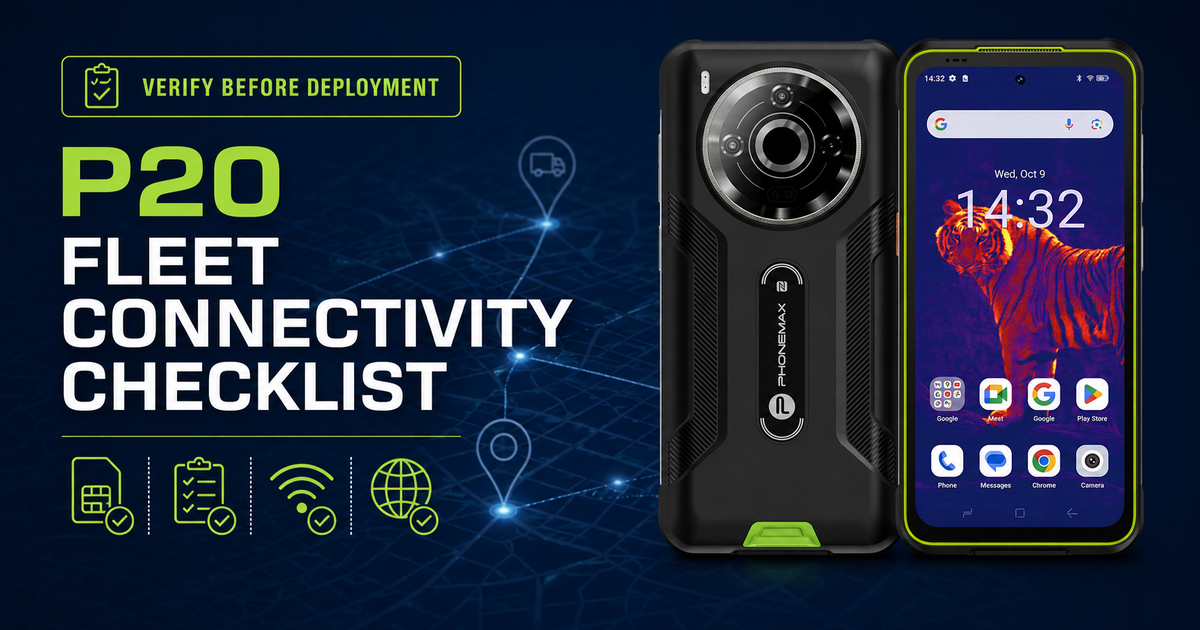
Answer first: The Phonemax P20 can be shortlisted for fleet connectivity when its published 5G/4G bands, carrier acceptance, route coverage, GNSS workflow, hotspot behavior, power plan and device-management process all pass a controlled pilot. A long band list and large battery do not by themselves guarantee fleet service.
P20 fact block for fleet planning
| Published P20 specification | Fleet relevance | Verification still required |
|---|---|---|
| 5G n1/n3/n7/n28/n38/n41/n77/n78/n79 | 5G band-overlap planning | Carrier/region acceptance and route coverage |
| 4G FDD B1/2/3/4/5/7/8/12/17/18/19/20/25/26/28A/28B/66; TDD B34/38/39/40/41 | LTE fallback planning | Voice, data, roaming and provisioning |
| Dual-frequency L1/L5 positioning listed | Positioning input for compatible apps | Accuracy in vehicle, route and app |
| 10,000 mAh battery and 66 W charging | Shift and turnaround planning | Measured runtime, charger and vehicle-supply fit |
| Android 14 | Application and management platform | Exact app, enrollment and policy compatibility |
| 172.6 × 81 × 17.8 mm; 394 g | Mount and handling planning | Safe position, retention and driver workflow |
This article covers the standard P20 listing. The current P20 product record does not list an integrated thermal camera; do not transfer P20 Pro or other model features to it.
Eight fleet gates before rollout
- Variant gate: record the exact model, software build and identifier from received units.
- Carrier gate: submit the actual device identifier through the intended carrier's BYOD or enterprise process.
- Band gate: compare the listed P20 bands with the carrier's current bands in every country and roaming region.
- Route gate: test voice, messaging, data and handover along representative routes, depots, loading areas and weak-signal zones.
- GNSS gate: test the production positioning/dispatch app from the intended in-vehicle mount; L1/L5 support is not an accuracy guarantee.
- Hotspot gate: if tethering is required, verify carrier-plan permission, client stability, heat and battery impact.
- Power gate: test 10,000 mAh capacity and 66 W charging with approved vehicle power hardware under the real duty cycle.
- Management gate: validate enrollment, required applications, updates, security policies, recovery and offboarding with the organization's chosen management platform.
Route-pilot record
| Test | Record | Escalate when |
|---|---|---|
| Carrier admission | Dated approval/IMEI result | Device or service is unsupported |
| Coverage | Route, time, signal/service outcome | Critical location repeatedly fails |
| Dispatch app | Login, job receipt, upload and recovery | Workflow cannot finish reliably |
| GNSS | Mounted acquisition and route behavior | Positioning fails operational threshold |
| Power | Start/end percentage, charging and temperature | Reserve target is missed |
| Mount | Retention, visibility and cable strain | Driver view/control is affected |
Management and lifecycle planning
Android Enterprise describes management options and enrollment approaches for organizational devices, but those pages are general platform guidance. They do not certify that P20 works with a particular enterprise-mobility-management vendor or enrollment method. Confirm support directly with the chosen provider, then document staged updates, lost-device response, user reassignment and retirement.
Limitations and trade-offs
- Published 5G/4G bands do not guarantee activation, VoLTE, roaming or route coverage.
- L1/L5 support does not establish fleet-tracking accuracy or regulatory suitability.
- 10,000 mAh and 66 W are first-party specifications, not an independent runtime or charging benchmark.
- The 394 g device weight must be included in mount selection and safe placement.
- Hotspot use may be limited by the carrier plan and can change thermal and power behavior.
- Android 14 does not prove compatibility with every dispatch or management system.
For a focused band discussion, read the rugged phone carrier compatibility checklist.
FAQ
Does P20 support every 5G network?
No. Match its published bands and exact variant with the target carrier and complete admission and route testing.
Can P20 replace a certified telematics unit?
Not based on this guide. Telematics, emergency and regulated systems may have separate certification and integration requirements.
Does P20 include thermal imaging?
The current standard P20 product record used here does not list an integrated thermal camera.
Can L1/L5 guarantee precise fleet tracking?
No. Test the complete app, mount, antenna environment and route against a documented operational threshold.
Sources
- Phonemax P20 product page — first-party bands, dimensions, weight, battery, charging, positioning and platform specifications.
- Android Enterprise management and Android Enterprise enrollment — general management-process background; not a P20 certification.
- AT&T BYOD, T-Mobile BYOD, and Verizon BYOD — carrier-owned admission guidance.
Publisher disclosure
This guide is published by Phonemax about the standard Phonemax P20. The 5G/4G bands, L1/L5 listing, 10,000 mAh battery, 66 W charging, Android 14, dimensions and 394 g weight come from Phonemax first-party materials. Android Enterprise is named only for general management and enrollment concepts; Google did not test, certify or endorse P20 or confirm a specific management integration. AT&T, T-Mobile and Verizon are named only for their own BYOD processes; none certified or endorsed P20 for this article. No relevant supplied third-party link directly tested P20 fleet deployment, so none was used. No independent carrier, route, GNSS, runtime, charging or mount test is claimed. Phonemax is the manufacturer and publisher, making this first-party commercial guidance.


Laat een reactie achter
Alle reacties worden gemodereerd voordat ze worden gepubliceerd.
Deze site wordt beschermd door hCaptcha en het privacybeleid en de servicevoorwaarden van hCaptcha zijn van toepassing.