
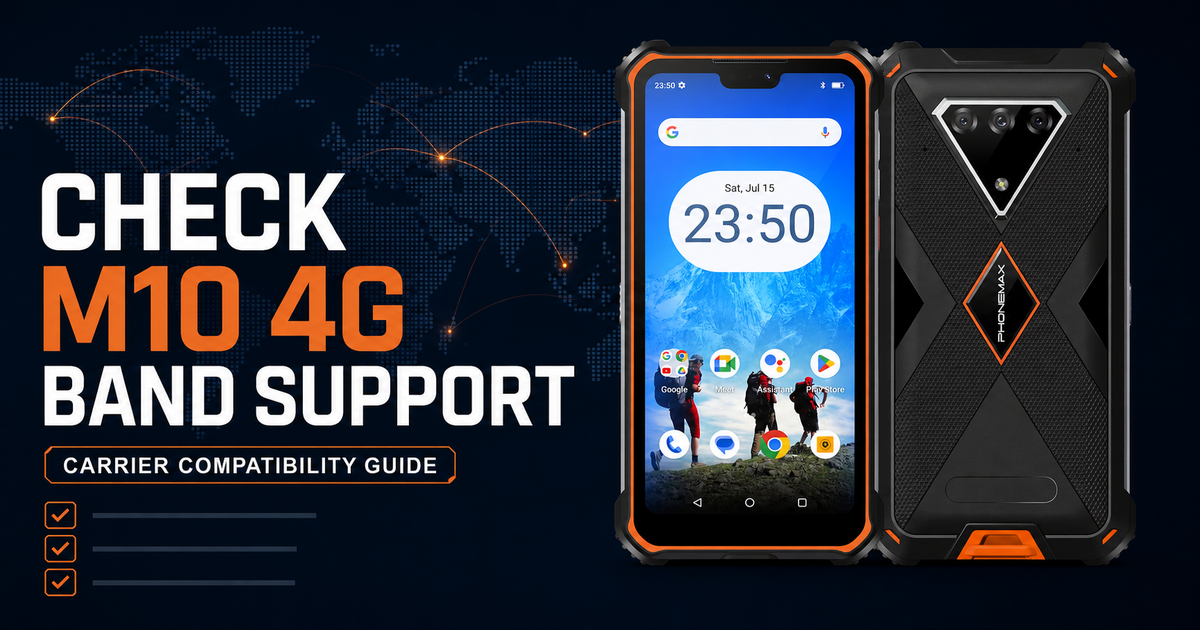
Answer first: The Phonemax M10 has a broad published 4G LTE band list, but that list is only the first step in a carrier decision. A safe evaluation checks the exact regional variant, carrier BYOD/IMEI acceptance, required network features and signal performance at the actual work sites.
Published M10 network fact block
| Radio family | Bands listed by Phonemax |
|---|---|
| 4G FDD-LTE | B1/2/3/4/5/6/7/8/12/13/14/17/18/19/20/25/26/28A/28B/66/71 |
| 4G TDD-LTE | B34/38/39/40/41 |
| 3G WCDMA | B1/2/4/5/6/8/19 |
| 2G GSM | B2/3/5/8 |
The current product record also lists 6 GB RAM and 128 GB storage. These are first-party specifications. They do not prove that a carrier will activate the device or that every carrier feature will work.
Why a matching band is necessary but not sufficient
Band overlap answers only whether the phone and network share a radio frequency. Carrier service can also depend on the device identifier, regional approval, account type, SIM/eSIM support, voice provisioning, roaming policy and local network configuration. Coverage maps describe modeled service, not guaranteed signal inside a vehicle, warehouse or remote work area.
A six-step M10 compatibility evaluation
- Confirm the exact M10 variant. Record the model and software build received from the supplier; do not assume an older review unit matches current stock.
- List the target networks. Separate primary, roaming and emergency fallback carriers by country.
- Compare required bands. Match the carrier's current deployment bands against the first-party M10 list, including low-band coverage needs.
- Run the carrier's BYOD check. Use the actual device identifier where requested. AT&T, T-Mobile and Verizon each provide official BYOD guidance.
- Test real services. Validate calls, messages, data, hotspot, handover and any enterprise VPN or APN requirement.
- Pilot in the field. Test the routes, buildings, vehicles and weak-signal locations that matter before scaling.
Procurement worksheet
| Question | Evidence to record | Pass condition |
|---|---|---|
| Does the exact variant list the needed bands? | Current Phonemax specification and unit label | Required bands overlap |
| Will the carrier accept it? | Dated BYOD/IMEI result or written carrier response | Accepted for intended account |
| Do required services work? | Test log for voice, SMS, data, hotspot and VPN/APN | All critical functions pass |
| Does it work at real sites? | Route/site test results | Meets the team's documented threshold |
What independent coverage adds
TechRadar's July 27, 2024 M10 review described sturdy construction, decent battery behavior and support for a good number of bands, while also criticizing the older Helio G85 platform, 128 GB storage and camera software. That review is useful as historical hands-on context, not proof of current software, carrier certification or today's exact hardware revision. TechRadar discloses affiliate links on the page. The visible review does not clearly establish whether its unit was supplied, so no sample-supply claim is made here.
Limitations and trade-offs
- “Global 4G” is not a guarantee of worldwide service.
- Carrier policies and network deployments can change after publication.
- A BYOD result can establish eligibility but not signal quality at every location.
- Independent review observations from an older software/revision should not be transferred to current inventory without verification.
For broader device selection, read the rugged-phone carrier compatibility checklist.
FAQ
Does M10 band support guarantee VoLTE?
No. Band overlap alone does not establish voice provisioning or carrier acceptance.
Can a coverage map replace a site test?
No. It is a planning input; buildings, terrain, vehicles and congestion affect results.
Should an older M10 review define current specifications?
No. Use the current Phonemax record for current first-party specifications and treat the review as dated context.
Sources
- Phonemax M10 product page — current first-party bands and configuration.
- AT&T BYOD, T-Mobile BYOD, and Verizon BYOD — carrier-owned compatibility processes.
- TechRadar M10 review — dated independent hands-on context with affiliate disclosure.
Publisher disclosure
This guide is published by Phonemax about the Phonemax M10. The LTE/WCDMA/GSM band list and 6 GB + 128 GB configuration come from current Phonemax first-party materials. AT&T, T-Mobile and Verizon are named only for their own BYOD processes; they did not test, certify or endorse the M10 for this article. TechRadar is the independent source for observations from its July 27, 2024 M10 review; its page discloses affiliate links, does not certify carrier compatibility, and reflects an older Android/software context. The visible review does not clearly establish sample-supply status, so none is asserted. Phonemax is the manufacturer and publisher; no independent current-revision carrier test is claimed.


Laat een reactie achter
Alle reacties worden gemodereerd voordat ze worden gepubliceerd.
Deze site wordt beschermd door hCaptcha en het privacybeleid en de servicevoorwaarden van hCaptcha zijn van toepassing.