
Price update — October 9, 2026: Prices in this guide were rechecked in USD against the listed product configurations. Prices and availability may change; confirm the selected configuration on its product page before ordering.
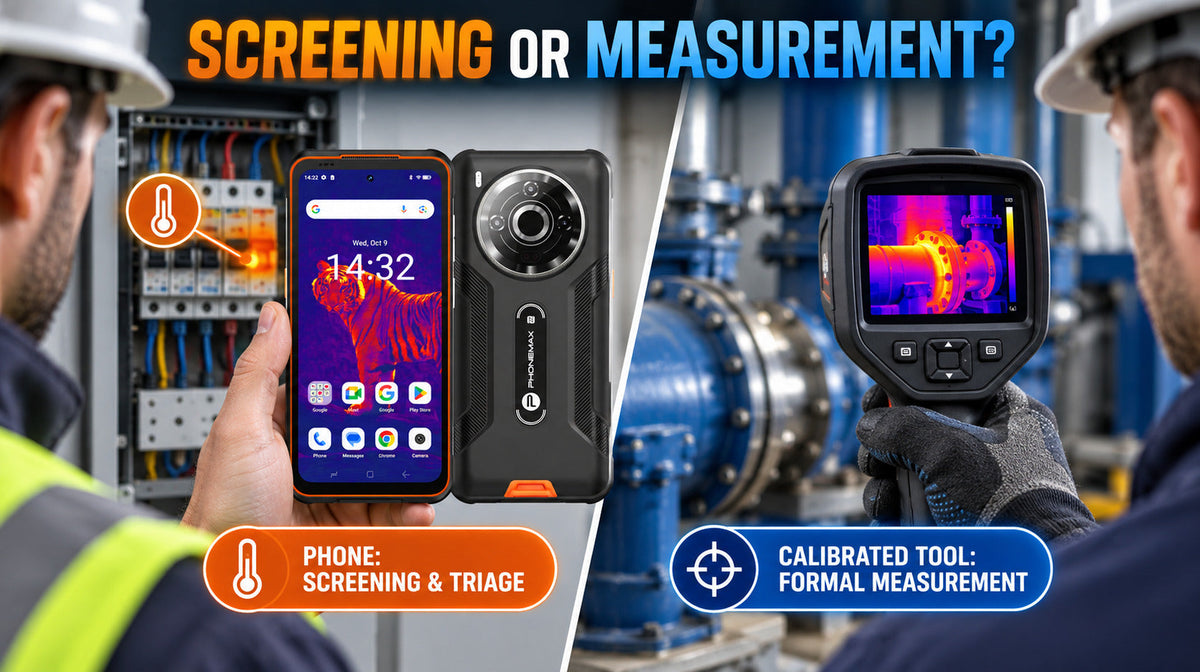
For most inspection work: no, not as a measurement instrument — but that is often the wrong question. A thermal-imaging rugged phone like the Phonemax P20 Pro replaces the decision to carry a second device on routine walk-arounds where you are looking for a hot spot, not certifying a number. A dedicated imager remains necessary whenever the reading itself is the deliverable: compliance reports, warranty claims, electrical certification, or anything where an emissivity setting and a calibration certificate matter. Decide by asking what happens to the image after you capture it.
Last reviewed: 5 September 2026.
Key facts
| Question | Phonemax P20 Pro | Dedicated thermal imager |
|---|---|---|
| Primary role | 5G rugged smartphone with integrated thermal camera | Purpose-built measurement instrument |
| Always carried? | If assigned as the user's everyday phone | No — a second device to pack and charge |
| Calibration certificate | Not published on the product page | Often available on professional models; verify the exact instrument and certificate |
| Emissivity adjustment | Not published on the product page | Common on professional models; verify adjustment range and workflow |
| Reporting workflow | Android apps, direct upload over 5G | Vendor software, usually offline first |
| Listed price | $479 (Orange) | Varies widely by class |
| Body | 172.6 x 81 x 17.8 mm, 394 g | Additional volume and weight |
Verify the P20 Pro's published network bands against your carrier before ordering. Current product materials state 256 × 192 thermal resolution, a −15°C to 550°C measurement range, ±2°C accuracy, NETD ≤50 mK and 25 Hz refresh rate. These are manufacturer figures, not independent calibration evidence; regulated or measurement-critical work still requires confirmation of the applicable procedure and traceability.
What "replace" actually means in thermal work
Thermal imaging covers two jobs that are easy to conflate.
The first is detection. You are scanning a switchboard, a motor housing, a roof section or a pipe run to find the anomaly — the one component running hotter than its neighbours. Detection is comparative. You are not asking "is this 68.4 degrees"; you are asking "why is this one brighter than the identical one beside it". For detection, immediate availability can matter as much as image detail because it lets the user record a possible anomaly when it is first noticed.
The second is measurement. You are producing a number that someone else will act on: a contractor will be paid, a component will be replaced under warranty, an insurer will accept or reject a claim, an auditor will sign off. Measurement requires known accuracy, documented emissivity handling, controlled reflected-temperature compensation and, in most regulated contexts, a traceable calibration record.
A phone-integrated thermal camera is well suited to convenient screening and triage. Whether it can support formal measurement depends on the required standard, calibration traceability, environmental controls and documented procedure—not on resolution alone.
Why the "always with you" factor matters more than buyers expect
Field teams consistently under-use dedicated imagers for a mundane reason: the imager lives in the van, in a case, with a battery that was last charged the week before. The routine observation — the warm bearing you walked past, the connection that looked off — never gets captured because retrieving the tool costs five minutes and a conversation.
An integrated camera can reduce the friction of capturing a possible anomaly during a routine visit. Whether that improves detection rates depends on training, procedure and follow-up; the practical advantage is availability, not an assured inspection outcome.
This is the honest case for a device like the P20 Pro: it is a triage tool. It widens the funnel. It does not replace the instrument at the narrow end of that funnel.
What the P20 Pro publishes, and what it does not
Working from the current Phonemax product page, the P20 Pro is a 5G rugged smartphone that combines mobile connectivity with an integrated thermal camera in a single body measuring 172.6 x 81 x 17.8 mm and weighing 394 g. It is listed at $479 in Orange. The non-thermal sibling, the Phonemax P20, is listed at $358 in Orange and Gray, and is the correct choice when rugged construction and 5G are needed but thermal imaging is not.
Current product materials publish 256 × 192 resolution, −15°C to 550°C measurement range, ±2°C accuracy, NETD ≤50 mK, 25 Hz refresh rate, 12 μm pixel pitch and an 8–14 μm spectral range. They do not state a traceable calibration certificate or a documented emissivity-adjustment workflow. Those omissions do not prevent screening use, but buyers should verify them before relying on readings for regulated, contractual or safety-critical decisions.
One independent specification aggregator lists the P20 Pro — the DeviceSpecifications comparison page — which is useful for cross-checking the communication hardware. It is not a substitute for a manufacturer statement on thermal accuracy, and it is worth noting that the P20 Pro has attracted very little independent coverage of any kind.
Practical use cases where the phone is enough
- Pre-shift walk-arounds. Scanning a plant room or vehicle bay for obvious thermal outliers before work starts, with anything unusual escalated to a proper survey.
- Documenting a customer conversation. Showing a homeowner or site manager the cold spot behind a wall, in the moment, without a return visit.
- Locating before excavating. Following an underfloor heating loop or tracing a leak path to narrow down where to open up.
- Night and low-visibility awareness. Distinguishing a warm body, an animal or a recently used vehicle in conditions where a normal camera shows nothing.
- First-response screening. Flagging an unusual heat pattern for follow-up without using the phone alone to declare equipment safe.
Where the phone is not enough: energy-performance certification, electrical thermography reports issued under a standard, insurance-grade moisture surveys, and any workflow whose output is a signed number.
Comparison: three realistic configurations
Phone-only (P20 Pro). Lowest friction, lowest cost, no second device. Suitable when thermal output feeds internal decisions, not external documents. Around $479 for the phone that also replaces your work handset.
Imager-only. Correct when every thermal job you do is a reporting job. The trade-off is capture rate — the tool is only present when you planned for it to be present.
Both, with clear roles. The configuration most established inspection teams end up with. The phone does discovery on every visit; the imager does the survey when discovery finds something. Written into a procedure, this stops the expensive instrument from becoming the bottleneck on routine visits, and stops the phone from being cited in a report it cannot support.
If you are pricing option three, note that the phone in that pairing is doing double duty as the team handset, which is a different budget line from a second inspection instrument.
Phonemax options for thermal and near-thermal work
If integrated thermal imaging plus 5G is the requirement, the Phonemax P20 Pro is the model in the range built for that combination.
If you need thermal imaging in a substantially smaller body — for example when the device is worn or pocketed all day rather than carried in a hand — the Phonemax R4 GT combines thermal imaging and night vision in a 121 x 59.2 x 18.3 mm, 190 g 4G body at $298. It trades 5G and screen size for size and weight. Both sit in the Thermal Imaging Rugged Phones collection.
If the actual requirement turns out to be low-light visibility rather than heat detection — seeing in the dark rather than measuring temperature — that is a different sensor. The Phonemax X3 at $155 provides a night-vision camera that captures monochrome images in very low light, plus L1+L5 dual-band positioning. It has no thermal camera, and no night-vision camera can substitute for one: night vision amplifies available light, thermal imaging detects emitted heat. A perfectly camouflaged warm object is invisible to one and obvious to the other.
And if thermal imaging is genuinely not needed, the Phonemax P20 delivers the same rugged 5G platform at $358 without the thermal camera. Paying for a sensor that gets used twice a year is a common and avoidable overspend.
Limitations and what to know
- Published accuracy is not the same as traceable measurement. The stated ±2°C figure is a manufacturer specification. Do not treat it as sufficient for a professional report unless the relevant procedure, calibration and environmental requirements are met.
- Emissivity will mislead you. Shiny metal, galvanised surfaces and glass reflect thermal energy and read incorrectly on any camera without emissivity compensation. This affects entry-level dedicated imagers too, but professional units let you correct for it.
- Glass blocks thermal radiation. You cannot scan through a window. This surprises first-time users routinely.
- Ambient conditions change results. Wind, direct sun, recent rain and time-of-day all shift surface temperatures. Comparative scanning within one session is far more reliable than comparing across days.
- Regulated environments have their own rules. Any site requiring intrinsically safe or explosion-protected equipment has certification requirements that a standard rugged phone does not meet. Verify certification requirements against the device's actual published certifications, never against its marketing category.
- 394 g is a real weight. For a device carried all day, compare it against your current handset before assuming it is a straight swap.
FAQ
Can I use P20 Pro thermal images in a professional inspection report? They may be useful as clearly labelled screening images. For temperature values used as formal evidence, confirm that the stated ±2°C specification, calibration traceability, emissivity controls and the applicable inspection standard are all satisfied.
What is the difference between the P20 and the P20 Pro? The integrated thermal camera. Both share the same rugged 5G platform, 172.6 x 81 x 17.8 mm body and 394 g weight. The P20 is listed at $358 without the thermal camera; the P20 Pro at $479 with it.
Is thermal imaging the same as night vision? No. Night vision amplifies small amounts of visible or infrared light to produce a monochrome image of a dark scene. Thermal imaging detects heat emitted by objects and works in total darkness. The Phonemax X3 offers night vision; the P20 Pro and R4 GT offer thermal imaging.
Will a phone thermal camera find a water leak? Sometimes — leaks often show as cooler patches through evaporative cooling. Detection is realistic; confirming extent and moisture content is not. Moisture surveys use dedicated meters alongside imaging.
Do I need to check network bands before ordering? Yes. The P20 Pro publishes its supported 5G, 4G, 3G and 2G bands on the product page. Compare them against the bands your carrier actually operates in your country before purchase. Broad band support does not establish compatibility with every network.
Which is better for a small team on a budget: one imager or several thermal phones? It depends on whether your output is numbers or decisions. If any part of your work produces documents a third party relies on, you need at least one properly specified imager, and the phones become triage devices around it.
Evidence and disclosure
Phonemax publishes this commercial comparison and sells the products mentioned. Specifications were checked on 5 September 2026 and are manufacturer-stated; no independent thermal calibration is cited. Treat the P20 Pro as a screening and triage tool unless your procedure confirms suitable calibration, emissivity controls and traceability. Where a wrong reading carries safety or liability consequences, use an appropriate calibrated instrument and qualified operator.
Sources and references
- Phonemax P20 Pro product page — manufacturer specifications
- Phonemax P20 product page — non-thermal comparison model
- DeviceSpecifications, P20 Pro comparison page (independent aggregator)
Evidence boundaries: thermal resolution, range, sensitivity and accuracy are first-party manufacturer specifications. The DeviceSpecifications page is an independent aggregator useful for cross-checking communication hardware, not laboratory verification of thermal performance. No independent calibration or thermal-performance test is cited.
Related guides
- How to Build a Repeatable Thermal Inspection Workflow with the Phonemax P20 Pro
- Phonemax R4 GT vs P20 Pro: Compact Thermal Phone or 5G Thermal Rugged Phone?

Lämna en kommentar
Alla kommentarer modereras innan de publiceras.
Denna webbplats är skyddad av hCaptcha och hCaptchas integritetspolicy . Användarvillkor gäller.