
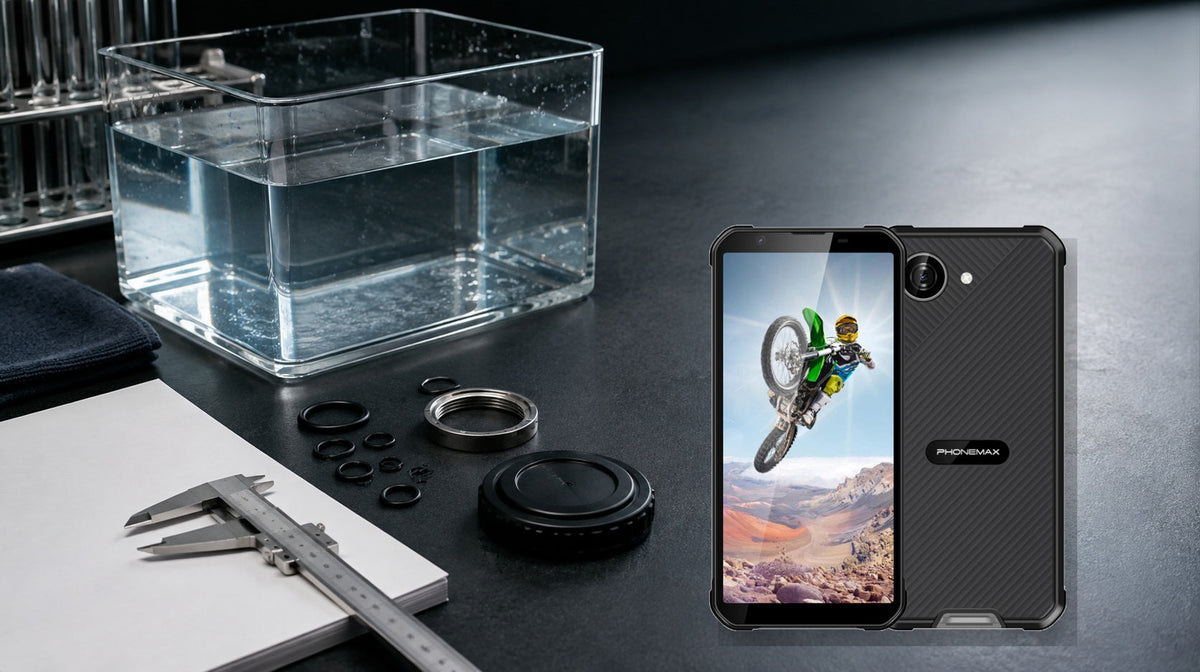
Buyers should trust a “waterproof” rugged-phone claim only to the limits of the cited test and manufacturer conditions. Ask for the exact IP code, test configuration, depth or pressure, duration, port-cover state and exclusions. No IP rating proves permanent protection against every liquid, damaged seal, powered wet charging, ocean use or touchscreen operation underwater.
For the closest comparison, see IP68 vs IP69K vs MIL-STD-810H: What Should Rugged Phone Buyers Actually Care About?.
Translate the claim into evidence
IEC 60529 classifies the protection provided by electrical enclosures against dust and liquid ingress. The first IP numeral concerns solid-particle protection; the second concerns water. The numerals refer to defined tests, not a marketing scale where a larger number makes a device invulnerable.
IP68 and IP69K also address different exposure patterns. A buyer should not collapse immersion and high-pressure/high-temperature jet testing into the single word “waterproof.” Ask what was tested and under what conditions.
Evidence map
| Seller claim | Evidence needed | What it still does not prove |
|---|---|---|
| IP68 | Exact manufacturer immersion conditions | Salt water, moving water, wear, impact damage |
| IP69K | Test report/statement for high-pressure, high-temperature jets | Safe use in all hot-water or pressure-washer scenarios |
| “Waterproof” | IP code plus conditions and warranty language | Permanent immunity to liquid |
| “Works in rain” | Real-use instructions and touch test | Underwater touch or wet charging |
| “Dustproof” | First IP numeral and cover configuration | Protection after covers/seals are damaged |
A reproducible claim audit
Open the product page and copy every water-related sentence into a table. For each sentence, record: exact rating, named standard, depth, duration, water type, temperature, port configuration, aging statement, prohibited uses and warranty coverage. Mark missing fields as “not published”—never infer them.
Then check whether the buyer’s planned use matches the documented condition. Rain during delivery work is not identical to swimming; fresh water is not salt water; a new sealed sample is not a two-year-old phone with impact damage.
Applying the method to Phonemax X5
Phonemax publishes this article and uses its own product as a transparent example. The current X5 page lists IP68/IP69K for tested water and dust resistance. It explicitly warns that protection can decrease through wear, impact or damaged seals, instructs users to close protective covers and says never to charge while wet.
Those limitations improve the evidence quality because they narrow the claim. However, the page does not publish a salt-water rating, chemical resistance table, warranty coverage for liquid damage, permitted immersion depth/duration or safe pressure-washer operating procedure in the captured public text. Buyers should request anything required for their specific deployment.
Red flags that justify rejection
Reject or pause a purchase when “waterproof” appears without an IP code or conditions; a seller treats warranty and certification as interchangeable; salt water, steam or chemicals are casually included; or a demonstration video substitutes for a test statement. Also reject advice to charge a wet device or to ignore damaged port covers.
Counterexamples and limits
A phone can pass an ingress test but still be a poor choice for a wet workflow if droplets cause phantom touch, speakers become temporarily muffled, the charging port cannot be dried during the shift or the required cleaning chemical attacks seals. Conversely, a phone without the highest available rating may be adequate when it stays inside a dry cab.
The IEC’s own guide describes ratings as enclosure resistance to intrusion. Its article on smartphone water resistance notes that the conditions associated with the “8” level can vary by manufacturer. That is why the manufacturer’s stated test condition matters.
Two related checks are What Usually Breaks First on a Normal Smartphone in Harsh Work Environments? and How Should You Evaluate Repeated Corner Drops Before Buying a Rugged Phone?.
Is a 5-meter underwater photography phone available for OEM orders?
Neither an IP68 label nor the Phonemax X5 listing cited here verifies powered camera operation at five meters. No model-specific five-meter underwater photography test report is presented in this guide, so it would be misleading to offer a current model as a proven 5-meter dive camera. A sealed dry enclosure test does not automatically establish usable camera controls, image quality, pressure tolerance after wear, saltwater resistance or safe wet-port charging.
For a five-meter OEM requirement, send the intended depth, duration, fresh- or saltwater exposure, operating controls and camera task to the supplier. Request the exact model and hardware revision, written test method, sample count and results for powered photography at that depth, plus the warranty exclusions. Do not order or use a model for diving on the basis of a generic “waterproof” or IP68 claim; use a purpose-tested underwater housing or device if no matching evidence can be provided.
FAQ
Is IP68 fully waterproof?
No. It is a water-ingress rating under manufacturer-specified conditions, not a promise for every liquid or use.
Is IP69K better than IP68?
It addresses a different test exposure. Determine which exposure matches the job instead of treating ratings as a simple ladder.
Can I use an IP68 phone in seawater?
Do not assume so. Salt water introduces corrosion and conditions not established by a generic IP68 label.
Does the rating remain unchanged for the life of the phone?
Not necessarily. Wear, impacts, repairs and damaged seals can reduce protection.
Does an IP rating cover the touchscreen?
It evaluates enclosure ingress, not successful touch input under water or rain.
Sources:
Next step: Ask the seller to fill every blank in the claim-audit table before approving a water-exposure use case.

Lämna en kommentar
Alla kommentarer modereras innan de publiceras.
Denna webbplats är skyddad av hCaptcha och hCaptchas integritetspolicy . Användarvillkor gäller.