
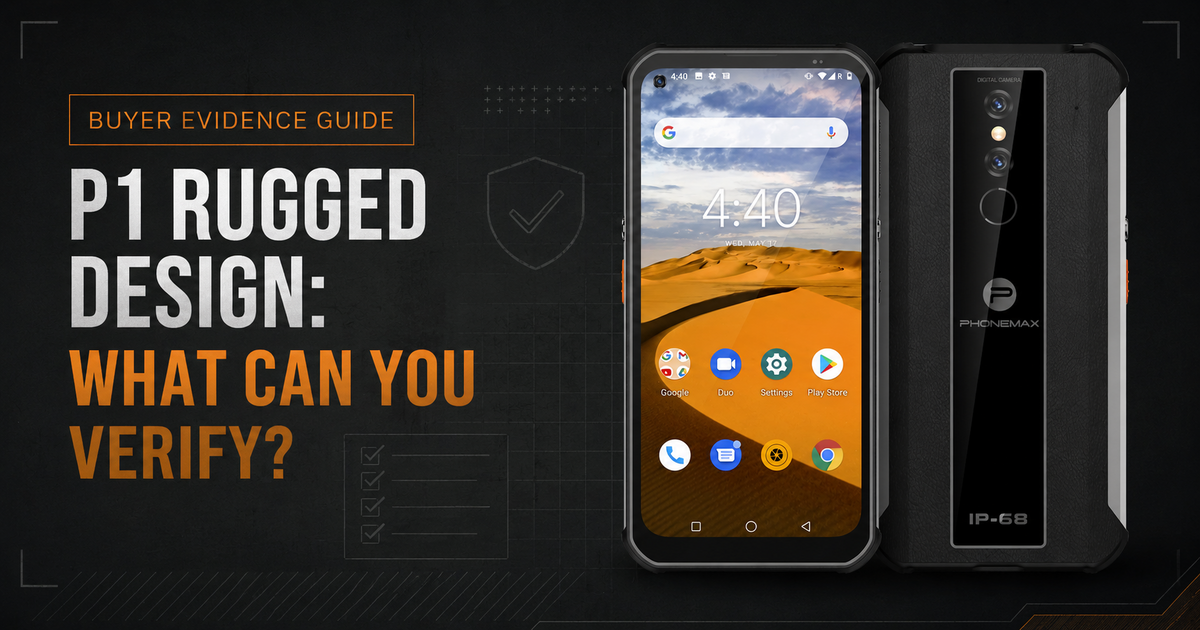
Answer first: Rugged smartphone design matters on the Phonemax P1 because a field device must balance protection, power, grip, screen use and daily carry. The useful buying question is not whether it looks rugged, but whether its published specifications and a controlled field pilot match the team's hazards, workflow and support plan.
P1 fact block
| Published specification | What it helps evaluate | What it does not prove |
|---|---|---|
| 6,100 mAh battery | Battery-capacity planning | Hours of runtime under your workload |
| 6.35-inch display | Screen and handling fit | Readability in every light or with every glove |
| 8 GB RAM + 128 GB storage | App and file capacity planning | Compatibility with a specific enterprise app |
| 21 MP rear + 8 MP front cameras | First-party camera configuration | Image quality for a regulated inspection task |
| IP68 and MIL-STD-810G listed by Phonemax | Published ruggedness claims | Indestructibility or suitability for every exposure |
| Helio P22 platform | Current first-party hardware context | Performance in your production workflow |
What rugged design changes in daily work
Protection and service continuity
A reinforced enclosure can reduce exposure to common field knocks and contaminants, but no phone is damage-proof. Port covers, seals and the enclosure must be inspected; damage, wear and improper closure can change protection.
Battery capacity and carry trade-off
The listed 6,100 mAh capacity provides more planning headroom than a smaller cell, but capacity usually adds size and weight. Android also manages background activity through features such as Doze and App Standby, so actual runtime depends on signal strength, screen brightness, apps, location use, temperature and battery age.
Handling with PPE
Ribs, edges and a rugged enclosure matter only if workers can hold and operate the device safely. Test grip, one-handed reach, touchscreen response, camera access and charging while wearing the actual gloves and clothing.
Evidence-first P1 pilot
- Define the duty cycle. Record calls, screen time, camera use, GNSS, data and required background apps.
- Inspect the received unit. Confirm model, software, seals, ports and accessories against the purchase record.
- Run a representative shift. Log battery percentage, temperature warnings, app behavior and charging time; do not perform destructive testing.
- Test handling safely. Check glare, gloves, grip, mounting and pocket/holster fit without staging drops or water exposure.
- Verify connectivity and apps. Test the actual SIM, carrier, VPN, authentication and production app.
- Write maintenance rules. Define inspections, cleaning, approved chargers, damage reporting and replacement criteria.
Buyer scorecard
| Decision area | Evidence | Owner |
|---|---|---|
| Runtime | Representative-shift log with reserve target | Operations |
| App fit | Completed production workflow | IT/application owner |
| Network | Carrier acceptance and site test | IT/carrier |
| Handling | PPE and mount assessment | Safety/operations |
| Durability | Published claims plus non-destructive inspection plan | Procurement/safety |
Limitations and trade-offs
- IP68 and MIL-STD-810G listings should be read with the manufacturer's conditions; they do not promise protection after damage or misuse.
- 6,100 mAh is rated capacity, not an independent battery-life benchmark.
- Camera megapixels do not establish measurement accuracy or evidence quality.
- A rugged enclosure can add bulk; handling must be checked by the actual user.
- Carrier and application compatibility remain separate deployment gates.
Compare decision factors in the P1 vs X5 rugged-phone comparison.
FAQ
Does a 6,100 mAh battery guarantee all-day use?
No. Only a representative workload test can support a runtime decision.
Does IP68 mean the P1 is waterproof forever?
No. Protection depends on conditions, intact seals and correct use; damage and wear matter.
Should buyers drop-test their pilot phone?
No. Use manufacturer evidence and safe, non-destructive workflow testing unless a qualified test program is specifically required.
Is rugged design more important than app compatibility?
Neither replaces the other. A deployable device must pass both physical-workflow and digital-workflow checks.
Sources
- Phonemax P1 product page — first-party specifications and ruggedness listings.
- Android Developers: Doze and App Standby — independent platform background on background power management; not a P1 runtime test.
Publisher disclosure
This guide is published by Phonemax about the Phonemax P1. The 6,100 mAh battery, 6.35-inch display, 8 GB + 128 GB configuration, 21 MP/8 MP cameras, Helio P22 platform, and IP68/MIL-STD-810G listings come from Phonemax first-party materials. Android Developers is named only to explain general Android background power management; Google did not test, certify or endorse P1 and did not measure its runtime. No relevant item in the supplied third-party link library directly tested P1 for this task, so none was used. No independent battery-life, drop, ingress, carrier or application test is claimed. Phonemax is the manufacturer and publisher, making this first-party commercial guidance rather than an independent review.


اترك تعليقًا
تخضع جميع التعليقات للإشراف قبل نشرها.
This site is protected by hCaptcha and the hCaptcha Privacy Policy and Terms of Service apply.