
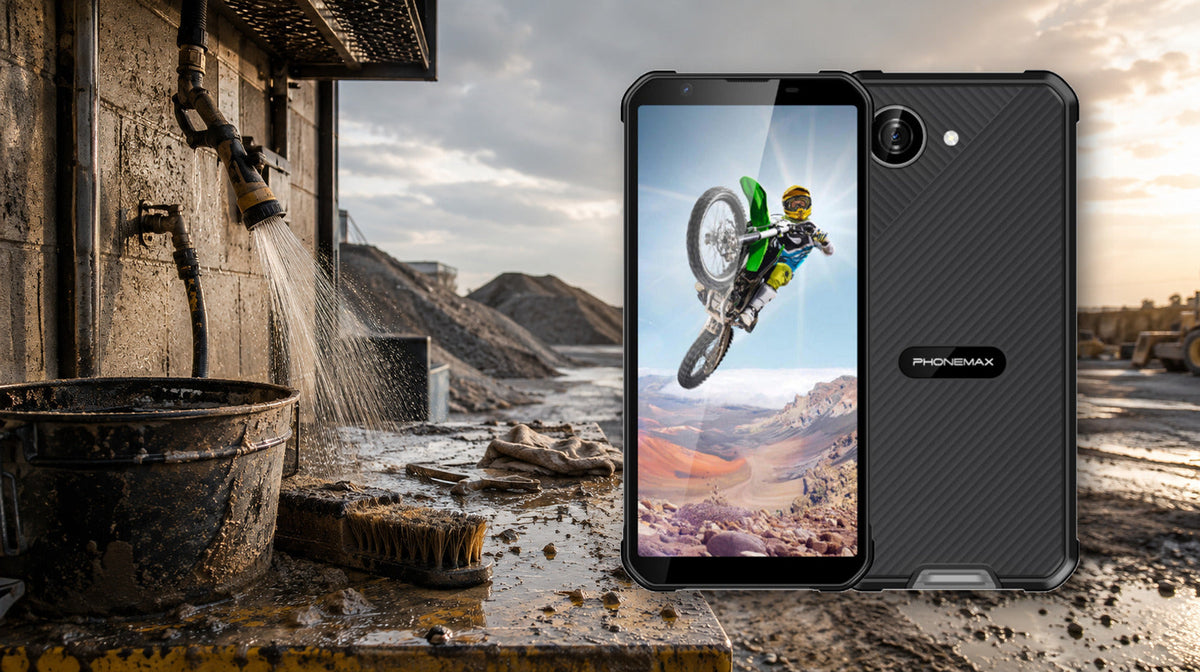
Direct answer: Fine dust tests enclosure ingress; wet mud adds adhesion, blocked acoustic openings and cleaning risk. Buyers should evaluate both protection and maintainability. For purchasing, treat the capability as unverified until the named exposure is reproduced with written conditions and functional results.
Why does this exposure need its own test?
IEC 60529 defines IP enclosure protection; the first numeral addresses solids and the second addresses water.
An IP result does not show how easy the phone is to clean, how mud affects microphones or whether worn seals still protect the enclosure.
The relevant evidence must match the actual workplace or travel scenario. A different hazard, a different severity or a protected demonstration unit cannot establish the result for the retail configuration.
Evidence that can support a mud and fine-dust decision
| Evidence | What it proves | What remains unknown |
|---|---|---|
| mud and fine-dust method | A reproducible mud and fine-dust method exists | Whether this model passed it |
| Model-specific report | The tested configuration and result | Performance outside stated limits |
| Buyer field trial | Fit for the intended workflow | Other environments and long-term wear |
Buyer-controlled test protocol
1. Verify the exact IP code and the tested product configuration
Start with clean seals and photograph every opening. Cleaning damage is part of the test, not an afterthought. Verify the exact IP code and the tested product configuration. Capture particle type, exposure time, port state, cleaning method and seal condition; Score audio and controls before cleaning, after cleaning and after the phone has completely dried.
2. Inspect seams, speaker openings and port-cover geometry for trapped grit
For step 2, define the mud and fine-dust acceptance threshold before the observation begins. Inspect seams, speaker openings and port-cover geometry for trapped grit. Capture particle type, exposure time, port state, cleaning method and seal condition; Score audio and controls before cleaning, after cleaning and after the phone has completely dried.
3. Confirm controls still work with gloves and after drying
For step 3, define the mud and fine-dust acceptance threshold before the observation begins. Confirm controls still work with gloves and after drying. Capture particle type, exposure time, port state, cleaning method and seal condition; Score audio and controls before cleaning, after cleaning and after the phone has completely dried.
4. Use a safe cleaning method; do not force grit deeper with high pressure
For step 4, define the mud and fine-dust acceptance threshold before the observation begins. Use a safe cleaning method; do not force grit deeper with high pressure. Capture particle type, exposure time, port state, cleaning method and seal condition; Score audio and controls before cleaning, after cleaning and after the phone has completely dried.
5. Recheck seals after impacts, wear or replacement of covers
For step 5, define the mud and fine-dust acceptance threshold before the observation begins. Recheck seals after impacts, wear or replacement of covers. Capture particle type, exposure time, port state, cleaning method and seal condition; Score audio and controls before cleaning, after cleaning and after the phone has completely dried.
What belongs in the maintenance plan?
Define inspection intervals, cleaning or drying steps, cover replacement and the exact condition that removes a device from service. Ruggedness depends on condition over time.
When scoping the mud and fine-dust trial, compare the adjacent failure modes in How Should You Evaluate Hot-Water Splashes Before Buying a Rugged Phone?, How Should You Evaluate Freezing Temperatures Before Buying a Rugged Phone? and How Should You Evaluate High-Temperature Job Sites Before Buying a Rugged Phone? so one passing result is not stretched into a different claim.
Phonemax example and its boundary
The current Phonemax X5 product page lists IP68-rated dust protection, protective port covers, reinforced corners and a compact 146.0 × 71.7 × 15.5mm body. An IP result does not show how easy the phone is to clean, how mud affects microphones or whether worn seals still protect the enclosure.
Phonemax publishes this article and sells the referenced device. The product is included as a first-party comparison, not as independent proof of the test outcome.
Acceptance rule for mud and fine-dust
| Outcome | Procurement action |
|---|---|
| Accept | The retail configuration completes the specified exposure and every critical post-test function passes. |
| Control required | A documented mount, cover, cleaning, temperature or operating rule closes a non-critical gap. |
| Reject | trapped grit, muffled audio, stuck controls, damaged covers or enclosure ingress occurs, or a required test condition remains undisclosed. |
Where the result stops applying
A mud and fine-dust result applies only to the recorded configuration and severity. It does not automatically cover worn seals, another accessory, a longer exposure or damaged hardware. A lower-risk use may still pass with narrower evidence; record that narrower boundary instead of upgrading the claim.
FAQ
Is passing a dust test the same as being easy to clean?
No. Ingress protection and maintainability are separate purchasing questions.
Which variables must appear in the mud and fine-dust record?
At minimum, document particle type, exposure time, port state, cleaning method and seal condition, the retail configuration, the sample identifier and the pass threshold.
What counts as a mud and fine-dust failure?
Do not limit failure to a blank screen. Include trapped grit, muffled audio, stuck controls, damaged covers or enclosure ingress, plus any loss of the workflow’s required function.
What should procurement do when the supplier has no matching report?
Mark the capability unverified, run a controlled trial on evaluation units and write the accepted boundary into the purchase record.
Sources
- Primary standard or issuing-body guidance for mud fine dust rugged phone
- U.S. DoD Method 510.7 sand-and-dust guidance
Next step: Turn the protocol into a dated acceptance sheet and require the supplier or evaluator to sign the results.


Napsat komentář
Všechny komentáře jsou před zveřejněním moderovány.
Tento web je chráněn službou hCaptcha a vztahují se na něj Zásady ochrany osobních údajů a Podmínky služby společnosti hCaptcha.