
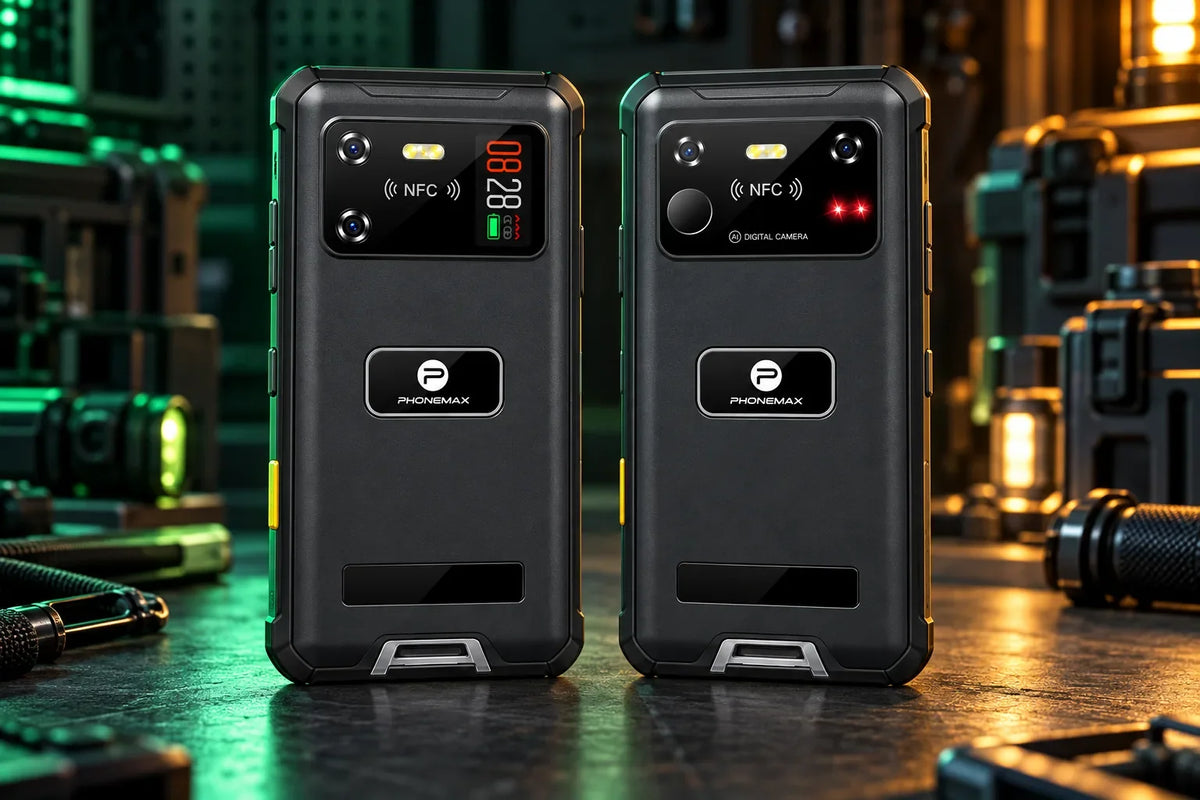
Choose Phonemax R4-T for its rear information display; choose R4 GT for integrated thermal imaging. Both list a 20MP night-vision camera, a 4.3-inch main display and the same 190 g body. Decide which rear function you need, then compare the current single-phone options using the product links below.
1. Size and weight: the same compact format
The two models share the published external dimensions and weight. Both list a 4.3-inch, 540 × 1200 main display. The purchase changes the rear feature while keeping the same published body size and main display.
If your main requirement is less weight or more display area, compare other devices before deciding between these two.
2. The specification differences that affect the purchase
| Feature | Phonemax R4-T | Phonemax R4 GT |
|---|---|---|
| Dimensions; weight | 121 × 59.2 × 18.3 mm; 190 g | 121 × 59.2 × 18.3 mm; 190 g |
| Main display | 4.3-inch; 540 × 1200 | 4.3-inch; 540 × 1200 |
| Defining rear feature | 0.96-inch information display; 80 × 160 | 256 × 192 thermal-imaging camera |
| Night vision | 20MP night-vision camera | 20MP infrared night-vision camera |
| Other cameras | 64MP autofocus main; 13MP front | 64MP autofocus main; 13MP front |
| Processor | MediaTek Helio G99 | MediaTek Helio G99 |
| Memory for the price comparison | 8GB RAM + 128GB storage | 8GB RAM + 128GB storage |
| Battery capacity | 3200mAh | 3200mAh |
| Mobile connectivity | 4G LTE; see the model band list | 4G LTE; see the model band list |
| Single-phone price checked 17 October 2026 | US$175 · Gray, 8GB+128GB | US$298 · Gray, single phone, 8GB+128GB |
The checked price difference is US$123. Both offers are for one 8GB+128GB phone. Compare the selected color, included items and checkout total; bundle prices are separate. These are dated USD prices, with promotions, tax and delivery assessed at checkout.
The official rear-hardware comparison illustration shows the rear-display version beside the thermal version. The R4-T's status panel and the R4 GT's thermal sensor serve different jobs.
3. Choose R4-T for rear status checks and night vision
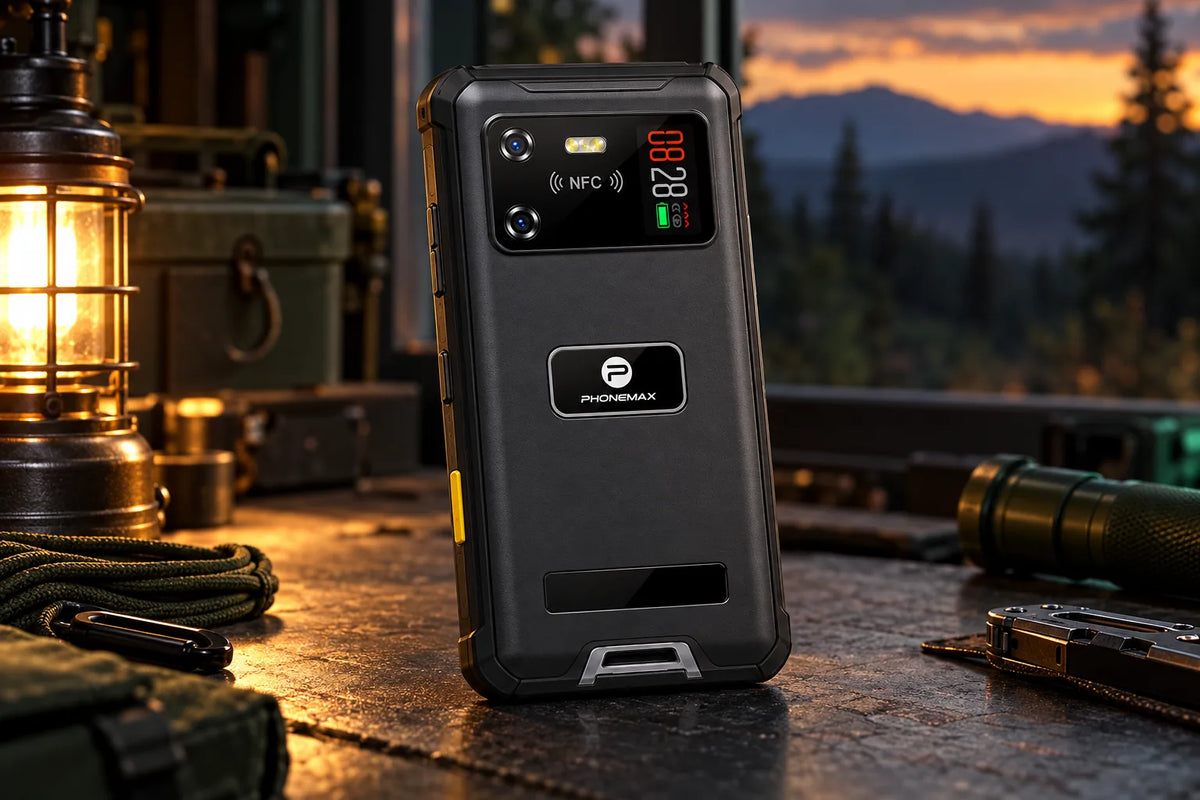
The R4-T panel displays the time, battery level and incoming-call reminders. It suits a phone that frequently rests on a desk with its back facing upward. The separate night-vision camera is for dark-scene photographs.

R4-T fits a buyer who wants rear status information and night vision without a thermal-imaging requirement. The compared phones share the listed processor, display size, memory and battery capacity, so choose R4 GT for its thermal capability rather than assuming that every other function is upgraded.
4. Choose R4 GT when temperature patterns are part of the task
The R4 GT's published thermal resolution is 256 × 192. Thermal imaging provides temperature-pattern information; the separate night-vision camera records scene detail in darkness. Choose this capability when your job involves comparing apparent hot and cool areas on equipment or building surfaces.
For a maintenance walk-through or an equipment check, thermal imaging is relevant when you need to locate an apparent hot or cool area. Reading a label in darkness is a night-vision task. Small components and temperature measurements require a closer look at the imaging setup.

Detailed thermal specifications, small-target limits and viewing distance
Manufacturer-published R4 GT thermal specifications
The following ratings come from Phonemax’s official thermal feature sheet and resolution and sensitivity sheet. Source and measurement limits are summarized in the evidence note below.
| Parameter | Published value | What it means for a buyer |
|---|---|---|
| Thermal image resolution | 256 × 192 | 49,152 image positions; separate from the 20MP night-vision camera. |
| Published temperature measurement range | −20°C to 550°C | A temperature range, not an observation-distance rating. |
| Thermal sensitivity (NETD) | ≤40 mK | 40 mK is a temperature difference of 0.040 K. This is a sensitivity rating, not ±0.04°C absolute measurement accuracy. |
| Refresh rate | 25 Hz | The published thermal image refresh rate. |
| Pixel pitch | 12 µm | Detector pixel spacing; this does not specify the smallest object visible at a given distance. |
| Field of view | 50° × 37.2° | The published angular view; target size and distance determine how much of the thermal image it occupies. |
| Advertised temperature accuracy | ±2°C | Advertised rating; applicable temperatures, calibration and emissivity conditions are not specified in the source. |
What does 256 × 192 mean in practice?
A broad temperature pattern on a large surface is a different imaging task from resolving a tiny component on a circuit board.
Can it identify a small circuit-board hotspot? Resolution alone does not establish that. Target size, field of view, focus and working distance determine how much of the image the component occupies. A component covering very few pixels may blend with its surroundings. FLIR's technical explanation of target size and distance explains the general relationship between target size, optics and distance.
How far can R4 GT thermal imaging see?
A fixed range cannot be established from 256 × 192 resolution or the 4.3-inch display alone. Detecting a warm object, recognizing its type, identifying detail and measuring its temperature are different tasks. Each requires sufficient target pixels and appropriate conditions. The manufacturer feature sheet includes an “up to 1000m” observation claim, but does not state the target, test conditions or success criterion; it therefore does not establish a person-detection, identification or accurate temperature-measurement distance.
Digital zoom does not create additional sensor detail. Enlarging an existing image can make its pixels easier to inspect, but it does not support doubling a detection range or improving the accuracy of a small-target temperature reading. FLIR’s distance-to-size explanation describes this general limitation. For a range-dependent task, request an original R4 GT sample with the target dimensions, distance, weather and imaging settings recorded; for temperature measurements, also request the measurement setup and reference instrument.
Recommendation: choose R4 GT when temperature-pattern imaging is a recurring task. Choose R4-T when rear status checks and night vision meet your needs. The checked US$123 difference does not buy a larger main screen, more RAM or a larger battery in these configurations.
A direct way to decide
| Your priority | Start with | Reason |
|---|---|---|
| Rear time, battery and incoming-call information | R4-T | This is the rear-display model. |
| Night vision without a thermal-imaging requirement | R4-T | R4-T combines night vision with the rear status panel; compare current offers using the product links. |
| Temperature-pattern imaging in a compact phone | R4 GT | The thermal sensor is the meaningful feature difference. |
| A smaller body, lower weight or a larger screen | Compare other models | These two share the listed dimensions, weight and display size. |
| 5G as a mandatory requirement | Compare the 5G range | The R4-T and R4 GT configurations discussed here are 4G models. |
Common comparison questions
Does R4-T have the R4 GT thermal camera?
R4-T uses a rear information display in place of the R4 GT thermal module, as shown in the official hardware comparison. Choose R4 GT for integrated thermal imaging.
Do both phones have night vision?
Yes. Both current product records list a 20MP night-vision camera. That shared feature should not be confused with thermal imaging.
When is it worth paying for thermal imaging?
When temperature-pattern imaging is a recurring requirement and the R4 GT specification fits the job. For calls, messages and night vision alone, compare current offers without treating thermal imaging as an automatic upgrade you need. Both compared configurations share the listed display size, RAM, storage and battery capacity.
Will they have identical battery life?
Both list 3200mAh capacity. That does not establish equal runtime: imaging use, mobile signal, software and settings affect consumption.
Which version should I order?
Choose the imaging feature first, then confirm memory, carrier acceptance and included accessories. Confirm the supplied Android version for the selected configuration before ordering.
R4-T: status at a glance
Choose the rear information panel and night vision for compact daily use.
R4-T: current price & optionsR4 GT: temperature patterns
Choose integrated thermal imaging alongside night vision.
R4 GT: current price & optionsRead the R4-T rear-display guide or check R4-T carrier compatibility before choosing your configuration.
Protection documents for your purchase
The R4 GT product materials list IP68, IP69K and MIL-STD-810H. Ask for the applicable report and its water/drop conditions when those ratings affect your purchase. For R4-T, request its own model-specific documentation through the compliance hub.
Sources and review date
R4-T product specifications and single-phone price; R4 GT product specifications, options and single-phone price; official rear-module comparison.
Reviewed on 17 October 2026. Phonemax sells these devices. Specifications are manufacturer-published; this article does not report independent camera, runtime or protection testing. The supplied R4 GT photograph documents the thermal interface in use. Original exported thermal frames, night-vision samples and an R4-T-specific IP/drop report were not available in the reviewed sources; this does not establish whether R4-T testing has been performed. The R4 GT’s advertised ±2°C accuracy lacks full test conditions. FLIR links explain general thermal-imaging principles and do not identify the R4 GT sensor supplier. Labelled AI illustrations are not camera samples. USD prices are a dated snapshot, with current offers available through the product links.


Napsat komentář
Všechny komentáře jsou před zveřejněním moderovány.
Tento web je chráněn službou hCaptcha a vztahují se na něj Zásady ochrany osobních údajů a Podmínky služby společnosti hCaptcha.