

Price update — November 4, 2026: Prices in this guide were rechecked in USD against the listed product configurations. Prices and availability may change; confirm the selected configuration on its product page before ordering.
A rugged phone is financially justified when the cost of repeated failure and downtime is greater than the extra hardware and carry cost. If your main risk is an occasional drop and past phones rarely interrupt work, a quality case may remain the better purchase. This page provides a cost worksheet; the broader feature decision belongs to our rugged phone versus regular phone plus case guide.
Start with your own failure history
Review the last 12–24 months rather than imagining the worst possible accident. Count screen repairs, damaged ports, liquid incidents, failed mounts, unusable cameras and days when a device could not complete its assigned work. A rugged phone cannot be justified by a toughness label alone; it needs to address a failure that actually costs you time or money.
The downtime-cost worksheet
| Input | What to record | Evidence source |
|---|---|---|
| Phone cost | Real purchase price of each shortlisted device | Current seller listing |
| Protection cost | Case, screen protector, mount and replacement accessories | Supplier quote |
| Repair/replacement cost | What past failures actually cost | Invoices or internal records |
| Downtime hours | Time without a working device, including setup and data restoration | Incident record |
| Downtime cost per hour | Labour and directly attributable operational loss | Internal finance estimate |
| Expected service period | The period used for both options | Procurement policy |
Use the same formula for both options
Total operating cost = phone + protection/accessories + repairs/replacements + downtime hours × downtime cost per hour + deployment/support cost.
Run the formula once for a conventional phone plus case and once for the rugged candidate. Use the same service period and the same categories. Do not give the rugged option a zero-failure assumption: rugged devices can still break, and software, network or battery problems can stop work without visible damage.
Three decisions the worksheet can produce
1. Keep the normal phone and improve the case
Use this option if past failures are rare, charging is easy, specialist functions are unnecessary and users strongly value a lighter device. Spend first on grip, raised screen and camera edges, and a case that does not obstruct charging or controls.
2. Pilot a rugged phone
Choose a small pilot when the same physical failures recur but the team has not yet proved app compatibility, carrier support, ergonomics or charging workflow. A pilot is evidence; a rugged-looking enclosure is not.
3. Separate roles instead of standardising one device
Office and sales roles may keep conventional phones while field inspection, logistics or maintenance roles receive rugged hardware. The lowest-cost fleet is not necessarily one model for everyone.
Phonemax examples: compact protection versus specialist hardware
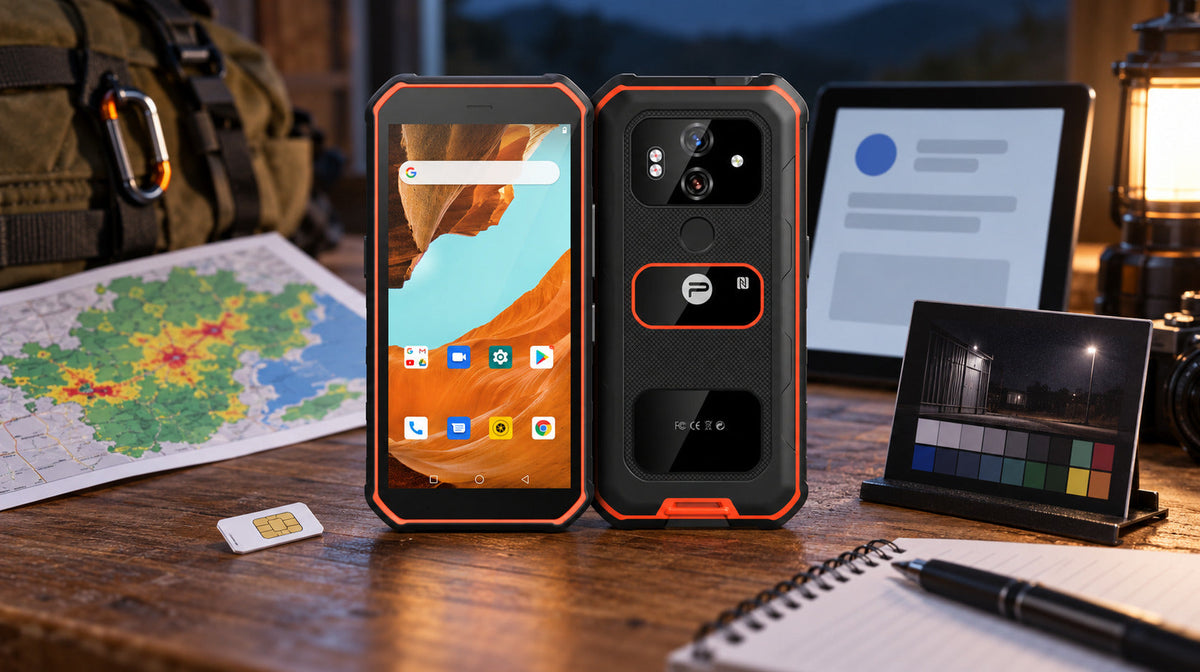
The current Phonemax X5 listing shows a 238g compact rugged phone with a 5000mAh battery, Android 16, starting at $139 at review time. It illustrates a choice aimed at everyday carry without moving to the heaviest end of the category.
The current Phonemax P20 Pro listing shows a 5G rugged phone with integrated thermal imaging at $479. That additional size and cost make sense only when thermal imaging or its other hardware solves a real task.
These are first-party examples from products Phonemax sells. They demonstrate different design priorities, not a controlled claim that either will create a specific saving.
What not to put in the calculation
- Invented failure rates. Use documented incidents or label the estimate.
- Guaranteed protection. IP and MIL-STD references describe defined tests, not immunity from damage.
- Unpriced safety outcomes. Where device failure affects safety, follow the risk assessment and required standard rather than reducing the decision to labour cost.
- Feature value nobody uses. Thermal imaging, night vision, PTT or a large battery add value only to roles that need them.
Before approving the purchase
- List the three failures that caused the most downtime.
- Confirm which option directly addresses each failure.
- Test required apps, carriers, cameras, charging and accessories.
- Have real users carry the device for a representative shift.
- Recalculate with pilot observations before a fleet order.
Hypothetical two-year example
Every figure below is invented to demonstrate the formula. These are not Phonemax prices, measured failure rates or documented customer savings.
| Cost in US dollars | Conventional phone + case | Rugged candidate |
|---|---|---|
| Phone | 180 | 250 |
| Case/accessories | 20 | 0 |
| Repairs/replacements | 100 | 50 |
| Downtime at $30/hour | 6 hours × 30 = 180 | 2 hours × 30 = 60 |
| Deployment/support | 40 | 40 |
| Total over two years | 520 | 400 |
The hypothetical difference is $120. If the rugged candidate also incurs six hours of downtime, its total becomes $520 and that difference disappears. Replace every assumption with your own records or pilot evidence.
| Observed situation | Decision to evaluate |
|---|---|
| Rare physical failures | Conventional phone and case |
| Repeated physical interruption | Small rugged-device pilot |
| Different exposure by role | Different devices by role |
| App, account or carrier failures | Resolve the underlying workflow problem first |
FAQ
Is a rugged phone cheaper than a normal phone with a case?
Not automatically. Compare purchase, accessories, repairs, replacements, setup and downtime over the same service period.
How many failures justify a rugged phone?
There is no universal number. One frequent low-cost repair may matter less than a single failure that stops a high-value field operation.
Should every employee receive the same rugged phone?
Usually not by default. Role-based deployment can avoid making low-exposure users carry and pay for hardware they do not need.
Evidence and commercial context
Phonemax publishes this worksheet and sells rugged devices. Current X5 and P20 Pro details come from our live product listings. The cost method is operational guidance, not a documented customer saving or a prediction of failure.

Hinterlasse einen Kommentar
Alle Kommentare werden vor der Veröffentlichung geprüft.
Diese Website ist durch hCaptcha geschützt und es gelten die allgemeinen Geschäftsbedingungen und Datenschutzbestimmungen von hCaptcha.