
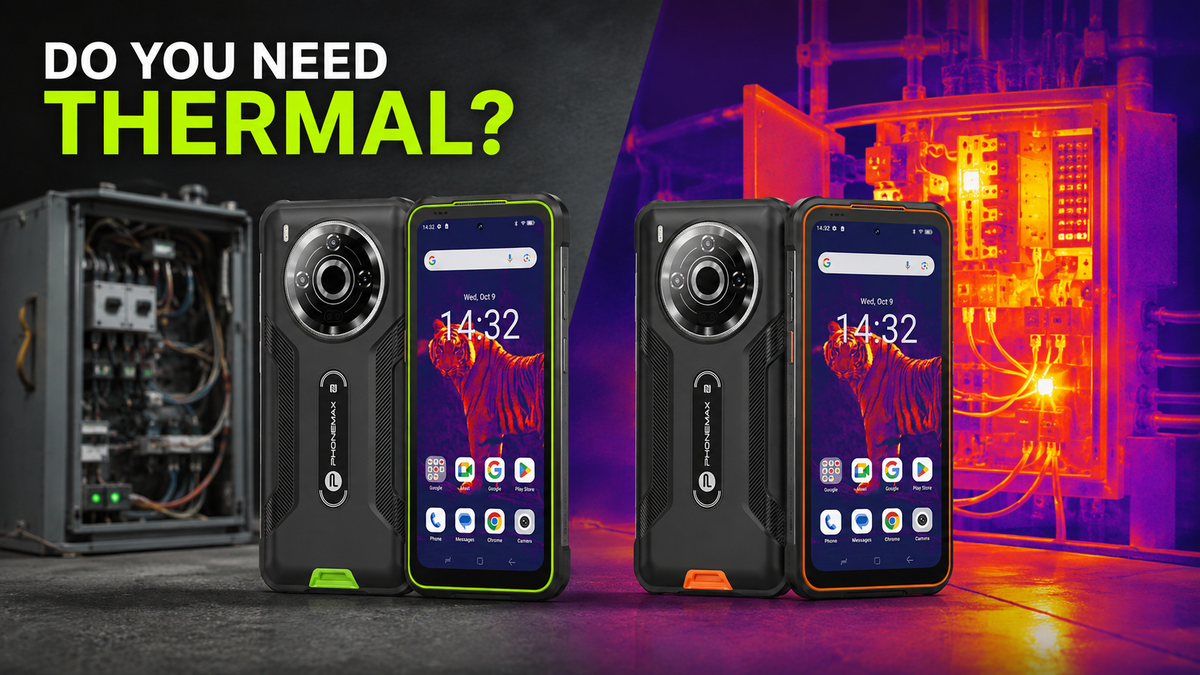
You need a thermal camera on a rugged phone only when thermal information is part of the job. If the device will mainly handle calls, messaging, navigation, photos, work apps and mobile data, paying for integrated thermal imaging may add a feature that rarely gets used. If workers routinely screen equipment for heat anomalies, thermal imaging can be much more relevant.
Use the inspection question as the decision point
Ask one question before comparing specifications: Will workers make decisions based on heat patterns? If the answer is no, a non-thermal rugged phone can often keep the device simpler and less expensive. If the answer is yes, the next step is to define how accurate, repeatable and documented the thermal workflow must be.
Within the Phonemax lineup, the P20 is explicitly the 5G rugged model without an integrated thermal camera, while the P20 Pro is the thermal-imaging model. That creates a straightforward product-selection fork instead of forcing every buyer into the more specialized configuration.
When integrated thermal imaging is useful
Thermal imaging can help technicians screen for unusual heat patterns in electrical connections, mechanical components and other assets. FLIR describes thermal cameras as tools that detect infrared energy rather than visible light, allowing temperature differences to be visualized even when ordinary visual inspection does not reveal them.
Integrated imaging can be convenient when the objective is rapid screening and documentation while the worker is already carrying a phone. It can reduce the number of devices required for routine checks.
When a non-thermal 5G rugged phone is the better fit
A non-thermal model is a rational choice when the job is communication-first. Examples include dispatch, site coordination, messaging, maps, standard photography, work-order applications and mobile connectivity. In those cases, thermal hardware may not improve the core workflow.
The P20 product page currently identifies the model as a 5G rugged smartphone without thermal imaging and lists the same body dimensions and weight as the P20 Pro. Therefore, the thermal function itself is the clearest distinction for many buyers choosing between the two.
Thermal imaging does not remove the need for inspection discipline
Seeing a hot area is not the same as proving a failure. FLIR notes that thermal measurement can be influenced by emissivity, reflections, atmospheric effects and distance. Professional thermography also depends on understanding load conditions and the target material.
For that reason, an integrated thermal phone is best treated as a field screening and documentation tool unless the workflow has established that its measurement performance, calibration and procedures meet the required standard. A specialist radiometric instrument may still be necessary for regulated or traceable measurements.
Decision framework
| Question | If yes | If no |
|---|---|---|
| Do workers inspect heat patterns regularly? | Consider thermal imaging. | Prioritize the non-thermal workflow. |
| Must the device produce traceable temperature measurements? | Verify radiometric capability and procedure in detail. | Screening may be enough. |
| Will one integrated device replace a separate thermal tool for routine checks? | Integration may reduce carrying burden. | The feature may add little operational value. |
| Is 5G connectivity needed independently of thermal imaging? | A 5G non-thermal model can still fit the job. | Reassess whether this product class is necessary. |
P20 or P20 Pro?
Choose the P20 when rugged 5G connectivity is the requirement and thermal imaging is not part of the workflow. Choose the P20 Pro when integrated thermal imaging is a genuine job requirement. Do not choose the Pro version solely because it has more features; choose it because those features will be used.
For either model, buyers should still verify local network bands and carrier requirements before purchase. A published 5G band list is not a guarantee of compatibility with every carrier or every service feature.
Compare current models: browse the Phonemax rugged phones and rugged smartphones collection to compare 5G, thermal-imaging, compact and other field-oriented options.
FAQ
Does every maintenance technician need a thermal phone?
No. It depends on whether thermal screening is part of the technician's actual inspection process.
Can a thermal phone replace a professional thermal camera?
Not automatically. Required accuracy, radiometry, calibration, reporting and inspection standards determine whether a specialist instrument is necessary.
What is the main difference between Phonemax P20 and P20 Pro?
The P20 is the 5G model without integrated thermal imaging, while the P20 Pro is the thermal-imaging model.
Sources
- FLIR: Electrical Inspections
- FLIR: What Is Infrared?
- Teledyne FLIR OEM: Choosing the Right Thermal Imager
Publisher disclosure: This article is published by Phonemax. The distinction between the Phonemax P20 as the current 5G model without an integrated thermal camera and the P20 Pro as the thermal-imaging model, together with their published body dimensions, weight and network specifications, comes from first-party Phonemax product information. FLIR and Teledyne FLIR OEM sources are used independently to support the discussion of thermal imaging principles, electrical/mechanical screening use cases and factors such as emissivity, reflections and measurement conditions. Those sources do not certify, endorse or independently validate the P20 or P20 Pro; they provide technical context for deciding when integrated thermal imaging is relevant.


השארת תגובה
כל התגובות מבוקרות לפני פרסומן.
This site is protected by hCaptcha and the hCaptcha Privacy Policy and Terms of Service apply.