
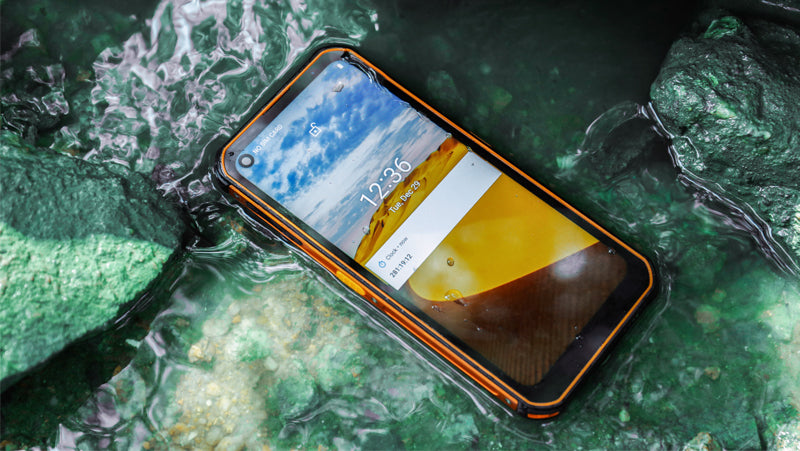
“Three-proof” is a useful shorthand, but it should not be treated as one technical certification. In rugged-phone marketing, the phrase commonly refers to resistance to water, dust and physical impact. Each of those claims needs separate evidence and model-specific conditions.
Water resistance: check the exact IP condition
IEC 60529 defines the IP Code used to classify enclosure protection against solids and water. A phone with an IP rating has been associated with defined ingress-protection tests, but that does not mean every device with the same marketing description can be submerged to the same depth or used in every liquid.
Do not infer a “3 meter” or other immersion claim for the entire Phonemax range. Use the current product page for the exact model and stated conditions.
Dust resistance: the first IP digit matters
The first digit of an IP rating describes protection against access and solid foreign objects. For field work, dust resistance can matter around construction debris, dry soil, workshops and other particulate environments. The actual IP code is stronger evidence than a generic “dustproof” statement.
Drop resistance: this is a separate test question
Ingress ratings do not prove impact performance. Drop resistance should be supported by model-specific test conditions such as drop height, surface, orientation and number of impacts. If MIL-STD-810 is referenced, buyers should ask which method and procedure were used rather than assuming the device passed every test in the standard.
Why the three claims should not be blended together
A phone can perform well in one area and still have different limits in another. Water resistance does not prove drop resistance; a drop test does not prove long-term water resistance; and neither tells you whether the phone is suitable for chemicals, salt water, hazardous locations or pressure washing.
Use a model-specific verification checklist
- Record the exact IP rating and stated water-test conditions.
- Check whether the manufacturer publishes a model-specific drop height or test method.
- Confirm whether ports or covers need to be closed for ingress protection.
- Check operating, storage and charging temperature limits separately if they matter.
- After severe damage or repair, do not assume the original enclosure protection remains unchanged.
Compare current Phonemax models
Browse the Phonemax rugged phones collection for current models, then open the individual product page for the exact protection claims. The Rugged Phone Buying Guide 2026 provides a broader checklist covering durability, battery, network and software.
FAQ
Does “three-proof” mean a phone is waterproof, dustproof and indestructible?
No. It is a marketing shorthand. Each protection claim has its own conditions and limits.
Can an IP68 phone automatically be used for diving?
No. Check the exact model’s stated immersion conditions and intended use.
Does an IP rating include drop testing?
No. Impact resistance is a separate claim and requires separate evidence.
Sources
- IEC 60529 — Degrees of protection provided by enclosures (IP Code)
- U.S. DoD ASSIST — MIL-STD-810 Environmental Engineering Considerations and Laboratory Tests
Publisher disclosure: This article is published by Phonemax. Protection claims vary by model; current model documentation takes priority over category-level wording.


תגובה 1
Lorie bodaly
Don’t have one what is the cost ?
השארת תגובה
כל התגובות מבוקרות לפני פרסומן.
This site is protected by hCaptcha and the hCaptcha Privacy Policy and Terms of Service apply.