
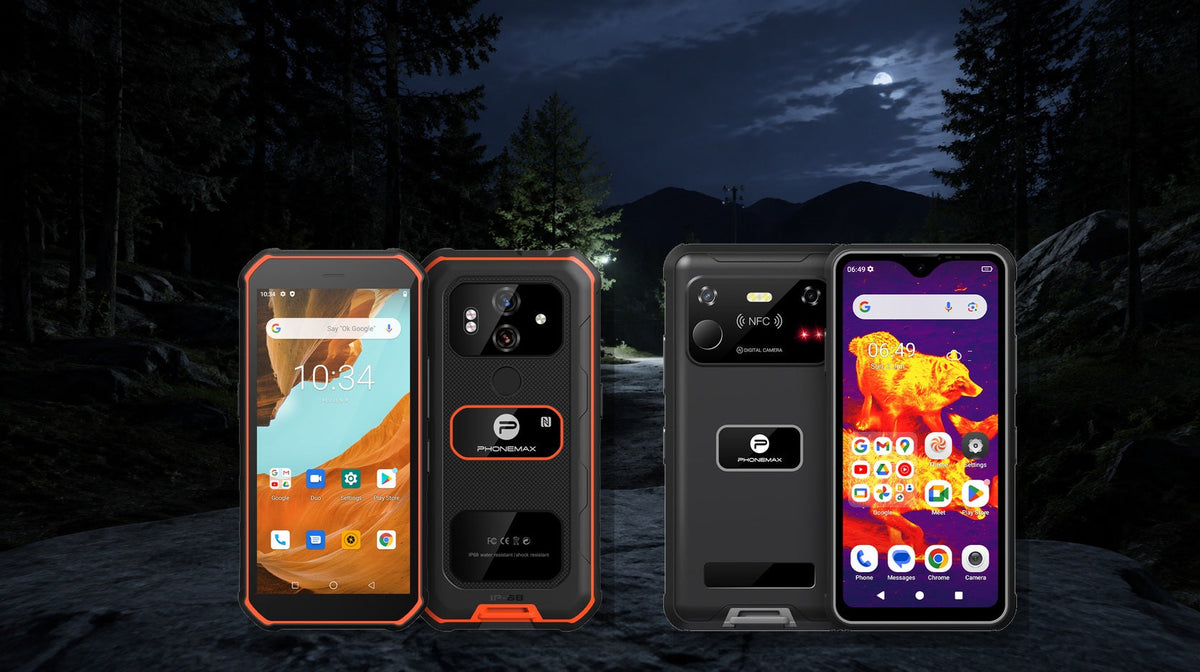
Last reviewed: August 7, 2026 · Editorial disclosure: This guide is published by Phonemax, a rugged-device manufacturer. The Phonemax X3 and P20 Pro are identified below as examples from our own catalog. Technical references are linked to specialist sources. No independent low-light range test was conducted specifically for this article.
For the closest comparison, see What Should Search-and-Rescue Teams Look for in a Rugged Phone?.
Quick answer
Night vision on a rugged phone is useful when you regularly need to see or document surface detail in very low visible light without relying on a bright white flashlight. Security patrols, maintenance technicians, campers, outdoor workers and some field teams can benefit. It is not the same as thermal imaging, and it is not a universal must-have feature.
Key takeaways
- Infrared-assisted night vision uses reflected near-infrared light to create an image; thermal imaging detects thermal energy.
- Night vision is most useful when visual detail—labels, shapes, equipment or surroundings—matters in darkness.
- Real performance depends on IR illumination, sensor, optics, focus, distance and environmental conditions.
- Range claims should be treated cautiously unless the test setup is stated.
- If the task is finding hot or cold patterns rather than visual detail, thermal imaging is the better tool.
What “night vision” means on a rugged phone
There are several ways to improve imaging in low light. A conventional smartphone camera can use a larger sensor, longer exposure, multi-frame processing and software enhancement. That works well when some visible light is available and the scene is relatively stable.
An infrared-assisted night-vision camera works differently. It can illuminate the scene with near-infrared energy that a compatible sensor can detect. The reflected IR light is then used to create an image, often monochrome.
Professional camera manufacturer Axis explains that near-infrared illumination can be used in low-light night modes to produce brighter black-and-white images. FLIR similarly distinguishes reflected-light night vision from thermal imaging, which forms images from thermal energy rather than visible or near-infrared reflected light.
Night vision vs thermal imaging
| Question | Infrared-assisted night vision | Thermal imaging |
|---|---|---|
| What creates the image? | Reflected visible / near-infrared light | Differences in emitted thermal energy |
| Can it work in near-total darkness? | Yes, if active IR illumination and the sensor are effective | Yes, when useful thermal contrast exists |
| Best for surface detail? | Often better for labels, shapes and visible features | Usually less suited to fine visible-surface detail |
| Shows temperature patterns? | No | Yes |
| Typical task | Seeing or documenting in darkness | Finding hot/cold anomalies |
If you need to read a label in a dark equipment room, night vision may be the more relevant tool. If you need to find an overheating electrical component, thermal imaging is the relevant technology.
Who actually benefits from night vision?
Security patrols
A night-vision phone can help document gates, equipment, rooms, vehicles or incidents when visible lighting is limited. It should be treated as a convenient field camera, not as an automatic substitute for purpose-built surveillance or certified security equipment.
Maintenance technicians
Basements, service ducts, ceilings, mechanical rooms and spaces behind equipment may be poorly lit. Integrated IR imaging can make quick visual inspection and documentation easier without requiring the worker to carry a separate camera.
Camping and outdoor use
At a campsite or on a night route, a bright white light can disturb other people and reduce dark adaptation. Infrared-assisted imaging can be useful for checking nearby equipment or documenting a scene. A normal flashlight may still be simpler and better for many users.
Wildlife observation
Near-infrared imaging can reduce the need for bright visible illumination, but serious wildlife observation generally benefits from dedicated optics, better range and purpose-built equipment.
Roadside and field documentation
During a blackout, night shift or roadside inspection, the main benefit is availability: the camera is already integrated into a communication device the user carries.
The specifications that matter more than the words “night vision”
IR illumination
The number, placement and output of infrared emitters influence how evenly and how far a scene can be illuminated. More LEDs do not automatically mean better usable range.
Useful range
A camera that produces a clear image at two meters may be much less useful at ten meters. Look for sample images taken at distances that match your task and ask how the range was tested.
Sensor and image resolution
Resolution affects the amount of visible detail, but sensor sensitivity, noise handling and optics also matter. A high pixel count cannot compensate for poor illumination or focus.
Focus behavior
For inspection work, the camera must focus reliably at the relevant distance. This is especially important for labels, connectors and equipment details.
Activation speed
If night vision is used during a shift, switching into the mode should be simple and repeatable. A useful feature that takes too many steps to activate may not fit a real workflow.
Reflections and camera placement
IR illumination can reflect from nearby glass, dust, protective covers or other surfaces and reduce image quality. Axis documentation specifically notes that IR reflections can sometimes be improved by adjusting illumination intensity. Phone buyers should look for real sample images rather than assuming the hardware label guarantees a clean picture.
What night vision cannot do
- see through walls,
- guarantee long-distance identification,
- measure temperature,
- replace thermal imaging,
- remove fog, rain or dust from the scene,
- turn a smartphone into military night-vision goggles,
- guarantee a clear image at every distance or under every environmental condition.
Usable range and contrast can fall substantially when the target is small, distant, reflective or obscured by weather.
Is a normal phone’s night mode enough?
For many people, yes. Computational night modes can produce excellent low-light photographs when there is some ambient light and the subject is reasonably still. Those modes often use longer exposures or combine multiple frames, however, which is different from actively illuminating a dark scene with near-infrared light.
If you mainly take city, restaurant or family photos at night, a strong conventional camera may be the better choice. Dedicated IR hardware becomes more compelling when you repeatedly need visual information in near-total darkness.
A Phonemax example: X3
The Phonemax X3 is currently listed in our catalog as a night-vision-camera rugged phone. Because this article is published by Phonemax, that link is a manufacturer example rather than an independent recommendation.
The X3 illustrates the strongest case for integrated night vision: an outdoor or field user can combine communication, navigation and low-light documentation in one device. Buyers should still verify current sample images, usable range, network compatibility and the exact night-vision workflow before purchase.
When thermal imaging is the better choice
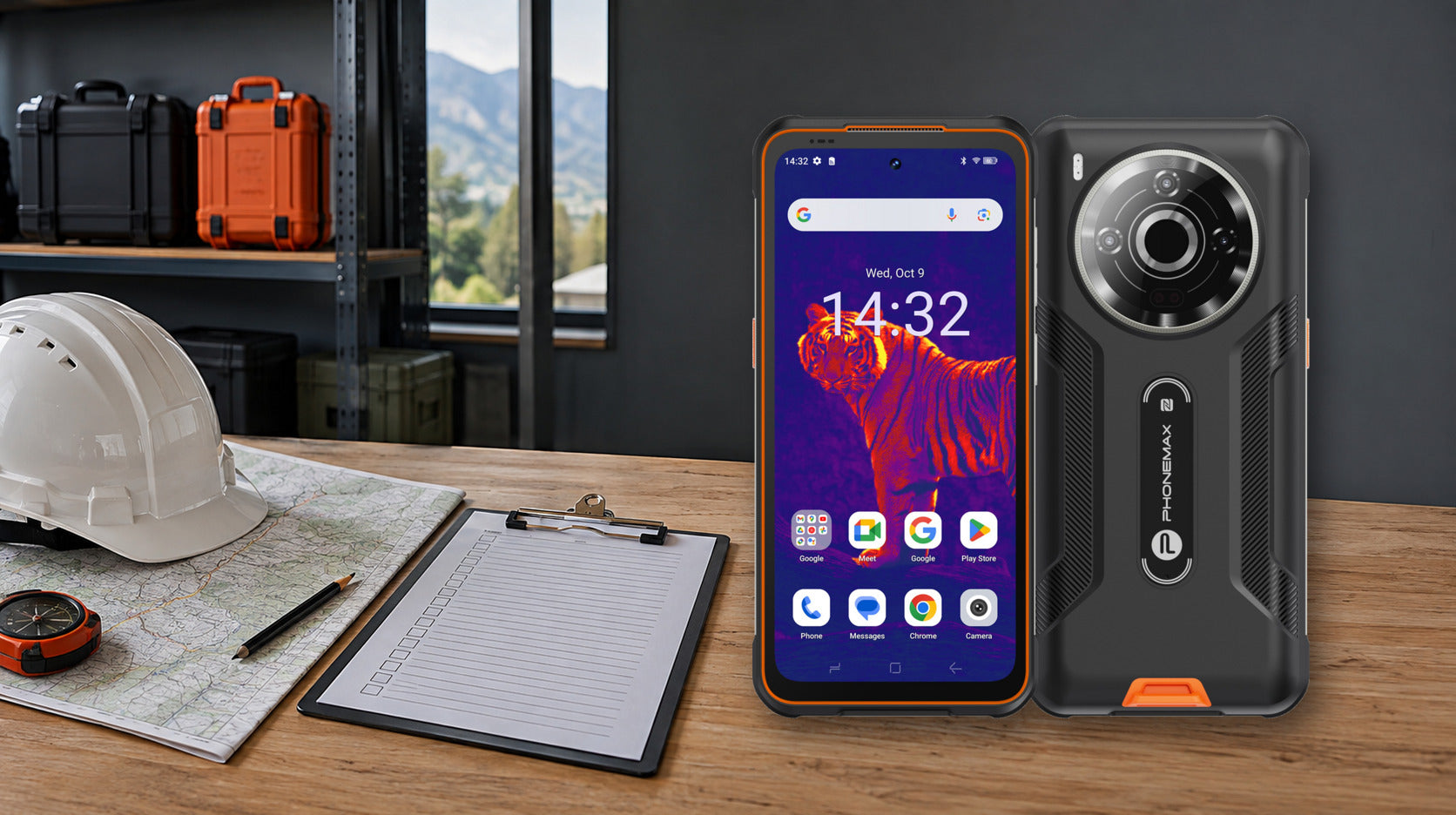
If your task is based on temperature differences rather than visible surface detail, choose a thermal solution. Our Phonemax P20 Pro is an example from our own catalog of a rugged phone built around thermal imaging rather than night-vision imaging.
The distinction matters because buying the wrong specialist sensor can add cost without solving the actual problem.
A three-question buying test
- Do you work or travel in very low light often enough to use the feature every week?
- Do you need visual surface detail rather than temperature information?
- Does integration into your main phone reduce equipment or steps in the workflow?
If all three answers are yes, integrated night vision can be genuinely useful. If the feature would be used only a few times a year, a flashlight, a conventional phone camera or a dedicated accessory may be better value.
Limitations of this guide
This article explains general night-vision concepts and buying criteria. It does not establish the range or image quality of every phone sensor. Manufacturers may define and test “night vision” differently, so compare real sample images and model-specific information under the distances and conditions that matter to you.
Bottom line
Night vision on a rugged phone is a specialist tool, not a universal requirement. It earns its value when a user repeatedly needs to see and document surface detail in darkness and benefits from having that capability inside the same device used for communication and field work.
Two related checks are What Should Agricultural Equipment Operators Look for in a Rugged Phone? and Who Actually Needs GPS Accuracy?.
FAQ
Can a night-vision phone see in complete darkness?
A phone with active infrared illumination can create an image when visible light is extremely limited, but useful distance and detail depend on the illuminator, sensor, optics, target and environment.
Is night vision the same as thermal imaging?
No. Infrared-assisted night vision relies on reflected light, while thermal imaging detects thermal energy and temperature-pattern differences.
Is night vision useful for camping?
It can be useful for checking equipment or nearby surroundings without a bright visible light, but most campers do not need it as an essential phone feature.
Can a normal phone camera replace it?
If enough ambient light is available, a normal camera’s computational night mode may produce better color photos. In near-total darkness, active IR hardware can have a clear advantage for visual documentation.
Should I choose night vision or thermal imaging for maintenance?
Choose night vision when you need to see surface detail in darkness. Choose thermal imaging when the task depends on identifying hot or cold patterns.
Independent night-vision evidence
Root-Nation’s R4GT hands-on review examines the phone’s night-vision and thermal functions, while this third-party R4GT camera-test video provides sample footage. Use these sources to inspect the reviewed unit’s output, not to infer a guaranteed range, recognition accuracy or performance for other models and lighting conditions.
Sources and verification
- FLIR — What’s the Difference Between Thermal Imaging and Night Vision?
- Axis Communications — near-infrared illumination and low-light night mode
Next step: before choosing a night-vision phone, define the distance, target size and lighting conditions you actually need, then compare real sample images taken under similar conditions.
Relevant Phonemax night-vision examples
The Phonemax X3 is the current catalog model explicitly positioned as a night-vision-camera rugged phone. The Phonemax R4 GT combines night vision with thermal imaging and its page lists a compact 190g body. Choose the X3 when night recording is the defined task; consider the R4 GT only when both sensing modes support real workflows. In either case, request sample footage and verify illumination range, field of view, recording resolution and legal or workplace restrictions before purchase.
A repeatable low-light sample protocol
Compare candidate phones at three fixed distances, using the same target, mounting position and scene. Record ambient light, whether active IR is enabled, image and video resolution, focus success, readable detail, reflections from glass or nearby surfaces and battery use over ten minutes. Repeat in dry air and, if safe, light mist or dust. Keep the unedited files so marketing clips can be compared with your real task.
The FLIR comparison of thermal and night vision supports the functional distinction. Model-specific range and image quality still require sample evidence under disclosed conditions.
Safety limitation: A phone display reduces dark adaptation and can distract from hazards. Do not use night vision as a sole navigation, driving, surveillance or safety system.
Editorial method and trust notes
How we prepared this guide: The Phonemax Editorial Team separated standards-based facts, manufacturer specifications and practical decision guidance. Standards claims are linked to the issuing organization or an official record; category guidance is presented as a framework readers can reproduce with their own device, environment and workload.
Review scope: Source alignment, commercial disclosure, limitations, internal consistency and claim-to-source proximity were reviewed on August 10, 2026. This editorial review is not a substitute for a laboratory certificate, a site safety assessment or advice from a qualified professional.
Corrections: Specifications, standards and software policies can change. Readers should verify the current model page, test report, warranty and support policy before purchase. If a material error is identified, Phonemax should update the article and review date.

השארת תגובה
כל התגובות מבוקרות לפני פרסומן.
This site is protected by hCaptcha and the hCaptcha Privacy Policy and Terms of Service apply.