
By Phonemax Editorial Team · Reviewed 2026-08-14
Disclosure: Phonemax produces and sells rugged devices. Product references are first-party examples, not independent rankings. No hands-on testing is claimed unless a reproducible test protocol is explicitly presented for readers to perform.
Direct answer: Before buying a smartwatch for battery life, verify the published capacity or runtime conditions, charging time, always-on-display setting, notification load, workout tracking, music use and end-of-day reserve. If the seller does not state test conditions, treat the runtime as unverified and run a normalized 24-hour return-window test before depending on it.
Why one battery-life number is not enough
A watch uses power differently when the screen stays on, sensors sample frequently, Bluetooth reconnects, notifications arrive, music plays or workouts run. The useful question is not “How many days?” but “Can it complete my heaviest normal day and retain an agreed reserve?”
Evidence checklist
| Check | Acceptable evidence | Red flag |
|---|---|---|
| Battery capacity | Product specification or manual | Missing value |
| Claimed runtime | Mode and test conditions stated | “Up to” with no conditions |
| Charging time | Charger and starting percentage disclosed | Proprietary charger with no replacement path |
| Feature impact | AOD, workouts, calls, music separated | One number for every mode |
| Battery reserve | Tested in buyer’s own routine | Finishes near zero |
A normalized 24-hour test
Charge to 100%, record time and settings, then use the same watch face, brightness, notification accounts and Bluetooth connection for every candidate. Include one 45-minute tracked activity, 20 minutes of local music if relevant, and the normal overnight monitoring mode. Record charge at 4, 8, 12 and 24 hours. Repeat twice and use the worse result.
Pass rule example: finish 24 hours with at least 30% reserve and recharge within the buyer’s available window. This is a procurement rule, not a universal battery standard.
What the Watch 1 page establishes
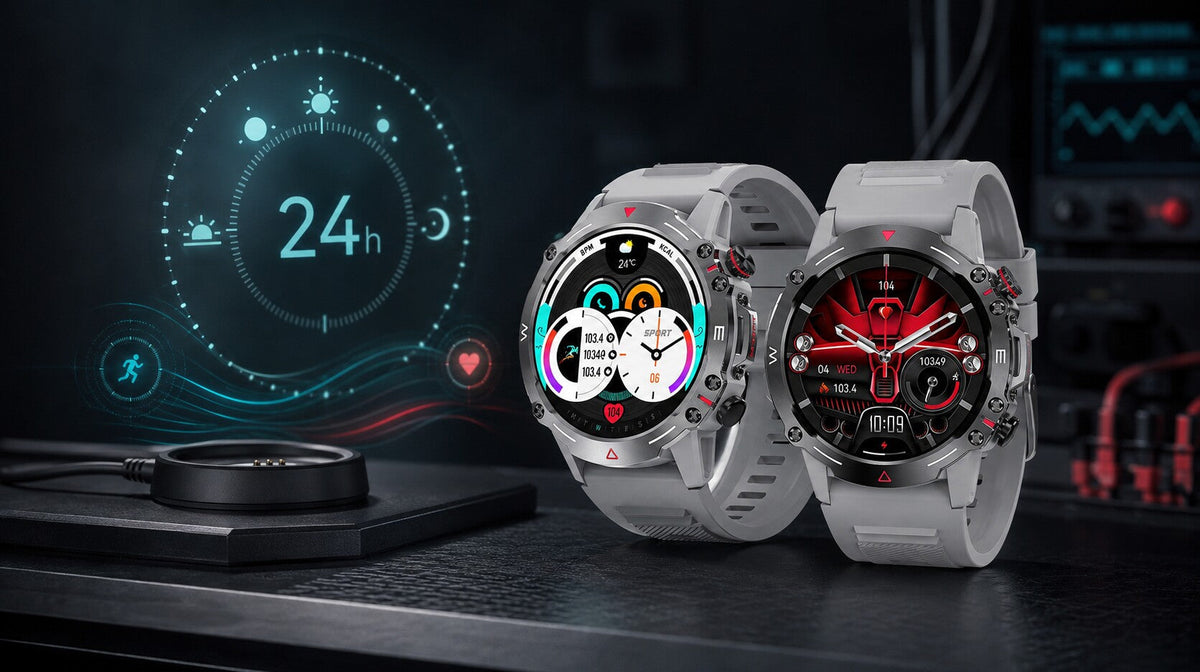
The current Phonemax Watch 1 page lists heart-rate and sleep monitoring, IP68 protection, Bluetooth 5.2, local music, compass and multilingual app support. It does not publish battery capacity, normalized runtime or charging time in the visible specification text reviewed for this draft. Battery life is therefore unverified and should not be used as a purchase claim until documentation or test results are added.
Limitations
A 24-hour test does not predict long-term battery aging, extreme-temperature behavior or future firmware effects. Health measurements are for wellness reference and not medical diagnosis. IP68 does not define swimming suitability unless the product instructions state the permitted activity and conditions.
Frequently asked questions
Is battery capacity enough to compare watches?
No. Display, processor, sensors, radio behavior and software can produce different runtime from similar capacities.
Should I test with always-on display?
Use the setting you plan to keep. If unsure, test both configurations separately.
Does local music affect battery life?
It can. Include it in the test if it is part of the buying reason.
What if no runtime conditions are published?
Treat the claim as unknown, request documentation and rely on a return-window test—not inference.
Next step: Review the Watch 1’s currently published functions, but do not select it for endurance until it passes the test above.
Primary source: Android guidance on power use for wearables. Product page checked 2026-08-14.

השארת תגובה
כל התגובות מבוקרות לפני פרסומן.
This site is protected by hCaptcha and the hCaptcha Privacy Policy and Terms of Service apply.