
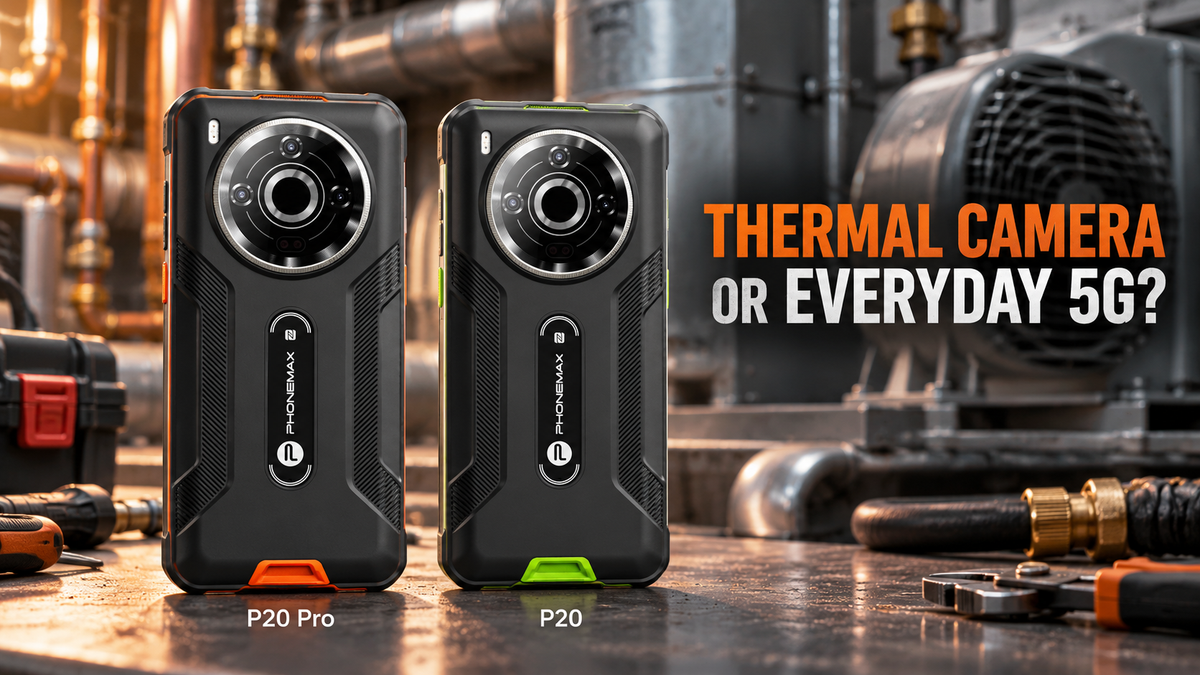
The Phonemax P20 Pro adds a 256 × 192 thermal camera, and its product summary lists more physical RAM than the standard P20: 12GB versus 8GB. At the checked prices of $479 and $358, the difference is $121. Choose the Pro when thermal imaging has a defined role in your work; choose the P20 when your priorities are communication, navigation, work apps and conventional photography.
Both models list the same dimensions, weight, 6.6-inch display, 10,000mAh battery and 66W charging. Thermal imaging is the clearest functional difference, so the buying decision starts with one question: what will you actually use the thermal camera to do?
Cover image: AI-generated illustration based on official product images; not a thermal-camera sample or customer photograph.
P20 Pro vs P20: Key Specifications
| Feature | P20 Pro | P20 |
|---|---|---|
| Dimensions | 172.6 × 81 × 17.8 mm | 172.6 × 81 × 17.8 mm |
| Weight | 394 g | 394 g |
| Integrated thermal camera | 256 × 192 | Not included |
| Display | 6.6-inch, 1080 × 2400, 120Hz | 6.6-inch, 1080 × 2400, 120Hz |
| Battery / wired charging | 10,000mAh / 66W | 10,000mAh / 66W |
| Listed processor | MediaTek 8791H 5G, up to 2.4GHz | MediaTek 8791H 5G, up to 2.4GHz |
| Physical RAM in product summary | 12GB | 8GB |
| Additional virtual RAM listed | 12GB | 8GB |
| Storage in product summary | 512GB | 512GB |
| Separate infrared night-vision camera | 20MP | 20MP |
| Mobile networks | Published 5G, 4G, 3G and 2G bands | Same published band list |
| USD price | $479 | $358 |
Prices and product information checked October 27, 2026. Prices and availability may change. Virtual RAM uses storage and is not equivalent to physical RAM.
The Pro does not provide a larger battery, a bigger display or a lighter body according to these listings. Its thermal camera is the main additional tool to assess against your work requirements.
What the P20 Pro Thermal Camera Adds
| Thermal specification | Published figure |
|---|---|
| Thermal resolution | 256 × 192 |
| Temperature range | −15°C to 550°C |
| Frame rate | 25Hz |
| Thermal sensitivity | NETD ≤50mK |
Resolution describes the thermal image grid. Whether it captures enough detail depends on target size and distance. Frame rate describes how frequently the image updates. Thermal sensitivity describes the ability to distinguish small temperature differences under specified conditions; it is not absolute temperature accuracy.
The strongest buying evidence is an original sample showing a comparable target at your intended working distance. For formal reporting, also check the files the thermal app can export and whether they meet your procedure.
Read the thermal imaging phone buying guide for more detail on target size, distance and reporting requirements.
Three Jobs Where Thermal Imaging May Be Useful
The following examples illustrate possible workflows. They are not customer case studies or measured performance results.
HVAC Maintenance: Compare Surface Temperature Patterns
A technician inspecting accessible heating pipes or HVAC equipment may want to record a surface temperature pattern alongside a work order and conventional photographs. A thermal image can help identify an area that deserves closer inspection, while the same phone holds the location photograph and maintenance note.
The value comes from helping the technician decide what to investigate next. A thermal pattern alone does not establish the cause of a fault or measure overall system efficiency.
Equipment Maintenance: Document an Unusual Pattern
During routine maintenance, a worker may compare the visible surface of a motor housing with an earlier image captured under similar operating conditions. Recording the operating state, distance and conditions makes that comparison more useful than saving an unexplained thermal picture.
The P20 Pro deserves consideration when this initial screening is recurring work. Where the procedure requires calibrated measurements or traceable records, select equipment that meets those requirements.
Building Inspections: Narrow the Follow-Up Area
A building technician may identify a surface pattern that warrants further investigation, then attach it to a location photograph and inspection note. That helps communicate where follow-up is needed. It does not prove a hidden leak, moisture level or structural defect; the finding needs the appropriate confirmation method.
When the Standard P20 Is the Better Purchase
Choose the P20 when your daily work is mainly calls, messaging, navigation, forms and conventional photography. It shares the listed 6.6-inch display, 10,000mAh battery and 66W charging specification.
Both models list a separate 20MP infrared night-vision camera. Night vision alone is therefore not a reason to pay for the Pro. Battery capacity does not establish working hours: screen brightness, reception, navigation and camera use affect runtime.
The P20 also makes sense when your team already carries the thermal instrument required by its inspection procedure. An additional phone-based camera is worthwhile only if it has a defined purpose.
Is the $121 Difference Worth It?
Use your own task frequency and costs rather than assuming a productivity gain:
Checks to recover the price difference = $121 ÷ verified net saving per useful check.
For labour savings, calculate minutes genuinely saved per check ÷ 60 × hourly labour cost, then subtract additional handling or reporting costs. Round the resulting number of checks up. If the net saving is zero or cannot be demonstrated, this calculation does not establish a financial return. This is a purchasing framework, not a measured saving or promise.
- What will we inspect? Define the target, approximate size and working distance.
- What will the image change? Identify the decision, follow-up action or record it supports.
- What evidence must we retain? Check measurement, calibration and export requirements before choosing.
If those answers are clear, the Pro is worth evaluating. If thermal imaging is only a possible future interest, the P20 is the more economical starting point.
Confirm the Configuration Before Ordering
The product summaries list 12GB physical RAM for P20 Pro and 8GB for P20. The P20 page also contains a shared promotional graphic advertising 24GB total RAM, which does not match its summary’s 8GB physical plus 8GB virtual RAM. Confirm physical RAM, storage and Android version for the supplied unit. A combined physical-and-virtual figure is not physical memory.
For network compatibility, compare the published bands with your carrier’s requirements and any carrier-specific restrictions.
Choose Your Next Step
Need thermal imaging? View P20 Pro or request original thermal samples and a quotation. Include target size, distance, reporting needs and, for team orders, quantity and destination.
Need a rugged 5G phone without thermal imaging? View P20 and confirm the configuration that fits your applications and budget.


Commenta
Nota che i commenti devono essere approvati prima di essere pubblicati.
Questo sito è protetto da hCaptcha e applica le Norme sulla privacy e i Termini di servizio di hCaptcha.