
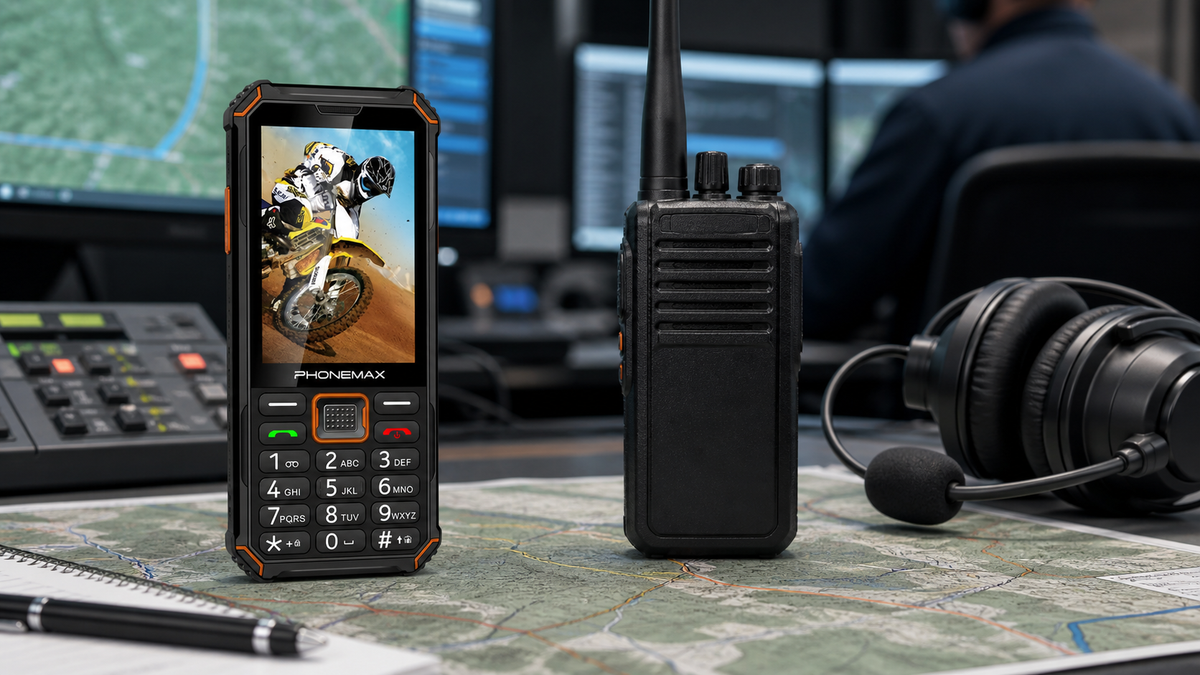
Author and review: Phonemax; sources for review batch B were checked on August 20, 2026. The comparison is a decision framework; it does not certify a phone, app, carrier or radio system for emergency use. Publisher relationship: Phonemax sells the F3 T used here as a possible test unit. This guide does not attribute an unverified PTT or programmable-button feature to the phone.
Decision in one paragraph
Use a push-to-talk app when the team has dependable data coverage, managed smartphones and a need for wide-area groups or multimedia. Use dedicated radio when instant local communication, predictable controls or operation without cellular service is essential. High-risk teams often need both, with a written rule for which system is primary.
Decision table
| Requirement | PTT app on phone | Dedicated radio |
|---|---|---|
| Wide-area communication | Strong with data service | Depends on radio system |
| Works without cellular data | Usually limited | Often yes within system range |
| Photos, location and text | Often available | Usually limited |
| Tactile control with gloves | Device/accessory dependent | Common, but verify |
| Licensing | App/account and local rules | Spectrum and local rules may apply |
| Single-device convenience | Strong | Adds another device |
Run a communication pilot
Map dead zones and test indoor, vehicle, basement and remote locations. Measure call setup, missed calls, audio quality and reconnection. Test while the screen is locked, while another app is active and with the actual headset or remote microphone. Then simulate loss of mobile data, account expiry, a damaged screen and a flat battery.
Dedicated land-mobile radio may also involve spectrum, equipment and licensing rules that vary by jurisdiction. The FCC's Private Land Mobile Radio framework is relevant to U.S. deployments, but it does not answer local rules elsewhere. Regulatory eligibility and interoperability belong in the deployment checklist, not in a generic product claim.
Do not label a physical side button “programmable” or “PTT-ready” unless the exact model, software and app integration have been demonstrated. The Phonemax F3 T may be evaluated as a touchscreen feature-phone form factor, but buyers must verify any PTT function instead of inferring it from the buttons.
Failure-mode questions
Can a rugged phone replace a two-way radio?
Sometimes, but only after coverage, latency, accessories, emergency procedures and failure modes pass the job-specific test.
Is cellular coverage enough evidence?
No. Test the exact network, SIM, app, building and route at working hours.
What should be the backup channel?
Choose an independent method appropriate to the risk and train the team to switch to it.
Deployment action: Validate communication inside the broader fleet pilot.
Where cold shifts are expected, repeat the scenario using the cold-weather runtime test. Vehicle teams need a separate set of hot-exposure controls.
Sources: FCC Private Land Mobile Radio Services; NIST SP 800-124 Rev. 2; Phonemax F3 T product page; Phonemax product catalogue

Legg igjen en kommentar
Alle kommentarer modereres før de publiseres.
This site is protected by hCaptcha and the hCaptcha Privacy Policy and Terms of Service apply.