
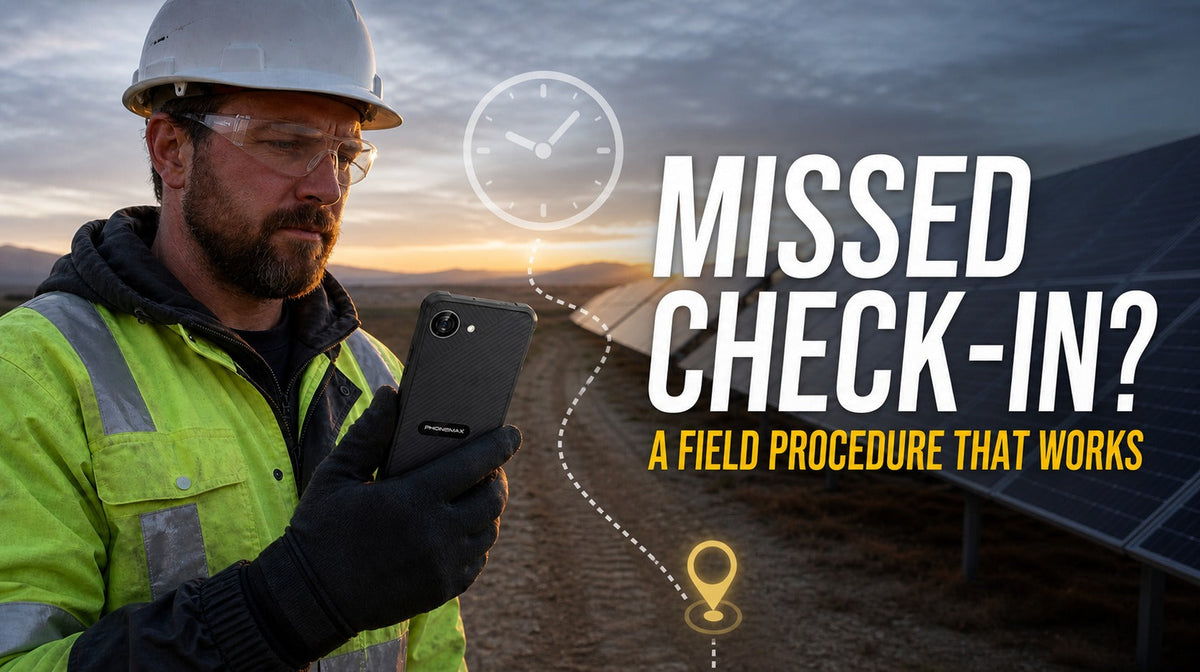
A lone-worker check-in works only when timing, ownership and escalation are agreed before the task begins. A message that says “I’m okay” is useful only if somebody is assigned to receive it and knows exactly what to do when it does not arrive.
Deployment checklist
| Control | Pass | Fail |
|---|---|---|
| Task risk | Location, hazards, route and local help documented | Generic “field work” description |
| Roles | Worker, monitor and escalation owner named for the shift | Unowned group inbox |
| Timing | Fixed check times and grace period | “Check in regularly” |
| Message | Worker, location, status and next check | Unstructured conversation only |
| Missed contact | Timed escalation ladder written and drilled | Monitor improvises |
| Coverage loss | Dead zones and backup channel planned | Phone assumed to work everywhere |
1. Start with the task
Record the work location, expected duration, travel route, hazards, normal coverage and available local assistance. Define situations in which lone work is not permitted. A phone procedure cannot make an unsuitable task safe.
2. Assign three roles
Roles may be combined only where the organization has arranged adequate cover. The worker sends the contact. The monitor records it and starts the missed-contact process. The escalation owner has authority to act. Each role needs shift start and end times plus a handover if responsibility changes.
3. Use one short message format
A practical format is: worker ID; job or location; status; next movement; next contact time. Keep it short enough to send without distracting from the task. Never require check-ins while driving or operating equipment.
4. Put times and tolerance in writing
Use start-of-task, interval, location-change and end-of-task contacts. Set a grace period appropriate to the risk assessment. The interval is not universal: higher consequence, uncertainty or isolation can require tighter control.
5. Define the missed-check ladder
- Retry the primary channel.
- Try the approved secondary channel.
- Contact the site or nearby colleague.
- Notify the escalation owner.
- Activate the locally approved emergency process.
Assign time limits to every step and record timestamps. Do not copy emergency-service instructions from another country or worksite.
6. Plan loss of signal and power
Pre-agree dead zones, contact points and the worker’s action when coverage fails. A phone without service is not a check-in system. Verify battery condition, planned charging and a suitable alternative channel where the risk requires it.
The current Phonemax X5 is a compact Android 16 rugged-phone example, but its 5000mAh capacity, regional variant or rugged claims do not prove coverage or lone-worker suitability. Test the exact carrier, app and route.
7. Drill one missed check
Use an announced drill with approved participants; do not create a false emergency. Confirm the monitor notices the missed contact, finds the job record and follows the ladder. Record delays and false alarms, then revise the procedure. Re-drill when people, routes, carriers or software change.
Copyable check-in message
| Field | Message content |
|---|---|
| Worker | [Worker ID] |
| Job/location | [Job ID and agreed location] |
| Status | [Current status] |
| Next movement | [Plan or remaining on site] |
| Next contact | [Time and time zone] |
Fictional example: “W-017; Job J-204; Gate B service area; safe; remaining on site; next contact 14:30 local time.” Share only the information needed by the authorized monitor.
Higher-risk work may require specialist monitoring, a companion or a prohibition on lone work. More frequent messages alone do not resolve every risk.
FAQ
How often should a lone worker check in?
Set the interval from the task-specific risk assessment; there is no universal schedule.
Is GPS tracking enough?
No. A location does not prove wellbeing and can be unavailable or stale.
Can one phone be the only emergency channel?
Only if the risk assessment supports it; higher-risk work normally requires planned alternatives.
Safety boundary and sources
Phonemax publishes this procedure. The X5 is not presented as a certified lone-worker safety system, and this page does not replace employer responsibilities or local law.




Leave a comment
All comments are moderated before being published.
This site is protected by hCaptcha and the hCaptcha Privacy Policy and Terms of Service apply.