
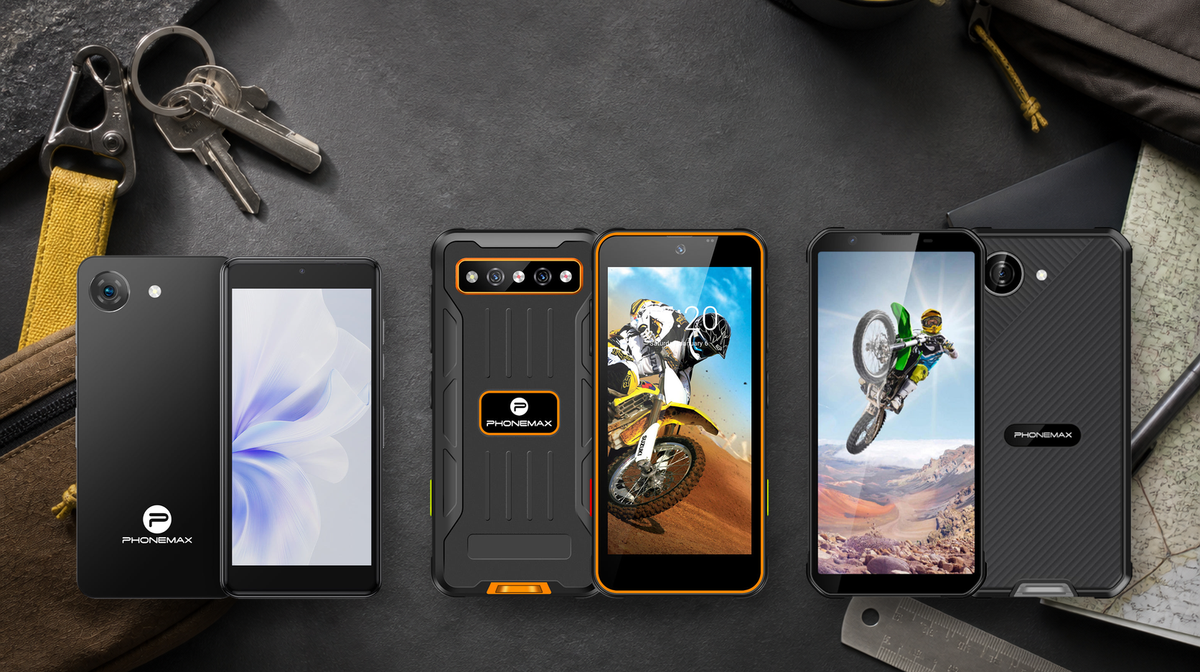
The best small Android phone is the smallest model that still supports your essential apps, carrier bands, typing habits and durability needs. For maximum portability, the Phonemax Q9 Mini is the lightest current option in this comparison. For a compact rugged body, consider the R4 Mini. For a larger everyday screen with rugged protection, consider the X5.
Disclosure: Phonemax manufactures the products used as examples in this guide. Product references are first-party examples, not independent rankings.

“Small” Should Describe the Whole Device, Not Only the Screen
Phone listings often use screen diagonal as a shortcut for size. That can mislead buyers. A phone with a modest display may still be wide, thick or heavy. A larger display can fit into a narrow body if the bezels are small.
A useful comparison therefore starts with four measurements:
- Height
- Width
- Thickness
- Weight
The physical result matters more than a category label. Ask whether the phone fits the pocket, mount, pouch or one-handed grip you actually use. A few millimetres of width can matter during one-handed typing. Extra thickness may be acceptable in a rugged phone because the enclosure is part of the protection strategy, but it may be inconvenient in fitted clothing.
Android supports a broad range of handheld display sizes, yet app interfaces can still feel cramped when controls, keyboards or maps occupy a small screen. Google’s Android compatibility documentation defines platform requirements; it does not guarantee that every third-party app will be comfortable on every compact display.
That is why app testing belongs in the purchase decision, not after it.
What Independent Community Discussion Adds
A Reddit r/smallphones discussion about the Phonemax Q9 Mini illustrates the questions compact-phone buyers raise in practice, including:
- Screen proportions
- Pocket fit
- Carrier compatibility
- GPS
- Bluetooth
- Camera quality
- Battery use
Reports in the discussion are mixed. Some participants liked the phone’s size and low carry weight, while others reported device or connectivity problems. Other commenters said their units behaved differently.
This is anecdotal, unverified user-generated content—not a controlled review. It should be used to identify checks a buyer should perform, not to prove that every Q9 Mini will deliver the same positive or negative result. Variant, carrier, software version, sample condition and individual device differences may affect the experience.
Three Phonemax Approaches to a Smaller Android Phone
The current Phonemax range takes three different approaches to compact Android phones. The following table is a factual fit comparison rather than an independent winner ranking.
| Model | Current published size facts | Best starting fit | Main trade-off to verify |
|---|---|---|---|
| Q9 Mini | 114 × 53.3 × 12.4 mm; 109 g; Android 14; 4GB + 64GB | Maximum portability, travel backup and light daily tasks | Smaller interface for long typing, video or complex work |
| R4 Mini | 121 × 59.5 × 15.5 mm; 150 g; Android 14 | Compact rugged carry, travel and field communication | Thicker and heavier than Q9 Mini |
| X5 | 5.3-inch display; 146.0 × 71.7 × 15.5 mm; approximately 238 g; Android 16 | Easier reading and broader everyday use in a compact rugged format | Less pocketable than the two mini models |
These facts were checked against the English product pages on August 24, 2026. Configurations can change. Network version, memory option and availability should be checked again before purchase.
How to Choose by Task
Choose for Portability First
If the phone will serve as a second device, travel backup or minimal everyday carry, low weight and narrow width may matter more than a large display.
The Q9 Mini is the strongest fit within this three-model set when the purchase goal is carrying less. It is not universally better: a small interface can slow long messages, document work and detailed navigation.
Before buying, test the tasks you expect to perform most often. A phone that is easy to carry but frustrating to operate may not solve the intended problem.
Choose for Compact Ruggedness
If the phone will face rough handling, dust or outdoor work, compare a standard compact phone with a purpose-built rugged option instead of assuming that every small device provides the same protection.
The R4 Mini is positioned by Phonemax as a compact rugged Android phone. Buyers should still read the product page, warranty conditions and care instructions rather than treating “rugged” as permission for deliberate abuse.
For a broader selection framework, see How to Choose a Small Rugged Phone for Travel, Field Work and Everyday Carry.
Choose for a More Conventional Daily Interface
The X5 is physically larger than the Q9 Mini and R4 Mini, but its 5.3-inch display can be a better compromise for reading, typing and repeated app use.
Its product page lists Android 16, a 5000mAh battery and IP68/IP69K protection. Those ratings describe resistance under defined conditions. They do not guarantee permanent water resistance or eliminate the need to keep seals and ports in good condition.
The X5 is therefore the option to examine when a mini phone feels too restrictive but a large rugged phone would be inconvenient to carry.
Five Checks That Prevent a Bad Compact-Phone Purchase
1. Test the Essential App Set
List the five tasks that would make the device useful. These might include:
- Calls
- Messaging
- Authentication
- Maps
- Ticketing
- A required work application
Check each app’s current Android requirement and regional availability. Then test the interface at the font and display size you will actually use.
“Runs Android” is not the same as “comfortable for my workflow.”
2. Verify Network Compatibility Line by Line
An unlocked phone is usable only on compatible networks. The U.S. Federal Communications Commission notes that unlocking does not create technical compatibility.
Compare the exact product variant’s listed 4G bands with the carrier’s bands in the country where the phone will be used. Do not rely only on labels such as “global,” “Europe and Asia” or “US/Americas.”
Carrier policies can also affect activation. If compatibility is essential, obtain confirmation before ordering rather than assuming that an unlocked regional variant will work everywhere.
3. Measure Your Real Carry Space
Create a paper rectangle using the published height and width, then add folded card to represent the listed thickness.
Put the model in the pocket, pouch or mount you plan to use. This simple check is more reliable than judging scale from product photographs.
Also consider whether you will add a case, tether, lanyard or charging adapter. Accessories can change the amount of practical carrying space required.
4. Decide How Much Screen Compromise Is Acceptable
Try a small keyboard, a map with controls visible and the most complex application screen you expect to use.
If the task requires frequent zooming, repeated typing corrections or unsafe levels of attention, move up one size. Compactness should reduce friction in carrying, not create friction in every interaction.
Users who mainly call, message or authenticate may accept a much smaller interface than users who edit documents, follow detailed maps or work with complex applications.
5. Separate Durability From Carelessness
Rugged construction may reduce certain damage risks, but no phone is immune to worn seals, damaged ports, extreme heat, salt water or impact.
Read the exact protection claim and its limitations. Keep ports and seals clean, avoid charging a wet device and maintain a backup plan when navigation, communication or authentication is critical.
A rugged phone should support a more resilient workflow. It should not be treated as indestructible.
Small Android Phone Decision Table
| Your priority | Best fit to examine first | Why | Stop condition |
|---|---|---|---|
| Lightest pocket carry | Q9 Mini | Lowest published weight in this set | Essential apps or typing are uncomfortable |
| Small rugged Android device | R4 Mini | Compact rugged positioning | You need a larger interface or specialized imaging |
| Compact rugged daily phone | X5 | Larger display and current Android version | Weight or width defeats your carry goal |
| Long documents or media | Larger conventional phone | More usable screen area | Compactness remains the top constraint |
| Mission-critical field work | Tested device plus backup | Workflow resilience matters more than size alone | Apps, bands, power or fallback remain unverified |
What This Guide Does Not Prove
This guide does not claim independent battery runtime, camera superiority, carrier approval or drop-test performance.
It does not rank every compact Android phone available in 2026. Instead, it provides a task-based selection framework using current Phonemax products as transparent first-party examples.
Published specifications help create a shortlist. The final decision should still be based on the exact regional variant, required applications, carrier compatibility and the physical carrying environment.
FAQ
What Is Considered a Small Android Phone in 2026?
There is no single universal cutoff. Compare the complete dimensions and weight, then test the intended grip, pocket and applications. Screen diagonal alone is insufficient.
Is the Smallest Android Phone Always the Easiest to Use?
No. Smaller phones are easier to carry, but keyboards, maps and complex interfaces may be harder to use. The best size balances portability with task completion.
Can a Mini Android Phone Use Normal Apps?
A mini Android phone can use compatible Android applications, but availability, performance and interface comfort depend on the app, Android version, hardware and region. Verify essential applications before purchase.
Will a US/Americas Version Work on Every U.S. Carrier?
Not necessarily. Compare the exact listed network bands with the carrier’s bands and check the carrier’s activation policies. A regional label is not a universal compatibility guarantee.
Which Is More Portable, Q9 Mini or R4 Mini?
According to the current published dimensions, the Q9 Mini is shorter, narrower, thinner and lighter. The R4 Mini adds a rugged enclosure and therefore carries a different size-and-weight trade-off.
Which Phonemax Model Is Better for Everyday Reading and Typing?
The X5 is the first model to examine when a larger interface matters more than minimum size. Its 5.3-inch display provides more room than the two mini models, but the device is also wider and heavier.
Should I Choose a Small Phone as My Main Device or a Backup Phone?
That depends on the required workload. A small phone can work well as a travel backup, authentication device or minimal everyday phone. Users who frequently edit documents, navigate for long periods or consume media may prefer a larger primary device.
Sources
- Android Compatibility Definition — Android platform compatibility context.
- FCC Cell Phone Unlocking Guide — distinction between unlocking and technical network compatibility.
- Reddit r/smallphones discussion: “Any one know anything about this phone? Phonemax Q9 Mini” — user-generated evidence about buyer questions and mixed reported experiences; not proof of specifications or universal performance.
- Phonemax Q9 Mini product page — current first-party dimensions, weight, operating system and memory information.
- Phonemax R4 Mini product page — current first-party dimensions, weight, operating system and product positioning.
- Phonemax X5 product page — current first-party display, dimensions, weight, operating system, battery and protection information.


Napsat komentář
Všechny komentáře jsou před zveřejněním moderovány.
Tento web je chráněn službou hCaptcha a vztahují se na něj Zásady ochrany osobních údajů a Podmínky služby společnosti hCaptcha.