
Price update — October 9, 2026: Prices in this guide were rechecked in USD against the listed product configurations. Prices and availability may change; confirm the selected configuration on its product page before ordering.
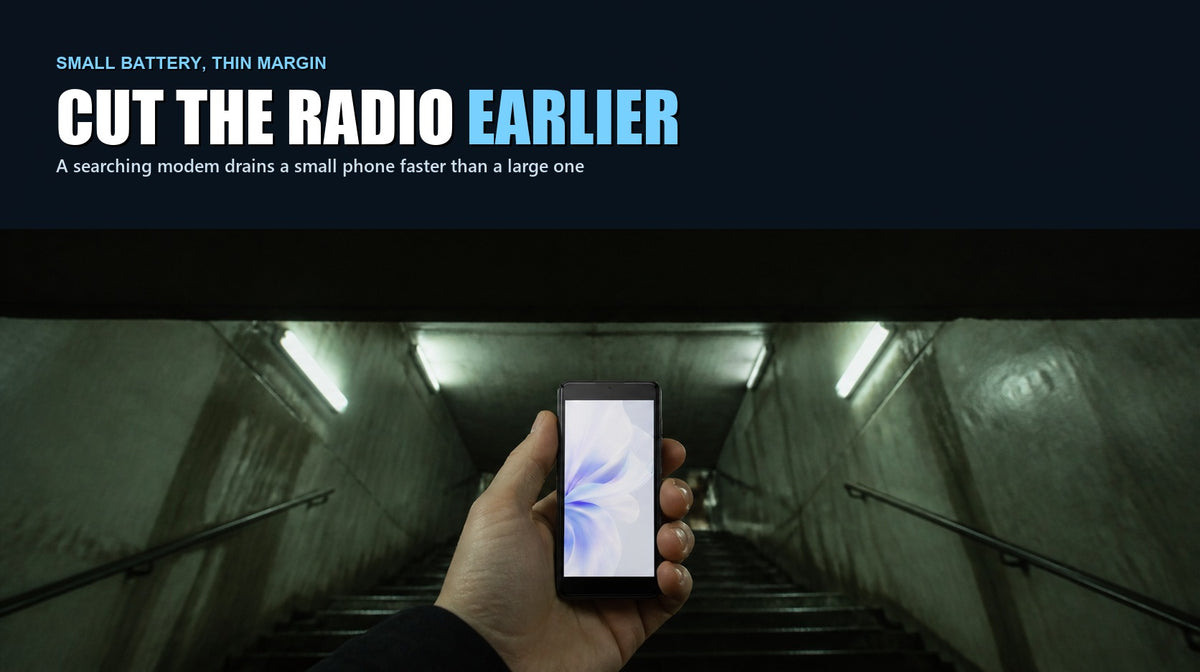
Use flight mode earlier and more aggressively than you would on a bigger phone. A small body holds a small battery, and a phone searching for absent signal is the fastest way to drain one — so the margin for error that a large-battery phone gives you simply is not there. Prepare the content offline, cut the radio, and the Q9 Mini handles a low-coverage day perfectly well. Take it somewhere genuinely remote and unprepared, and its size works against you twice: less battery, and no rugged protection.
Key facts: what works with no signal
| Capability | Works offline? | Preparation needed |
|---|---|---|
| Satellite positioning | Yes | None — does not require a mobile network |
| Map display | Only if cached | Download the area before departure |
| Camera and local storage | Yes | Check free space in 64GB |
| Local notes and documents | Yes | Store locally, not cloud-only |
| Local music and media | Yes | Transfer before leaving |
| Calls and SMS | No | Requires coverage |
| Cloud sync, email, messaging | No | Queue and sync on return |
The Q9 Mini is a compact Android 14 smartphone at 114 x 53.3 x 12.4 mm and 109 g, with 4GB RAM and 64GB storage, listed at $119. Battery capacity is not published. It ships in separate published band versions for EU/Asia and the Americas, and the US/Americas version is currently out of stock.
Why a small phone needs stricter offline discipline
The offline techniques here are the same ones that apply to any Android phone. What changes is how much slack you have when you get them wrong.
The battery margin is thinner. A 114 x 53.3 x 12.4 mm body cannot hold what a 172 mm phone holds. That is physics, not a design failure, and it is the trade you accepted for pocketability. The practical consequence is that a mistake which costs a large phone 20% of its day costs this one considerably more of its.
Signal searching is the expensive mistake. In a dead zone the modem transmits at maximum power, repeatedly, hunting for a network that is not there. On any phone this is wasteful; on a small-battery phone it is the difference between arriving home with charge and arriving home with a brick.
There is no rugged protection. No IP rating is published for this model. In low-coverage areas — which tend to be outdoors, wet, dusty or cold — that matters more than it does in town. A phone that fails physically is worse than one that runs out of battery.
So the discipline is the same but the tolerance is lower.
Before you leave coverage
Download maps for the whole area plus margin, and verify. Switch to flight mode before departure and pan the route. Anything that fails to render was never cached.
Cache documents, tickets and references. Mark cloud files explicitly for offline availability. "It was in my email" is not a plan.
Screenshot anything critical. A screenshot is a local image file that survives app logouts, session expiry and sync failures.
Write critical numbers on paper. Costs nothing, covers the case where the device itself fails.
Check storage. 64GB is adequate but not generous; photographs accumulate faster than expected.
Charge to full and carry a compact power bank if the day is long. On this device that is a reasonable accessory rather than an admission of defeat — the small battery is the known trade-off.
Tell someone your plan. For any trip beyond routine, a person who will notice you are late is the most effective safety measure available.
In the dead zone
Flight mode immediately, positioning on. Do not wait until the battery looks low. On a small-battery phone the searching cost accumulates from the moment coverage drops, so switching early is worth substantially more than switching late.
Satellite positioning does not require a mobile network and continues to work in flight mode on most Android builds, so you keep location and cached maps while stopping the expensive part.
If you must stay reachable in marginal coverage, check at intervals instead of continuously — flight mode by default, out for a few minutes at fixed times or at high points.
Brightness down. The display is the other major constant drain.
Keep it warm in cold conditions. Lithium capacity falls in cold, and a 109 g phone in an outside pocket cools quickly. An inside pocket genuinely extends the day.
Do not let anything stream or auto-update. Both resume the instant a weak signal appears, at the worst possible moment.
Coming back to coverage
Sync deliberately. Get a stable connection first, then upload in order of importance. Walking into a weak signal with everything queued fails most of it and drains the battery retrying.
When the Q9 Mini is the wrong device for the trip
This is the honest part.
If the environment is wet, dusty or cold — most genuinely low-coverage environments — a non-rugged phone with no published IP rating is a poor choice. The Phonemax R4 Mini at $138 is a compact Android 14 rugged phone at 121 x 59.5 x 15.5 mm and 150 g. It is 41 g heavier and 3.1 mm thicker; that difference is the protection. For $19 more, in outdoor conditions, it is almost always the better choice. Note its US/Americas version is also currently out of stock.
If you need to see in the dark, the Phonemax X3 at $155 adds a night-vision camera and L1+L5 dual-band positioning, which improves position stability in the obstructed terrain that low-coverage areas tend to feature.
If battery endurance is the constraint, the Phonemax P2 at $191 publishes an actual 6100 mAh capacity with IP68/IP69K protection — a published figure, unlike the Q9 Mini.
If navigation is the main task, the Phonemax N1 at $509 pairs GPS, GLONASS and Galileo positioning with a 12,000 mAh battery.
If the trip crosses carriers or regions, the Phonemax M10 at $169 publishes a broad 4G band list, with the caveat from our own product page that a broad band set does not guarantee compatibility with every carrier.
Compare within the Mini Phones and Rugged Phones collections.
Where the Q9 Mini does suit low-coverage use
To be fair to the device: it suits urban and semi-rural low-coverage situations where the environment is benign — travel, commuting through poor-signal corridors, a second phone carried in a city with patchy indoor coverage, or a lightweight backup device alongside a primary phone.
Its size means it genuinely gets carried, and a phone in your pocket with cached maps beats a better phone left behind. That argument holds. It just does not extend to a wet hillside.
Limitations and what to know
- No phone is a satellite communicator. Positioning is receive-only. It cannot transmit your location or call for help. Genuinely isolated travel needs a satellite messenger or personal locator beacon — equipment we do not sell.
- No IP rating is published for the Q9 Mini. This is the main reason to take a different device into demanding outdoor conditions.
- Battery capacity is not published and we have not estimated it. Test your own endurance on a short trip first.
- The US/Americas version is currently out of stock.
- Emergency-calling behaviour varies by country, carrier and infrastructure. Never rely on it as a plan.
- Cold reduces battery capacity, and a small light phone cools faster than a large one.
- Offline app behaviour differs by app. Test yours in flight mode before departure.
- No independent professional review of the Q9 Mini exists that we are aware of.
FAQ
Does GPS work without a mobile signal on the Q9 Mini? Satellite positioning does not require a mobile network. Map applications, however, normally fetch map imagery over the network, so cache the area before you lose coverage.
Should I use flight mode in a low-coverage area? Yes, and earlier than you would on a larger phone. Continuous signal searching is a significant drain, and a small battery gives you less margin for delay.
Is the Q9 Mini suitable for hiking or remote outdoor use? Not ideally. No IP rating is published, so it lacks stated protection against water and dust, and the battery capacity is unpublished and constrained by the small body. For outdoor use in low-coverage areas, the R4 Mini or a larger rugged phone is a better choice.
Should I carry a power bank with it? For long days, yes. On this device that is a sensible accessory rather than a workaround — the small battery is the acknowledged trade-off of the form factor.
How do I check my documents are really available offline? Switch to flight mode before leaving and open each one. Anything that fails to load was never cached.
Can it call emergency services with no signal? In some regions a phone can place an emergency call over any available network, but this depends on country, carrier and local infrastructure. Never treat it as a safety plan.
Publisher disclosure
This article is published by Phonemax and is commercial content. Every device recommended is one we sell.
Specific to this article: a substantial part of this piece argues that you should probably take a different phone. That is the honest conclusion for the topic — a non-rugged mini phone with no published IP rating and no published battery capacity is not the right tool for genuinely demanding low-coverage environments, and pretending otherwise would produce disappointed customers and returns. We have named the R4 Mini at $138 as the better outdoor choice, which is a $19 upsell, and we have also been clear that the Q9 Mini does suit benign low-coverage use.
The most important sentence works against us entirely: no phone is a satellite communicator, and isolated travel needs a satellite messenger or PLB. We do not sell those, earn nothing from that advice, and would give it regardless.
Battery capacity is not published for this model, which is directly material to an article about offline endurance. We have not estimated it, and the article accordingly tells you to test rather than trust. No IP rating is published either, and for outdoor use that is the more consequential gap.
The offline techniques described are general Android practice, not features unique to this device — nearly all of it applies to any modern Android phone, and readers should not infer that the Q9 Mini performs these tasks better than alternatives.
No independent professional review of the Q9 Mini exists that we are aware of. All specifications and stock status are manufacturer-stated, read from our live product pages on 2 September 2026. No paid or sponsored review is cited.
Sources and references
- Phonemax Q9 Mini product page — manufacturer specifications and current variants
- Phonemax R4 Mini product page — rugged compact comparison
- smartphone.ma Q9 Mini specification entry (independent aggregator)
- Reddit r/smallphones discussion of compact models (independent user discussion)
Evidence boundaries: all device specifications and stock status are first-party manufacturer data. No battery capacity or IP rating is published for the Q9 Mini in any source, and none is estimated here. The aggregator listing republishes specifications rather than testing them; the Reddit thread is unmoderated user opinion included because independent discussion of compact phones is scarce. No professional review or field testing of this model exists in any cited source. The offline guidance is general Android practice, not benchmarked on this device.
Related guides
- Phonemax Q9 Mini vs R4 Mini: Which Small Android Phone Fits You?
- Small Backup Phone for Travel: What Should It Actually Be Able to Do?
- How Should You Set Up a Backup Phone Before International Travel?
Related products
- Phonemax Q9 Mini Compact Android 14 Smartphone — $119
- Phonemax R4 Mini Compact Android 14 Rugged Phone — $138
- Phonemax X3 Night Vision Camera Rugged Phone — $155
- Phonemax P2 6100mAh Battery Rugged Phone — $191
- Phonemax M10 Global 4G Band Fast Charging Rugged Phone — $169
- Phonemax N1 Rugged Rally Navigation Tablet — $509


Napsat komentář
Všechny komentáře jsou před zveřejněním moderovány.
Tento web je chráněn službou hCaptcha a vztahují se na něj Zásady ochrany osobních údajů a Podmínky služby společnosti hCaptcha.