
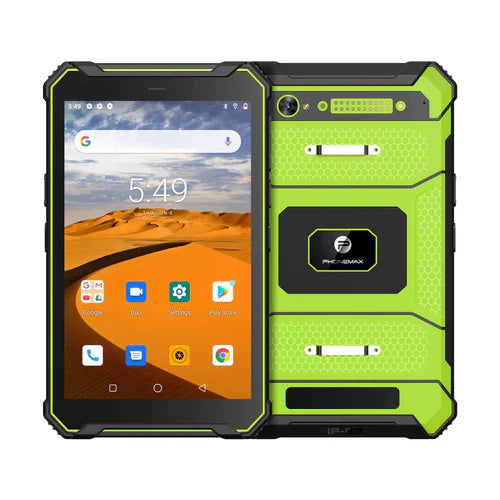
A rugged vehicle tablet has different power requirements from a purely handheld tablet. It may spend much of the shift connected to vehicle power, but the internal battery still matters when the device is removed from the mount, the vehicle is switched off or power is interrupted. A “10-hour battery” target should therefore be considered together with the complete vehicle power and mounting system.
Define mounted and handheld use
Estimate how much time the tablet remains docked and how much time workers carry it away from the vehicle. Delivery, field service, warehouse and inspection workflows can have very different battery needs.
Vehicle power architecture
Confirm how the exact tablet and dock receive power and whether USB-C, a dedicated dock or another protected input is required. Electrical details vary by platform. Consider cable routing, ignition behavior, temporary power loss and charging while high-load applications are running.
Internal battery as a bridge
Even when vehicle power is available, an internal battery can support operation during stops or handheld tasks. Validate runtime under the expected screen brightness, GNSS, cellular connectivity and applications.
Mounting, vibration and heat
The tablet, dock and mount should be evaluated as one system. Vehicles can expose devices to repeated vibration and direct sunlight, while cabins can become hot when parked. These conditions can affect both mechanical reliability and battery performance.
GNSS and connectivity
Navigation and dispatch workflows may keep GNSS and cellular data active for long periods. Vehicle structure and mounting position can influence antenna performance, and weak signal can increase power consumption. Test the installed system in the actual vehicle.
OEM and ODM requirements
For a fleet project, customization may involve firmware, branding, applications, mounts, docks, charging accessories, antennas or function keys. Define what is standard and what requires engineering, then test the final production configuration.
Vehicle deployment checklist
- Separate mounted and handheld runtime requirements.
- Validate the vehicle charging method.
- Test battery runtime with GNSS and cellular active.
- Check vibration, temperature and mounting conditions.
- Confirm network bands and antenna performance.
- Validate dock, mount and cable durability.
- Include final software in power testing.
FAQ
Does a vehicle tablet need a very large battery?
Not always. If reliable vehicle charging is available, the battery may mainly support handheld use and temporary power interruptions. The correct size depends on the workflow.
Should vehicle runtime be tested while mounted?
Yes. Test the complete system, including screen brightness, GNSS, connectivity and charging behavior in the real installation.
Review rugged-device options or contact Phonemax for vehicle OEM/ODM requirements.

Laisser un commentaire
Tous les commentaires sont modérés avant d'être publiés.
Ce site est protégé par hCaptcha, et la Politique de confidentialité et les Conditions de service de hCaptcha s’appliquent.