
Price update — November 4, 2026: Prices in this guide were rechecked in USD against the listed product configurations. Prices and availability may change; confirm the selected configuration on its product page before ordering.
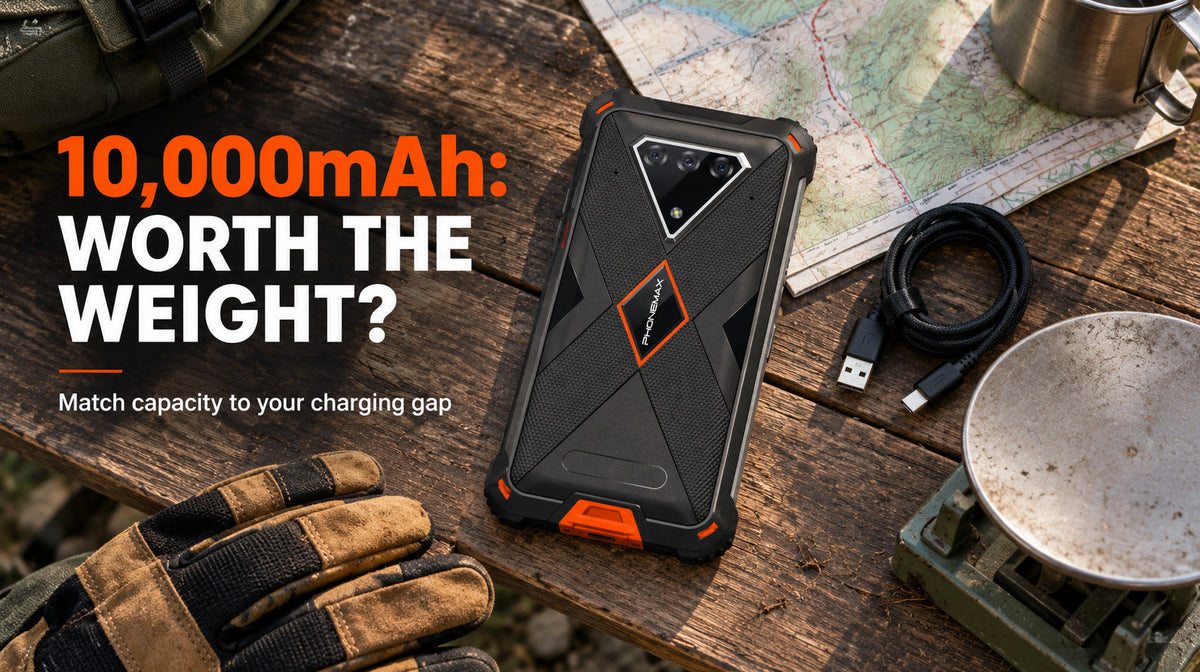
A 10,000mAh rugged phone is worth the weight when it closes a recurring charging gap. It is probably excessive when your present phone already finishes the day with a comfortable reserve and a charger is routinely available. Capacity should solve a measured problem, not simply win a specification comparison.
Fast decision: match the charging gap
- Choose 10,000mAh-class hardware when long GPS, hotspot, high-brightness or communication workloads repeatedly outlast available charging windows.
- Choose a mid-capacity rugged phone when you need more reserve but still prioritise weight and pocketability.
- Choose a compact rugged phone when daily charging is reliable and carry comfort matters more than maximum reserve.
- Keep a power bank when the long day is occasional rather than routine.
Current Phonemax capacity choices
| Model | Current listed battery | Published weight | Current positioning |
|---|---|---|---|
| X5 | 5000mAh | 238g | Compact rugged phone; Android 16; from $139 |
| P2 | 6100mAh | 275g | 6.35-inch, 8GB + 128GB; US$140 clearance configuration |
| M10 | 10,000mAh | 384g | 33W wired and 15W wireless charging; broad published 4G bands; $169 |
These figures were checked against Phonemax listings on November 4, 2026. The P2 figure is a clearance configuration price; confirm its current offer and final checkout amount. Prices and stock can change. They do not form a runtime ranking: display, modem, chipset, software, signal, temperature and workload differ between devices.
Measure demand before choosing capacity
- Record three representative days. Note start/end percentage, elapsed hours and the workloads that dominated the day.
- Include the difficult day. Weak coverage, navigation, hotspot use and high brightness can be more useful than an easy office day.
- Define the longest period without reliable charging. That period is the charging gap the new phone must cover.
- Set a reserve. Do not design routine operations around reaching 0%.
- Test the exact phone. Capacity alone cannot establish the final result.
Use the P2 full-workday battery worksheet for a model-specific example and the all-day GPS battery-drain guide when navigation is the dominant load.
What 10,000mAh changes—and what it does not
It increases available stored energy
Additional capacity can create more operating margin, but mAh should not be converted into a guaranteed number of hours or days without a defined test.
It makes charging logistics less frequent, not irrelevant
The M10 listing pairs 10,000mAh with 33W wired and 15W wireless charging. Peak wattage still does not guarantee a particular recovery time with every charger, temperature or workload. Test the exact charger and whether the phone gains charge while the required apps are running.
It adds a carry trade-off
At 384g, the current M10 is 146g heavier than the 238g X5 and 109g heavier than the 275g P2. That difference may be unimportant in a vehicle mount and noticeable in a pocket or during continuous one-handed work.
Choose by recurring scenario
| Scenario | Likely direction | What to verify |
|---|---|---|
| Daily vehicle navigation with poor coverage | Large integrated battery may reduce cable dependence | Mount, heat, charge rate under load and carrier support |
| Occasional weekend trip | Smaller phone plus power bank may be more flexible | Total carried weight and weatherproof cable management |
| Long security or logistics shift | Measure whether current reserve is actually insufficient | Calls, screen, scanning, apps and missed charging windows |
| Everyday pocket carry near chargers | Compact device may be the better compromise | Comfort, app compatibility and end-of-day reserve |
Reasons not to buy on capacity alone
- A long band list does not guarantee carrier acceptance.
- A large battery does not compensate for incompatible work apps or an unsuitable Android lifecycle.
- Capacity does not reveal camera quality, screen readability or GNSS performance.
- Battery aging still depends on temperature, state of charge and cycling conditions.
- A phone that is too heavy for the user may remain on a desk instead of supporting the job.
Shift battery log
| Date/shift | Start/end charge | Hours away from charging | Main workload | Interruptions | Reserve acceptable? |
|---|---|---|---|---|---|
| [Date] | [% / %] | [Hours] | [GPS, calls, hotspot] | [Details] | [Yes/no; target] |
Compare the complete carry setup, including any power bank, cable and mount. Across devices, mAh alone does not describe usable energy or runtime; voltage, efficiency and workload also matter.
FAQ
How long does a 10,000mAh rugged phone last?
There is no universal duration. The answer depends on the exact device, signal, display, software, GPS, temperature and workload.
Is 10,000mAh better than carrying a power bank?
It can be more convenient for daily high-demand work. A power bank is often more flexible when the extra endurance is needed only occasionally.
Does M10 support 5G?
No. The current M10 listing is a 4G device. Check its published bands and carrier acceptance separately.
Evidence boundary
Specifications in this guide come from current Phonemax listings. No article-specific laboratory runtime comparison is presented. Operational recommendations are methods for testing your charging gap, not measured performance claims.

Laisser un commentaire
Tous les commentaires sont modérés avant d'être publiés.
Ce site est protégé par hCaptcha, et la Politique de confidentialité et les Conditions de service de hCaptcha s’appliquent.