
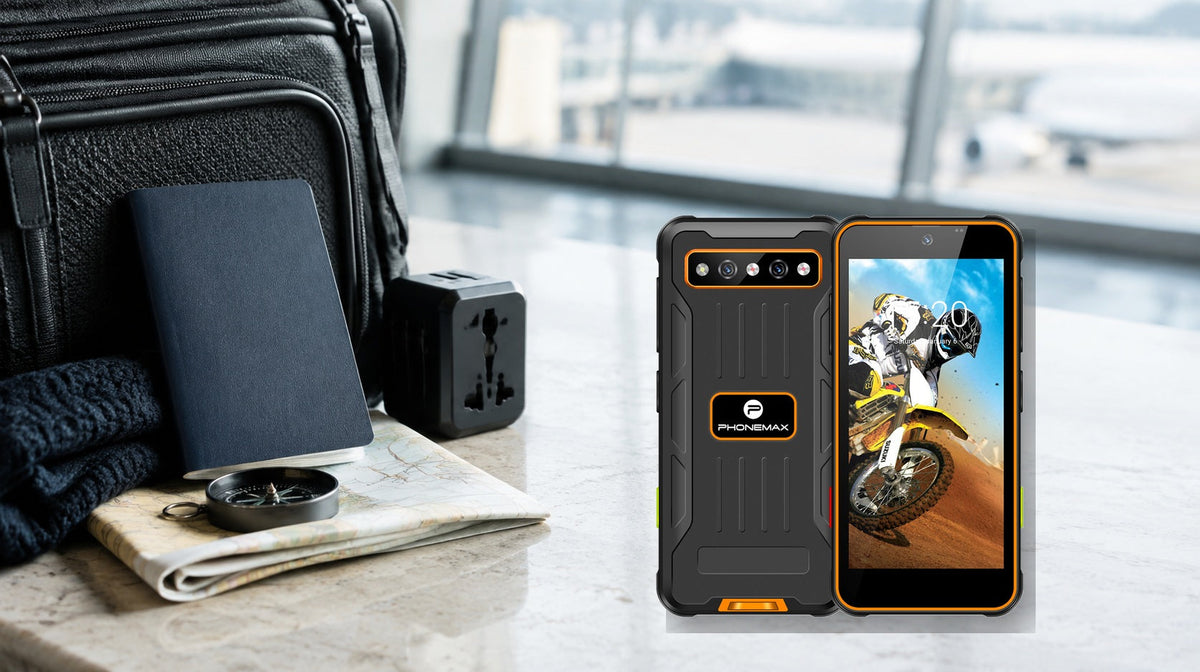
Short answer: Travelers should choose a rugged backup phone by destination compatibility, SIM plan, compactness, battery readiness, offline access and security. Test it before departure, carry it where it remains accessible, and do not assume “unlocked” or “global” guarantees service in every country.
Commercial disclosure: Phonemax publishes this article and sells the R4 mini. Airline, border, carrier and battery rules vary; confirm current requirements with the relevant provider before travel.
For the closest comparison, see What Should Search-and-Rescue Teams Look for in a Rugged Phone?.
What failure should a travel backup cover?
A backup phone can address theft, breakage, water exposure, exhausted battery, a failed charging port or the need for a separate local SIM. It cannot solve every failure: if both phones depend on the same account, charger, bag or carrier, one incident may disable both.
Build diversity where practical. Store the backup separately, use a second cable, keep offline information available and know how to contact your carrier without the main phone.
Will it connect at the destination?
Check the exact regional variant against the destination carrier’s LTE bands and voice requirements. Also check roaming, eSIM or physical SIM needs, APN setup and whether local registration is required.
The FCC notes that unlocked phones can be used on compatible networks, including abroad, but compatibility still matters. See its cell-phone unlocking guide.
The Phonemax R4 mini has separately listed Europe/Asia and US/Americas versions. Its current product information lists Android 14, dimensions of 121 × 59.5 × 15.5 mm and weight of 150 g. Those compact dimensions make it a plausible backup candidate, but the buyer must select the correct version and verify destination networks.
What should be available offline?
Before departure, download:
- Maps and key addresses
- Booking references and emergency contacts
- Insurance and identification copies where legally appropriate
- Carrier support numbers
- Authentication recovery codes stored securely
- Translation or transport information needed on arrival
Test each item in airplane mode. A file that exists only in an online account is not an offline backup.
How should you manage power and airline rules?
Keep the phone charged, powered down or in a low-drain state, and inspect it for damage. The FAA recommends carrying lithium-battery portable electronic devices in carry-on baggage; if placed in checked baggage, they must be completely powered off and protected from accidental activation and damage. Spare batteries and power banks belong in carry-on baggage, subject to capacity and airline limits. Review the FAA PackSafe guidance and your airline’s rules.
Never travel with a swollen, damaged or recalled battery.
How do you avoid creating a security problem?
Use a strong screen lock, install updates, enable a device-location or remote-erasure method where appropriate, and minimize stored sensitive data. Consider whether the backup should have full access to email and banking or only the credentials needed for recovery.
Google’s Android update guide shows where to check the Android, security and Google Play system update status. Perform that check before every significant trip.
48-hour pre-departure test
- Insert or activate the planned SIM.
- Make a call and use mobile data.
- Open offline maps in airplane mode.
- Test the charger and separate cable.
- Sign in to essential apps and confirm recovery methods.
- Record the IMEI and carrier contacts somewhere secure.
- Pack the phone separately from the main device.
Final recommendation
Choose the smallest device that meets the destination network and backup role. R4 mini is a relevant Phonemax option when compact rugged carry is the priority, but its regional version is the critical specification. The best travel backup is not the phone with the most features; it is the one you tested, charged and can reach when the main phone is gone.
Two related checks are What Should You Check Before Using a Rugged Phone for Multi-Day Hiking? and Which Rugged Phone Features Matter Most for Plumbers?.
Buyer decision table
| Evidence | Accept when | Reject or verify when |
|---|---|---|
| Current model page | The exact configuration and required feature are stated | The claim applies only to a family or older version |
| Primary technical source | The method and limits match What Should Travelers Who Need a Backup Phone Check Before Choosing a Rugged Phone | The source addresses a different hazard or use case |
| Buyer trial | The real workflow finishes with the required reserve | A critical task fails or conditions were not recorded |
FAQ
Can I pack a backup phone in checked luggage?
FAA guidance prefers carry-on baggage. A device in checked baggage must be fully powered off and protected; airline and international rules may be stricter.
Do I need a separate SIM?
It can improve readiness, but carrier plans vary. Confirm activation, roaming and local rules before departure.
Is an unlocked phone guaranteed to work overseas?
No. Its bands and carrier features must be compatible with the destination network.
Should the backup contain all my personal data?
Usually not. Store the minimum needed to recover and continue the trip securely.
Editorial method: Travel-failure analysis covering connectivity, offline access, power and security. No roaming or carrier availability is guaranteed.

Laisser un commentaire
Tous les commentaires sont modérés avant d'être publiés.
Ce site est protégé par hCaptcha, et la Politique de confidentialité et les Conditions de service de hCaptcha s’appliquent.