
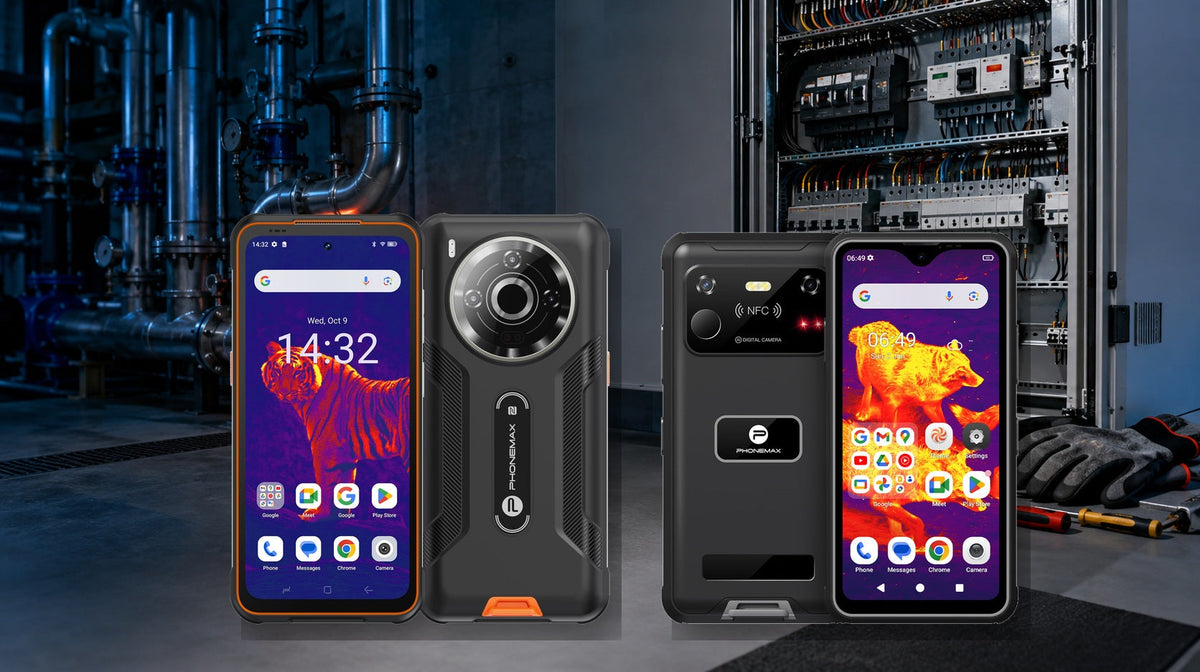
Last reviewed: August 7, 2026 · Editorial disclosure: This guide is published by Phonemax, a rugged-device manufacturer. The Phonemax P20 Pro is identified below as an example from our own catalog. Technical references are linked to specialist and public-sector sources. No independent thermal-camera laboratory test was performed specifically for this article.
For the closest comparison, see Night Vision on Rugged Phones: Who Actually Needs It and When Is It Useful?.
Quick answer
Thermal imaging on a rugged phone is a useful professional tool when temperature patterns are part of a repeatable task. Electricians, HVAC technicians, maintenance teams, building inspectors, mechanics and some emergency workers can use thermal images to screen for unusual hot or cold areas and document what they see. For most ordinary smartphone users, however, it is a specialist feature that may not justify extra cost.
Key takeaways
- Thermal imaging detects infrared energy associated with surface temperature patterns; it is not X-ray vision.
- Its strongest advantage in a phone is workflow: capture, annotate, communicate and report from one device.
- A phone thermal camera can be useful for screening, but it should not automatically replace a calibrated professional instrument.
- Measurement accuracy depends on more than sensor resolution; emissivity, reflections, distance, optics, calibration and environment matter.
- Buy the feature only if temperature differences help you solve a task you encounter regularly.
What a thermal camera actually shows
A thermal imager detects infrared radiation and converts differences in detected energy into an image. That is different from a normal camera, which primarily records reflected visible light.
The U.S. Department of Energy describes infrared thermography as generating images that represent variations in infrared radiance from object surfaces. This makes thermography useful for identifying temperature-pattern anomalies, but interpreting the pattern still requires context.
One common misconception is that thermal imaging can see through walls. FLIR explains that a thermal camera generally detects the surface heat pattern of the wall, not objects behind it. Something inside a wall may influence the surface temperature, but the imager is not seeing through the material.
Where phone thermal imaging can be genuinely useful
Electrical screening
Abnormal resistance, load or poor connections can be associated with unusual heat patterns. A thermal imager can help a qualified technician identify an area that deserves further investigation. It should support—not replace—electrical testing, safe isolation procedures and professional judgment.
HVAC troubleshooting
Heating and cooling systems create temperature differences that are often easier to understand visually. Thermal imaging can help screen supply-air patterns, pipes, radiators, insulation areas and equipment for anomalies that merit closer inspection.
Building-envelope inspection
The U.S. Department of Energy has funded work using infrared imaging to identify thermal anomalies in building envelopes. In practice, thermography can help point an inspector toward possible air-leakage, insulation or moisture-related areas, but the image should be interpreted alongside other evidence.
Mechanical maintenance
Motors, bearings, pumps, connectors and other equipment can develop abnormal thermal patterns. Integrated phone imaging can be useful for quick comparison, documentation and communication, especially when the technician already carries the device throughout the shift.
Automotive and field work
Thermal images can help visualize heating patterns in electrical components, brakes, cooling systems and other parts where temperature differences are informative. Again, the image identifies a pattern; it does not automatically diagnose the cause.
Why integration into a phone can be valuable
The biggest advantage is often availability and workflow, not maximum thermal performance. A tool already in the worker’s pocket is easier to use during routine checks.
An integrated thermal phone can make it simpler to:
- capture a visible photo and a thermal image during the same visit,
- annotate the finding immediately,
- attach images to a work order,
- message a colleague or supervisor,
- record job and location information,
- store or upload evidence without transferring files between devices.
For mobile technicians, fewer devices and fewer transfer steps can be a meaningful productivity benefit.
When a dedicated thermal camera is still the better tool
A professional standalone thermal camera may provide higher thermal resolution, better sensitivity, more suitable optics, broader measurement ranges, calibration options and dedicated reporting software. If temperature measurement is central to the job—or if a result affects safety, compliance or a formal inspection—the correct comparison is not “thermal phone versus no thermal camera.” It is “thermal phone versus the professional instrument required for the task.”
NIST research on thermal-camera measurement highlights that calibration and measurement uncertainty matter, and that factors such as emissivity and the camera’s point-spread behavior can influence quantitative results. That is why a colorful thermal image should not be treated as automatically precise temperature evidence.
Specifications buyers should check
| Specification / factor | Why it matters |
|---|---|
| Thermal resolution | More detector pixels can reveal smaller spatial details, though resolution alone does not determine measurement quality. |
| Thermal sensitivity / NETD | Indicates how small a temperature difference the system can distinguish under stated conditions. |
| Measurement range | Building inspection and high-temperature industrial work may need very different ranges. |
| Stated accuracy | Important if the user will make quantitative decisions rather than only look for patterns. |
| Frame rate | Affects how smoothly moving equipment or a scanning motion can be viewed. |
| Focus and optics | Determine how well the user can resolve the target at the required distance. |
| Software tools | Measurement points, palettes, annotations, image export and reporting can matter as much as the sensor. |
| Calibration and environmental limits | Critical when measurement accuracy, repeatability or compliance matters. |
What can make a thermal reading misleading?
Thermal interpretation becomes harder when surfaces have different emissivity, when shiny materials reflect thermal radiation, when the target is too small or too far away, or when environmental conditions change. Glass and polished metal can be especially deceptive. A thermal image can also show a genuine hot or cold pattern without telling you the root cause.
The safe approach is: use the image to identify and document an anomaly, then confirm the diagnosis with the appropriate method.
What thermal imaging cannot reliably do
- see through ordinary walls,
- identify the exact cause of every hot spot,
- prove moisture exists without supporting evidence,
- measure every surface accurately regardless of emissivity or reflection,
- replace a qualified electrician, HVAC technician or building inspector,
- replace required calibrated instruments or safety procedures.
A Phonemax example: P20 Pro
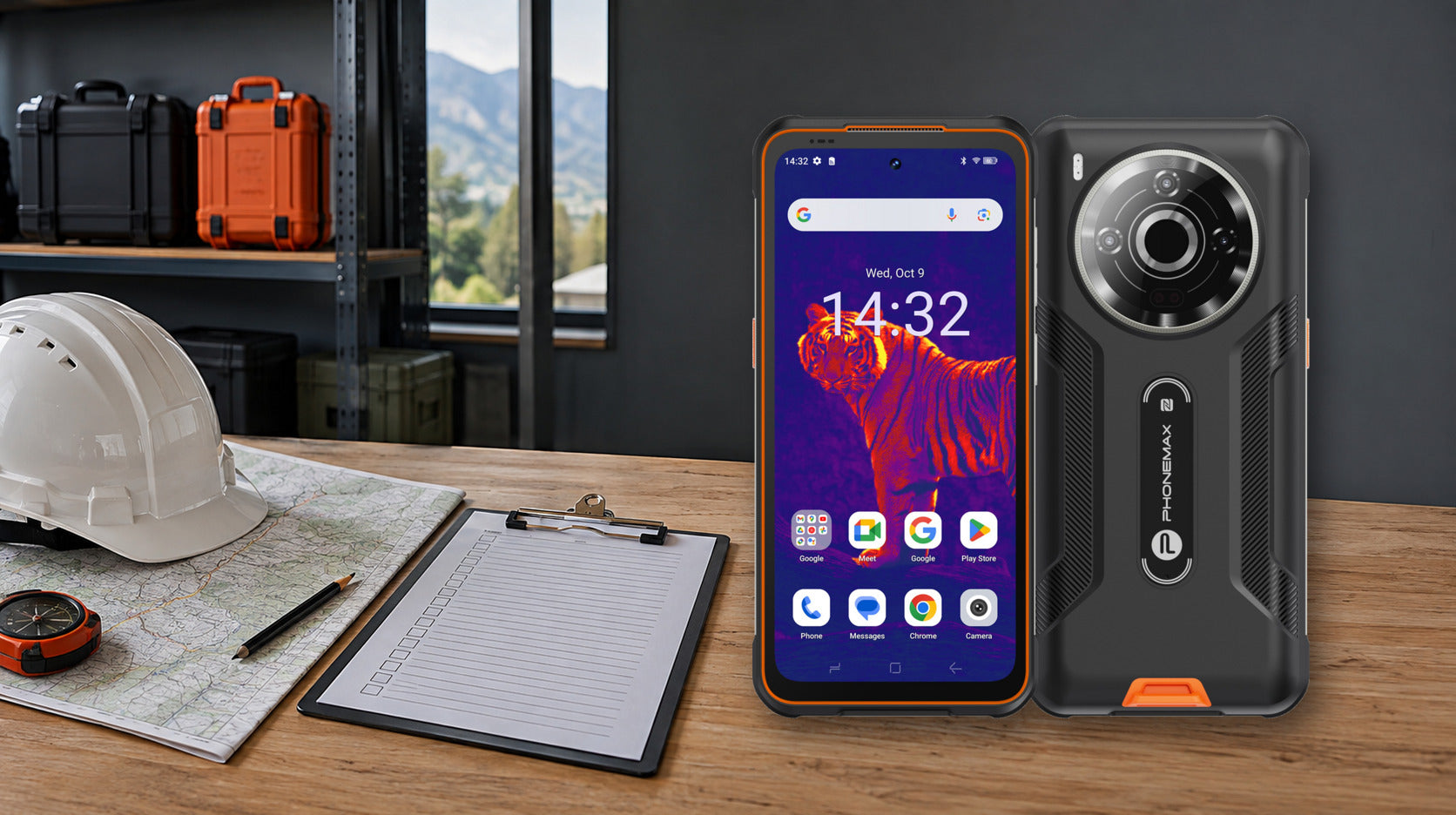
The Phonemax P20 Pro is listed in our current catalog as a flagship thermal-imaging rugged phone. Because this article is published by Phonemax, this is a manufacturer example rather than an independent recommendation.
The model illustrates the main reason to integrate thermal imaging into a rugged phone: one field device can combine communication, ordinary photography, work apps and thermal screening. Buyers should still verify the P20 Pro’s current thermal specifications and whether they meet the accuracy, range and workflow requirements of the intended job before purchase.
Thermal imaging or night vision?
These features solve different problems. Thermal imaging is useful when the important information is a temperature pattern. Infrared-assisted night vision is useful when the user wants to see surface detail in very low visible light. FLIR’s explanation of thermal imaging versus night vision makes the distinction clear: thermal systems form images from thermal energy, while night-vision systems rely on reflected light or active near-infrared illumination.
If you need to find an overheating component, thermal imaging is the relevant tool. If you need to read a label or document an object in darkness, night vision may be more useful.
A simple decision test
- Do temperature differences help you solve a problem you encounter every week?
- Do you need quick screening and documentation more than laboratory-grade measurement?
- Would carrying one integrated device materially simplify the workflow?
If the answer is yes to all three, a thermal-imaging rugged phone may be worth the premium. If you only expect to use the feature occasionally, a standard rugged phone—or a dedicated thermal tool used only when needed—may be the better value.
Limitations of this guide
This article explains general thermal-imaging principles and buying criteria. It does not validate the measurement performance of every phone sensor, and it does not establish whether a particular device satisfies a regulated inspection procedure. Check the exact model specification, calibration information and workplace requirements before relying on thermal measurements.
Bottom line
Thermal imaging on a rugged phone is not a gimmick when it supports a real inspection workflow. Its strongest advantage is convenience: screening, documentation and communication can happen on the same field device. But the feature is most useful when users understand its measurement limits and know when a professional calibrated instrument is still required.
Two related checks are What Should Search-and-Rescue Teams Look for in a Rugged Phone? and What Should Agricultural Equipment Operators Look for in a Rugged Phone?.
FAQ
Can a thermal phone see through walls?
No. It primarily detects the thermal pattern of the surface facing the camera. A hidden issue may influence that surface temperature, but the camera is not seeing through the wall.
Can thermal imaging detect a water leak?
It can reveal temperature patterns that may be associated with moisture or evaporation and help guide further inspection. It does not prove the cause by itself.
Are thermal phones useful for electricians?
They can be useful for screening and documenting unusual heat patterns, but they do not replace electrical testing, safe work procedures or qualified interpretation.
Is a thermal phone as good as a professional thermal camera?
Not necessarily. Dedicated instruments may provide better resolution, sensitivity, optics, calibration, measurement ranges and reporting tools.
What is more important: thermal resolution or accuracy?
They answer different questions. Resolution affects spatial detail, while accuracy relates to quantitative temperature measurement. The right priority depends on whether you are screening for patterns or making measurement-based decisions.
Independent Phonemax thermal-imaging demonstrations
For model-specific context, TechRadar Pro evaluated the R4GT’s thermal-imaging and night-vision functions, and GSMaholic’s R4GT video review visually demonstrates those features. They are useful evidence that the functions exist and can be observed on the reviewed unit; neither source replaces calibration data, a laboratory certificate or task-specific validation.
Sources and verification
- FLIR — Can Thermal Imaging See Through Walls?
- FLIR — Thermal Imaging vs. Night Vision
- NIST — Calibration and Measurement Procedures for a High Magnification Thermal Camera
- U.S. Department of Energy — infrared imaging for building-envelope auditing
Next step: before paying for a thermal phone, define the target, distance, expected temperature range, required accuracy and how the image will be used in the work process.
Relevant Phonemax thermal-imaging examples
The Phonemax P20 Pro and Phonemax R4 GT are the current first-party models explicitly sold with thermal imaging. The P20 Pro is the larger flagship-format option; the R4 GT page lists a 190g body and combines thermal imaging with night vision in a compact format. Neither product name alone proves measurement accuracy for your application. Before buying, request the current sensor specifications, temperature range, accuracy statement, image-storage workflow and calibration guidance, then test the exact model against a known reference during a returnable pilot.
A measurement-safe workflow
- Define whether the task is qualitative screening or quantitative measurement.
- Check thermal resolution, accuracy statement, range, focus, field of view and app controls.
- Document target material, emissivity setting, distance, angle and environmental conditions.
- Confirm anomalies with the appropriate instrument and procedure before a safety or maintenance decision.
FLIR’s explanation of how thermal cameras work supports the distinction between surface temperature patterns and visible imagery. Its guidance on common inspection mistakes shows why reflections, emissivity and context matter.
Professional-use limitation: An integrated thermal camera can help locate and document patterns, but this article does not validate a phone for electrical safety, medical screening, regulatory inspection or calibrated measurement.
Editorial method and trust notes
How we prepared this guide: The Phonemax Editorial Team separated standards-based facts, manufacturer specifications and practical decision guidance. Standards claims are linked to the issuing organization or an official record; category guidance is presented as a framework readers can reproduce with their own device, environment and workload.
Review scope: Source alignment, commercial disclosure, limitations, internal consistency and claim-to-source proximity were reviewed on August 10, 2026. This editorial review is not a substitute for a laboratory certificate, a site safety assessment or advice from a qualified professional.
Corrections: Specifications, standards and software policies can change. Readers should verify the current model page, test report, warranty and support policy before purchase. If a material error is identified, Phonemax should update the article and review date.

Laisser un commentaire
Tous les commentaires sont modérés avant d'être publiés.
Ce site est protégé par hCaptcha, et la Politique de confidentialité et les Conditions de service de hCaptcha s’appliquent.