
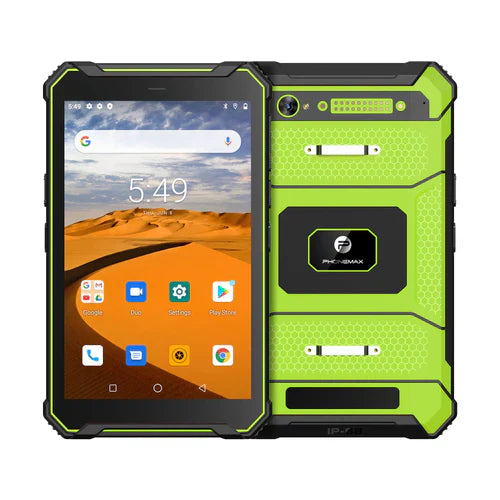
A rugged vehicle tablet with a 128GB storage target should be specified as a complete fleet system, not as a storage number alone. The deployment must also account for vehicle power, mounting, vibration, sunlight, GNSS, cellular connectivity, software management and data retention.
This guide treats 128GB as a project configuration target. Confirm the exact storage option and hardware platform before purchasing.
1. Decide why the vehicle workflow needs 128GB
Vehicle applications may retain offline maps, route data, inspection photos, proof-of-service records, manuals and application databases. Estimate daily data creation and how long records remain on the device before synchronization or deletion. A storage budget prevents over- or under-specifying the fleet.
2. Check usable capacity after fleet software is installed
Android, navigation software, MDM agents, offline maps and company applications reduce the free space available to users. Measure usable capacity on the final production image, not on a clean engineering sample.
3. Vehicle power and charging are part of the design
Define whether the tablet uses 12V or 24V vehicle power, how ignition switching is handled and what protection is required for voltage transients. If the internal battery provides backup operation, verify charging behavior across the expected temperature range.
4. Mounting changes vibration, heat and antenna performance
Test the tablet in the intended mount. Dashboard installations can face high solar load, while forklifts and industrial vehicles may expose the unit to continuous vibration. The mount can also affect GNSS and cellular antenna performance.
5. Verify GNSS and regional connectivity
Confirm the positioning systems and cellular bands required in every deployment market. Test GNSS accuracy and data connectivity with the real vehicle, mount and case. If external antennas or peripheral interfaces are required, include them in prototype testing.
6. Display usability matters in fleet environments
Outdoor and in-cab applications may need high brightness, anti-glare performance and glove-friendly touch. Test sustained brightness and touch behavior under the actual temperature and lighting conditions rather than relying only on a peak-nit specification.
7. Manufacturer and OEM/ODM questions
For a fleet project, ask the supplier for a complete configuration and validation plan. Manufacturer, OEM and ODM labels are less important than whether the hardware, software, accessories and lifecycle support match the deployment.
- Available internal-storage and RAM configurations
- Usable capacity after the final software image
- 12V/24V power and ignition behavior
- Mount and vibration requirements
- GNSS and regional cellular bands
- Wi-Fi, Bluetooth, NFC and peripheral interfaces
- Android version, kiosk mode and MDM support
- Temperature, ingress and drop validation
- Component lifecycle and change-control policy
- Accessory and spare-part availability
8. Pilot the complete fleet workflow
Run engineering samples in real vehicles before volume deployment. Include navigation, cellular data, mounting, ignition cycles, charging, high-brightness display use and expected data capture. Measure how quickly storage grows during the pilot and confirm that the 128GB target leaves adequate future margin.
FAQ
Is 128GB enough for a vehicle tablet?
It can be for many navigation and fleet workflows, but offline maps, photos, video and retention rules determine the actual requirement.
Is a vehicle tablet manufacturer page different from an ODM page?
The commercial scope can differ, but for technical selection the important factors are the available platform, customization scope, validation evidence and lifecycle support.
Should vehicle accessories be validated with the tablet?
Yes. The mount, power adapter, dock, antennas and peripherals can affect reliability and should be part of the pilot.
See Phonemax product options. For a vehicle-tablet project, contact Phonemax with the storage target, vehicle type, power system, mount, regional bands and software requirements.

Leave a comment
All comments are moderated before being published.
Ezt a webhelyet a hCaptcha rendszer védi, és a hCaptcha adatvédelmi szabályzata, valamint szolgáltatási feltételei vonatkoznak rá.