
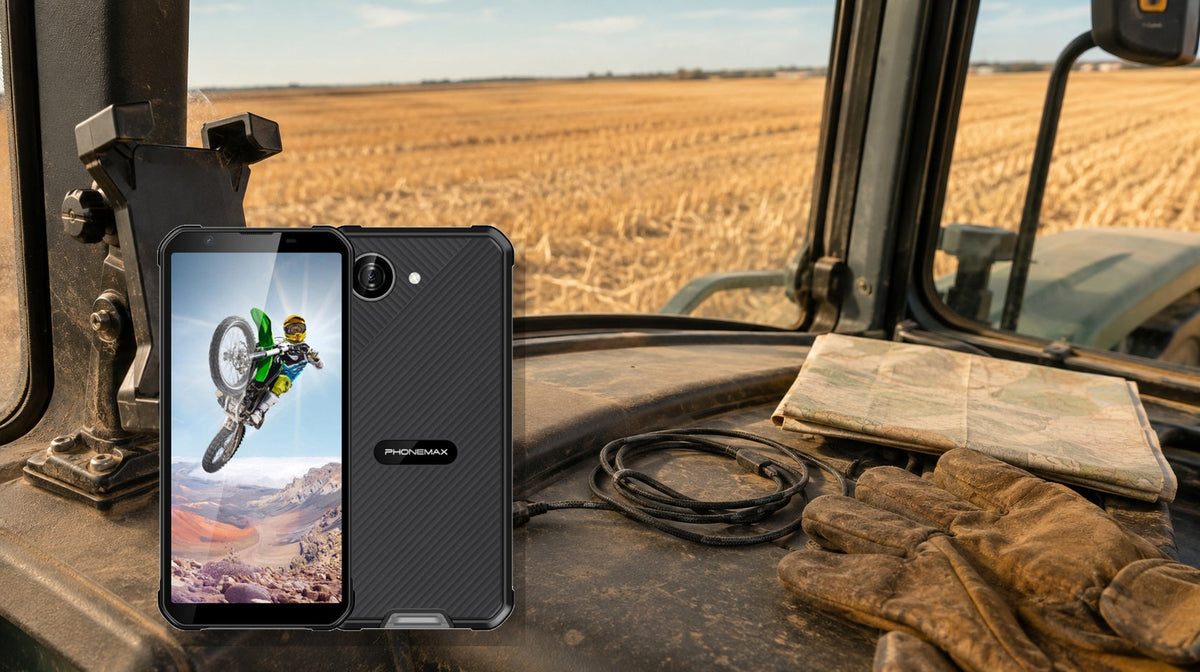
Agricultural equipment operators should prioritize a secure mount, sunlight-readable display, dust and mud resistance, loud but clear alerts, offline maps and records, practical battery life and strict distraction controls. The phone must not obstruct visibility, interfere with controls or encourage interaction while machinery is moving. Test the complete cab-and-app system before buying a fleet.
For the closest comparison, see Who Actually Needs GPS Accuracy?.
Start from agricultural hazards
Farm machinery combines vibration, dust, glare, mud, long shifts, large blind areas and seasonal urgency. A rugged label addresses only part of that environment. Mount failure, poor network coverage, unreadable screens and unsafe operator behavior can be more consequential than cosmetic damage.
OSHA advises pre-operational equipment checks, following operator manuals, remaining at the controls while equipment is moving and keeping steps free of mud. Its farm-vehicle backover guidance tells employers to keep personal mobile phones and other distractions out of active vehicle operations. A device policy must support those controls.
Pre-purchase questions
Mounting and vibration
Does the phone remain locked in its mount on rough ground? Can the mount be positioned without hiding mirrors, displays or field view? Is the power cable strain-relieved?
Dust, mud and cleaning
What ingress conditions are documented? Can port covers be opened with dirty hands without packing soil inside? What cleaning agents are allowed?
Display and control
Can the operator read the route, work order or implement record in direct sun? Can critical tasks be completed while stationary with normal work gloves?
Connectivity and offline function
Does the farm app store boundaries, tasks and safety documents locally? What happens when sync fails for half a shift?
Audio
Are alerts understandable in a running cab while still allowing the operator to hear machinery warnings? Louder is not automatically safer.
Reproducible stationary-cab test
Park the equipment on level ground, lower implements, set the brake, shut down as required by the operator manual and secure the key. Install the phone and run a 20-minute stationary workflow: open an offline field map, load a work order, photograph an equipment label, enter a note with gloves, receive a test alert and connect the charger.
Then, with an authorized evaluator—not the operator—observe mount stability during a controlled low-speed test on representative ground. The operator must not touch the phone while moving. Record mount movement, screen glare, cable strain, false inputs, app failures and battery temperature.
Decision table
| Requirement | Pass evidence | Reject when |
|---|---|---|
| Safe mount | Stable, no blocked sightline/control | Device moves or obstructs view |
| Offline workflow | Map and task complete without service | Critical data disappears offline |
| Outdoor display | Readable at planned position | Operator must hold device while moving |
| Cleaning | Approved method and intact covers | Cleaning exposure is undocumented |
| Alerts | Clear but not masking safety cues | Operator misses machine warnings |
| App performance | No restart/data loss in workflow | Records fail during sync loss |
Phonemax X5 as a first-party candidate
Phonemax publishes this guide. The Phonemax X5 lists a 5.3-inch display, 238 g body, Android 16, 5000mAh battery and IP68/IP69K. Its compact format may simplify cab mounting and pocket carry. The T615 Full-Band variant lists a large speaker; the G81 variant does not. Carrier bands, farm-app compatibility, MDM, mount fit and vibration behavior remain buyer tests.
The page does not publish a direct-sun luminance value, agricultural vibration result, chemical-resistance table or glove-control specification. Do not infer them from the rugged category.
When another device is better
Large equipment guidance, split-screen mapping or detailed service manuals may justify a rugged tablet mounted for stationary use. A radio may be better for urgent team communication. A dedicated GNSS receiver may be required for precision agriculture. The phone should complement these systems, not claim their accuracy or safety role.
Two related checks are How Does Three-Year Total Cost of Ownership Change the Business Case for Rugged Devices? and How Should You Evaluate All-Day Gps Battery Drain Before Buying a Rugged Phone?.
FAQ
Can an operator use the phone while driving a tractor?
No handheld interaction should occur while machinery is moving. Configure the workflow for safe, stationary use.
Does IP69K mean pressure-washer cleaning is always permitted?
No. Follow the exact manufacturer conditions and cleaning instructions; damaged seals and port covers change protection.
Is a smartphone GPS accurate enough for precision agriculture?
Typically not without appropriate augmentation and validated equipment. Use dedicated systems where the task requires them.
Should a phone be part of the pre-operation check?
Yes: verify mount, cable, offline data, battery, emergency contacts and that it does not obstruct controls or visibility.
Sources:
Next step: Add the phone, mount, offline data and charging cable to the stationary pre-operation inspection.

Hozzászólás írása
Minden hozzászólást moderálunk a közzététel előtt.
Ezt a webhelyet a hCaptcha rendszer védi, és a hCaptcha adatvédelmi szabályzata, valamint szolgáltatási feltételei vonatkoznak rá.