
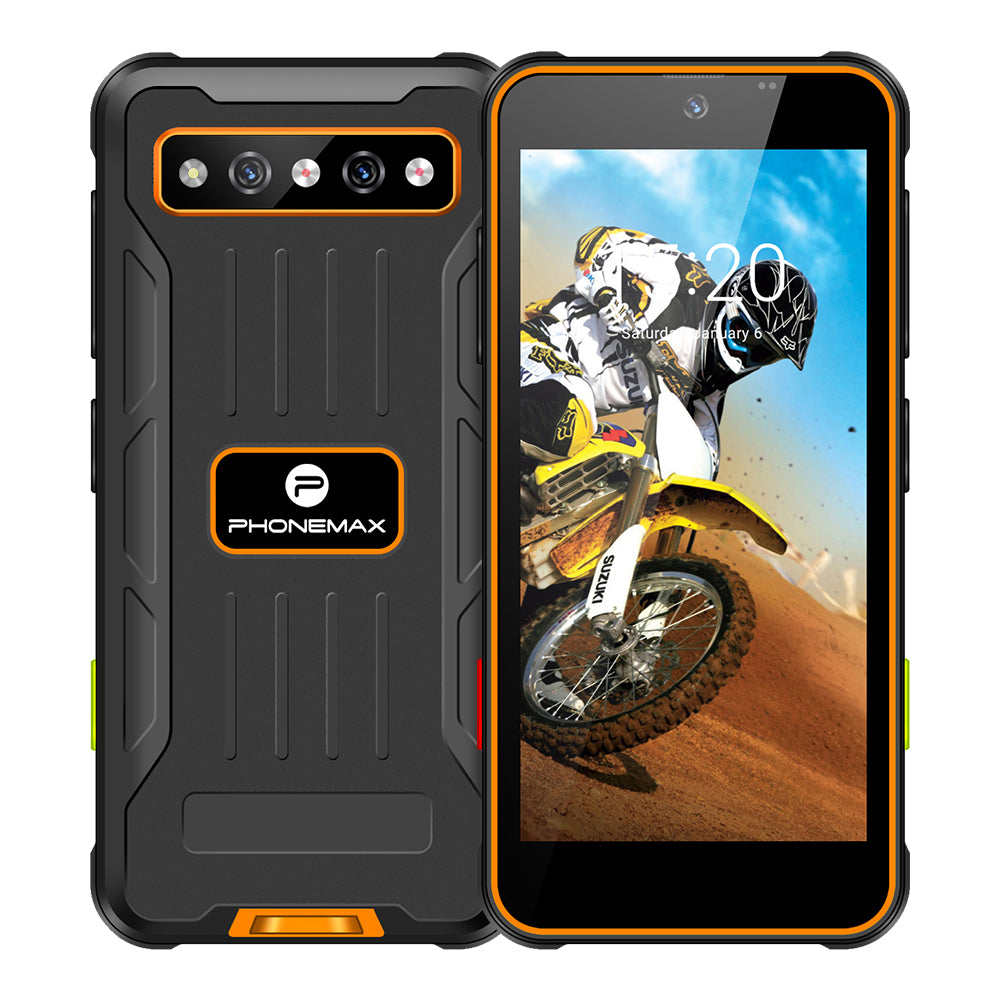
A rugged phone will work with your carrier only when its exact hardware version supports the network requirements of that carrier and location. Compare the phone’s published bands with the operator’s information, then confirm calls, SMS, VoLTE and mobile data before a full deployment.

This matters for Phonemax models with regional options. The R4 Mini publishes separate Europe and US/Americas configurations, while the R4 GT publishes its own 4G, 3G and 2G band list. Do not copy the bands from one model or regional option to another.
“Unlocked” does not mean universal
An unlocked phone may accept a SIM from another operator, but that does not guarantee compatible LTE or 5G bands, voice service, VoLTE registration, carrier device approval or coverage in the locations where you work.
The practical rule is: check the exact network version, not just the product title.
The information to collect first
- Your country and operating region
- The exact carrier name
- The exact Phonemax model
- The regional version shown on the product page
- Whether you need data, calls, SMS, VoLTE, hotspot or roaming
Step 1: Find the official band list
Use the official product page or manual rather than a shortened retailer title.
The Phonemax R4 Mini currently publishes:
- Europe 4G: FDD B1, B3, B5, B7, B8, B19, B20, B28A, B28B; TDD B38, B40, B41.
- US/Americas 4G: FDD B2, B4, B5, B7, B17, B28A, B28B.
The R4 GT publishes a separate 4G list including FDD B1, B2, B3, B4, B5, B7, B8, B12, B13, B14, B17, B18, B19, B20, B25, B26, B28A, B28B, B66 and B71, plus TDD B34, B38, B39, B40 and B41. It also lists 3G and 2G bands on its product page.
These are model-specific published lists. They are not a universal Phonemax band profile.

Step 2: Compare the carrier’s bands
Use the operator’s official coverage, compatibility or device-check resources for the locations where the phone will be used.
- Bands used at your home or work address
- Low-frequency bands used for broader or indoor coverage
- Capacity bands used in busy areas
- Any band or device requirement for voice service
- The operator’s IMEI or device-approval result, if offered
A band match shows technical potential, not guaranteed coverage. Signal conditions, congestion, roaming rules and network changes still affect service.
US carrier checks: Use the carrier's own compatibility process before ordering. AT&T explains its BYOD compatibility check, and Verizon provides an IMEI-based BYOD checker. Carrier approval can still depend on the exact device identifier, software and service configuration.
Step 3: Check voice service separately
Mobile data can work while voice service does not. Ask the carrier whether the exact model and IMEI support mobile data, voice calls, SMS and MMS, VoLTE where required, and hotspot or tethering if needed for work.
This is especially important when deploying phones for field teams. A device that can open a webpage but cannot reliably make a required work call is not deployment-ready.
Step 4: Select the correct regional version
Choose the regional option based on the network where the phone will actually operate, not simply the buyer’s nationality or shipping address.
For travel across regions, check both the home carrier and destination network. For a team purchase, record the chosen version next to each country or operator in the deployment plan.
Step 5: Test a sample before a bulk order
- Save the exact model and regional configuration.
- Ask the carrier to verify the model or IMEI where possible.
- Activate the intended SIM in a sample device.
- Test calls, SMS and mobile data.
- Verify VoLTE and hotspot requirements.
- Test at the actual work locations.
- Keep the model label and order record until testing is complete.
Compatibility worksheet
| Check | What to record | Why it matters |
|---|---|---|
| Phone model | Exact name and variant | Prevents mixing model-specific bands |
| Regional version | Europe or US/Americas, where applicable | Versions may use different bands |
| Carrier | Operator and country | Operators use different band combinations |
| Data bands | Matching LTE bands | Indicates potential data access |
| Voice support | VoLTE and carrier approval | Data access does not guarantee calls |
| SIM requirements | SIM type, activation and plan | Prevents setup failures |
| Field test | Calls, SMS, data and location test | Confirms real deployment conditions |
What if only some bands match?
Partial overlap increases uncertainty. The phone may work well in one location and poorly in another, particularly indoors or outside major population centers.
Ask the carrier which bands are important for your location and whether the device passes its own compatibility check. For professional deployment, test the phone where it will actually be used rather than relying only on a theoretical band comparison.
Bottom line
Carrier compatibility is a model-and-region question. Check the official band list, compare it with the operator’s network, confirm voice requirements and test a sample before a larger purchase.
The Phonemax R4 Mini and R4 GT pages publish model-specific network information. The correct choice still depends on your carrier and operating region.
Related guides
- Choose a small rugged phone after confirming the correct carrier-compatible version.
- Compare thermal imaging and night vision for field inspection requirements.
Frequently asked questions
Does an unlocked rugged phone work with every carrier?
No. Unlocked status does not guarantee matching frequency bands, voice support, VoLTE or carrier approval.
Which R4 Mini version should I choose?
Choose the Europe or US/Americas version according to the network where the phone will be used. Compare the published bands with your exact carrier before ordering.
Is a band match a guarantee of coverage?
No. Coverage also depends on signal strength, network capacity, congestion, roaming policy and local conditions.
Do I need to check VoLTE?
Ask your carrier. Some networks require VoLTE or device approval for voice calls even when mobile data bands appear compatible.
How should a business test rugged phones before a bulk purchase?
Test a sample with the intended SIM, calls, SMS, mobile data, VoLTE and the actual work locations before committing to the full quantity.

Leave a comment
All comments are moderated before being published.
Ezt a webhelyet a hCaptcha rendszer védi, és a hCaptcha adatvédelmi szabályzata, valamint szolgáltatási feltételei vonatkoznak rá.