
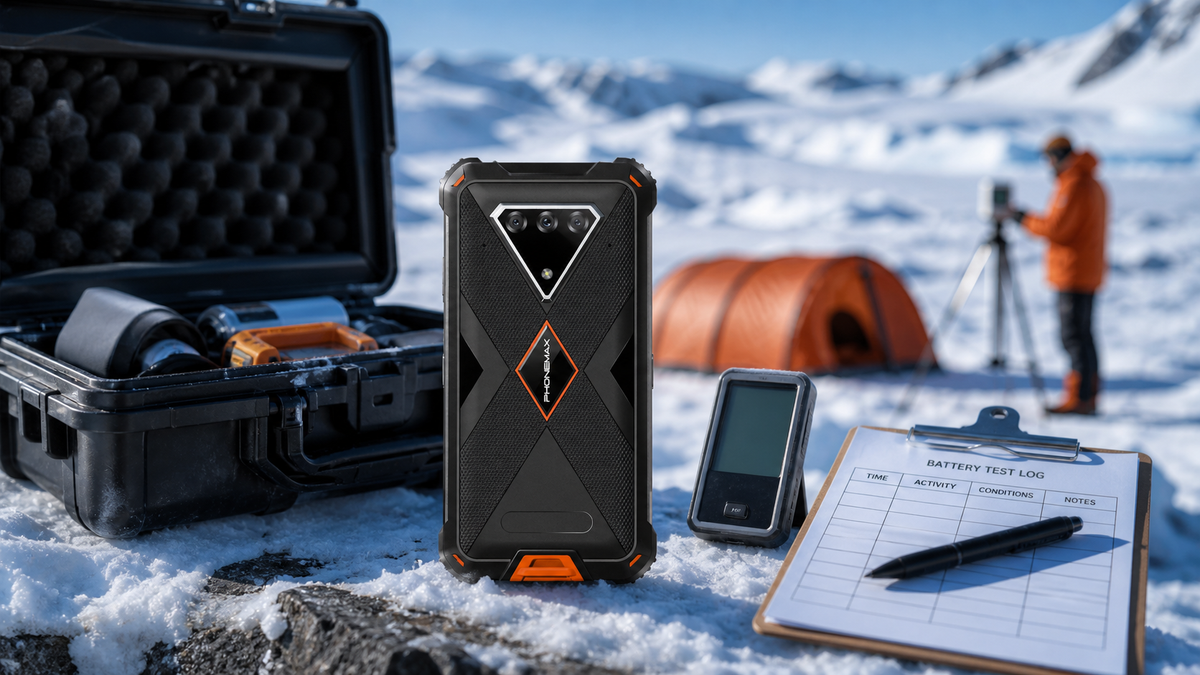
Author and review: Phonemax; review batch D, completed 2026-08-20. This article specifies a repeatable experiment but reports no invented runtime result. Commercial context: The M10 is a candidate here because Phonemax publishes the guide and sells the device. Its product page does not establish cold-weather runtime for the proposed workload.
Test rule
Test cold-weather battery life by running the same workload at a controlled room temperature and at the expected field temperature. Record starting temperature, signal strength, screen brightness, navigation activity, camera use, elapsed time and remaining charge. One cold run is not enough; repeat it and measure recovery after the phone warms naturally.
Why cold-weather runtime is not a single specification
Battery percentage is an estimate influenced by cell temperature, load and software. Navigation, weak signal, high screen brightness and video can increase demand at the same time cold conditions reduce available performance. A large advertised capacity therefore does not answer how long a device will last on a winter shift.
The Phonemax M10 is presented as a full-size rugged phone with broad published 4G support and fast charging. Its page does not publish a standardized cold-runtime result, so buyers should test the intended regional unit and workload.
This page owns controlled cold-discharge and runtime measurement. For the opposite failure mode—hot-vehicle storage, solar heating and charging limits—see the hot-vehicle exposure risk checklist.
Repeatable two-condition test
| Control | Warm run | Cold run |
|---|---|---|
| Starting charge | 100% | 100% |
| Apps and account | Same | Same |
| Screen brightness | Fixed | Fixed |
| Network/SIM | Same | Same |
| Route or workload | Same | Same |
| Accessories | Same | Same |
Run a representative 60–120 minute cycle: navigation, periodic photos, ten minutes of calls or PTT, data synchronization and the actual screen-on pattern. Log charge every 15 minutes. Repeat each condition at least three times when the purchase affects a fleet.
Stop conditions
Stop the test if the battery swells, the enclosure separates, the device becomes unsafe to handle, charging behaves abnormally or the manufacturer’s stated operating limit is crossed. Never cool a phone using water, ice or an uncontrolled freezer test.
Lithium-ion systems need temperature controls during charging and discharging. The U.S. Consumer Product Safety Commission's battery-safety materials address overheating, fire and related protection standards. They support the conservative stop rule, but they do not establish an M10 operating range; only the model documentation can do that.
How to interpret the result
Use the median drain rate, not the best run. Add operational margin for ageing, unexpected calls and weaker field signal. If the calculated shift runtime leaves less than 20–30% reserve, change the workflow, add approved power options or reject the unit for that role.
Reading the results
Does a higher mAh number guarantee better winter runtime?
No. Capacity matters, but temperature, software, radio conditions and workload also affect usable runtime.
Should the phone be charged while it is very cold?
Follow the manufacturer’s temperature and charging instructions. Do not assume that discharge and charging limits are identical.
What should a procurement report include?
Device variant, software build, battery age, temperatures, signal conditions, workload, raw logs, failures and median results.
Use the result: Add the median drain and reserve threshold to the fleet pilot decision sheet.
If communications are mission-critical, repeat the PTT-versus-radio failure test under the same temperature and signal conditions.
Sources: Android guidance on location and battery; CPSC high-energy-density battery safety; Phonemax M10 product page

コメントを書く
全てのコメントは、掲載前にモデレートされます
このサイトはhCaptchaによって保護されており、hCaptchaプライバシーポリシーおよび利用規約が適用されます。