

By Phonemax Editorial Team · Reviewed 2026-08-14
Disclosure: Phonemax produces and sells rugged devices. Product references are first-party examples, not independent rankings. No hands-on testing is claimed unless a reproducible test protocol is explicitly presented for readers to perform.
Direct answer: First-time buyers need a rugged phone when repeated exposure to water, dust, drops or long periods away from charging creates meaningful failure cost—and a standard phone plus case has not controlled that risk. If exposure is rare and replacement is easy, a conventional phone with a suitable case may be lighter, cheaper and sufficient.
Score exposure and consequence separately
For the previous 90 days, count phone drops, wet exposures, dust-heavy shifts, charging interruptions, broken ports and device-related missed tasks. Then rate the consequence of a failure: inconvenience, lost work, safety impact, customer delay or replacement cost.
Do not buy “rugged” because the environment sounds demanding. Buy it when the documented exposure and consequence justify the trade-offs in weight, thickness, price, camera performance, accessory choice or repairability.
First-time buyer decision table
| Evidence | Better starting point |
|---|---|
| Rare exposure; low failure cost | Regular phone plus suitable case |
| Frequent drops/water/dust; repeated damage | Rugged-phone pilot |
| Explosive or regulated environment | Purpose-certified device; ordinary rugged phone is insufficient |
| Remote work with communication consequence | Rugged device plus redundant power/communication plan |
| Specialized scanning, thermal or radio task | Purpose-built professional device |
A 7-day use audit
Carry the current setup for seven representative workdays and log each exposure, near miss, charging event, task failure and workaround. Photograph the carry position and mounts. At the end, calculate device-caused minutes lost and estimate the annual cost. Use the same record during a candidate rugged-phone trial.
Stop the rugged purchase if the problem is actually poor coverage, a bad app, an unsafe workflow or an unsuitable mount. A stronger enclosure will not fix those causes.
How the Phonemax X5 fits
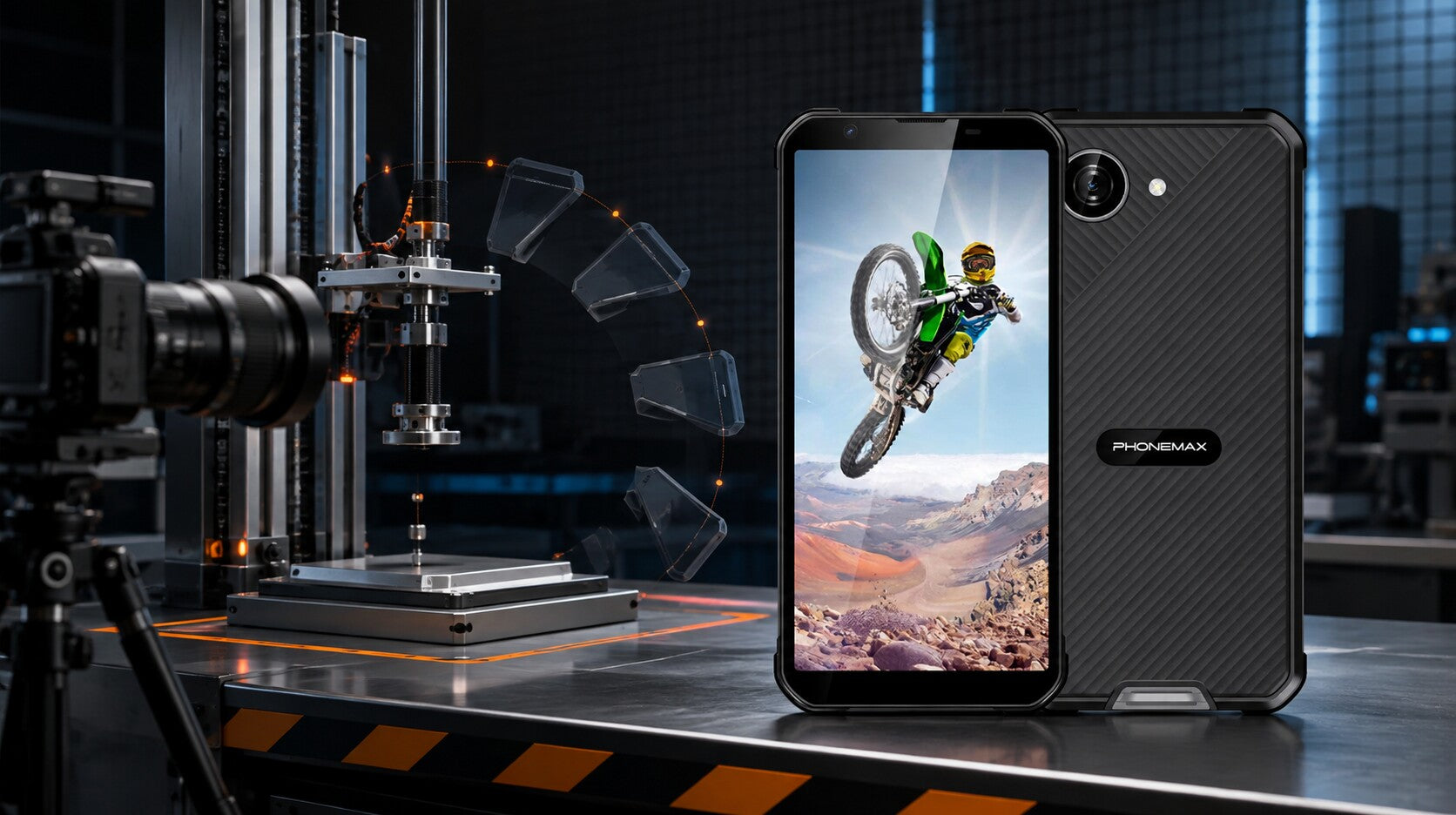
The X5 is a compact rugged candidate with a published 5.3-inch display, 238g body, 5,000mAh battery, Android 16 and IP68/IP69K claims. Buyers still need to compare its exact version, bands, size, app support and documented protection conditions with their audit. It is not automatically necessary because it is rugged.
Limitations
No consumer device is indestructible. Ingress protection can decline with wear or damage, and covers must be used as instructed. “Rugged” is not equivalent to intrinsically safe, ATEX-certified or approved for hazardous locations.
Frequently asked questions
Is a rugged phone better than a case?
It can integrate protection more comprehensively, but the better choice depends on measured exposure, serviceability and total cost.
Who should not buy one?
Users with low exposure who prioritize the lightest body, flagship camera or broad accessory ecosystem may prefer a standard phone.
Does IP68 mean waterproof forever?
No. It describes tested ingress conditions, and protection may decrease with wear or damage.
What should I compare in person?
Pocket fit, weight, controls, display, camera task, carrier connection, charging and required apps.
Next step: Run the audit, then review the X5’s exact version and published limits.
Source note: Product page checked 2026-08-14. The audit is an editorial decision tool, not a durability certification.


コメントを書く
全てのコメントは、掲載前にモデレートされます
このサイトはhCaptchaによって保護されており、hCaptchaプライバシーポリシーおよび利用規約が適用されます。