

Use infrared night vision to locate nearby objects and judge outlines in darkness; choose visible light for reliable colour or fine-print checks, and thermal imaging for temperature patterns. It is useful for checking emergency supplies during a power outage, packing fishing equipment after dark, inspecting a parked vehicle or observing a pet in a garden.
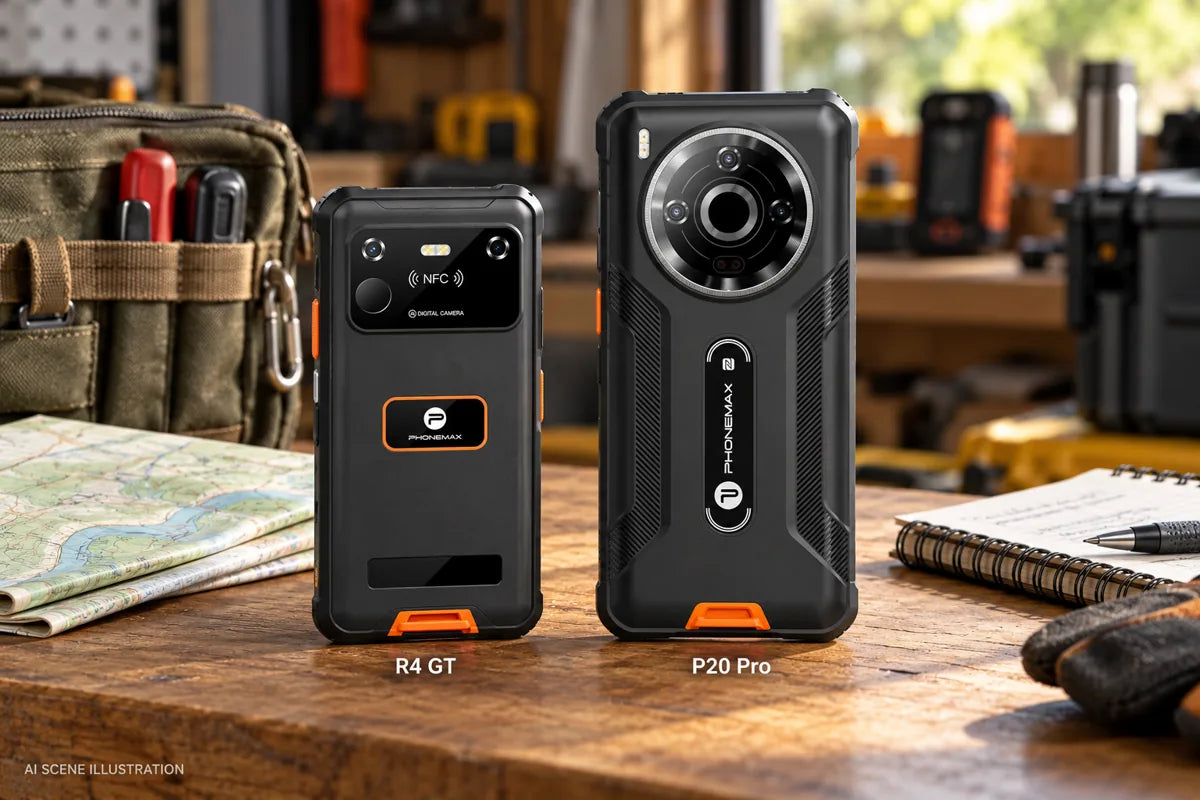
Looking for a phone with this feature? Browse Phonemax phones with infrared night vision. Start with R4 Mini for a light 150g body or R4-T for a compact phone with a rear status display. Their small bodies suit everyday carry; R4 GT shares R4-T's 190g weight and dimensions if you also need thermal imaging. The six-model Phonemax buying guide compares prices and hardware separately.
What is infrared night vision?
An active near-infrared system illuminates the scene with IR light and records the reflection. In darkness, this generally produces a black-and-white view, rather than a colour photograph. See Axis's infrared imaging explanation.
| Mode | Information you get | Best starting question |
|---|---|---|
| Ordinary night mode | A processed photograph using available visible light | Can I take a brighter evening photograph? |
| Infrared night vision | Monochrome outlines, texture and movement | What is in this dark area? |
| Thermal imaging | Heat patterns associated with surface temperature | Where is an unusual temperature pattern? |
A night-vision app can control compatible hardware. It cannot add an infrared camera and illuminator to a phone that lacks them.
Four practical tasks where night vision can help
1. Power outage: locate emergency supplies
Situation: The lights go out and you need to locate the emergency box and torch on a hallway table.
What to check: Stop moving and steady the phone, resting it on a stable surface if practical. Frame the table and identify the box and torch before reaching for them. Lower the phone before moving; do not walk while watching the screen.
Useful outcome: A quick check can help you find your lighting equipment. Once found, use the torch for movement and hands-on tasks. Night vision complements your emergency kit.
2. Night fishing: finish an equipment inventory
Situation: Before leaving your fishing spot, you want to check the landing net, tackle box and rod straps on the bank.
What to check: Hold the phone steady and compare the gear on dry ground against your packing list. Start with the large outlines of the net and tackle box, then inspect straps and smaller details. Keep reflective water and shiny metal out of the centre of the view; shift the angle if glare hides an item.
Useful outcome: The task is preventing forgotten gear. Use visible light when handling hooks or checking colour-coded tackle. This is a bank-side equipment check, not a way to detect fish underwater.

3. Parked vehicle: inspect a loose strap
Situation: At camp, a luggage strap beside the rear storage area appears to be hanging loose.
What to check: With the vehicle safely parked, frame the strap, buckle and adjacent luggage. Keep nearby windows and glossy paint out of the main view. If a bright reflection obscures the strap, move a little to one side and compare it from a second angle before approaching.
Useful outcome: You can identify where a closer check is needed. Use appropriate lighting to adjust the strap; use thermal imaging if the question concerns heat rather than visible position.

4. Campsite or garden: check layout and movement
At camp: Locate bags and guy ropes beside the tent entrance.
In the garden: Identify movement beside a planter.
What to check: Start with a wide, steady view. Establish the position of fixed objects, then watch for a changing outline. Reframe around the target rather than sweeping the phone quickly.
Useful outcome: Understand the immediate layout or narrow your pet search before checking directly. Keep a headlamp for walking; solid fences and dense cover still block the view.

Three preparations before you shoot
- Clean the camera window. Use a clean, soft lens cloth to remove fingerprints and moisture that can reduce contrast.
- Choose an angle without strong reflections. Glass, polished metal and other glossy surfaces can reflect the illuminator's light back toward the camera. Reframe before judging the image.
- Steady the phone. Brace your hands, pause your movement and begin with the full object before inspecting smaller details.
These steps apply the reflection principles described in Axis's IR-reflection guidance.
R4 GT night-vision gallery: independent review
Root-Nation's hands-on R4GT review includes a six-image night-vision test gallery and a full-resolution photo/video collection. This is third-party material from a reviewed R4 GT unit, separate from the labelled AI scenes on this page. The published review dates to September 2024; it is a visual reference, not a matched six-model range comparison.
Will the image have colour, and how far will it reach?
| Detail | What you should expect or verify |
|---|---|
| Image colour | Infrared-only imaging generally provides grayscale detail; use the main camera and visible lighting when colour matters. |
| IR wavelength | For everyday use, begin with the target and distance you need. For compatibility with an external IR illuminator, ask for the model's emitter wavelength and supported setup. |
| Effective distance | Recognition distance depends on illumination, optics, target size, reflectivity and movement. Request a model-specific sample for the task you need. |
| Camera resolution | The six Phonemax models in our buying guide list 20MP night-vision cameras; this does not determine their effective range. |
850nm and 940nm are common industry examples. Wavelength affects the illumination and camera response, so these numbers should not be assigned to a Phonemax model without its specification. Axis discusses 850nm, 940nm and grayscale imaging here.
Define “effective” before comparing distance. Seeing an object's presence, identifying it and reading a small label are different tasks. A useful comparison uses the same target, distance and lighting for both the normal camera and night-vision camera.
When ordinary lighting is the better choice
Choose visible lighting for colour identification, fine repair work and moving safely. Choose a normal camera's night mode for colourful evening scenes with some available light. Choose thermal imaging when temperature patterns matter.
For a one-off or occasional check, a torch is usually the simpler choice—including finding supplies during a power outage. Built-in night vision becomes worth considering when you repeatedly need to identify nearby objects in darkness, such as checking fishing gear or camp equipment. Keep visible lighting for walking and hands-on work.
Frequently asked questions
Can it work without visible light?
An active IR system can form an image in darkness when enough infrared illumination reaches the target.
Can night vision measure temperature?
No. Reflected-infrared night vision and thermal imaging capture different information. If temperature patterns are your priority, explore phones with built-in thermal imaging.
Can I use night vision through glass?
Glass can reflect the phone's infrared light back into the camera, causing glare or a washed-out view. Change angle or use an unobstructed viewpoint. Performance through a window depends on the glass, reflections and illumination.
Why can an object look lighter in night vision?
Materials reflect infrared differently from visible light. Do not use grayscale brightness to infer an object's original colour.
Does night vision use more battery?
The camera, infrared illumination and active display all consume power. For longer sessions, lower screen brightness to a comfortable level. You can also try Battery Saver; if it affects the camera, leave it off and simply keep the screen dimmer. Close night-vision mode when the check is finished.
Can I record video in night-vision mode?
Recording options depend on the model and camera app. For a video-based task, ask for an original night-vision clip and confirmation of the available resolution, frame rate and file format for your chosen phone.
Turn your use case into a shortlist
Choose around the task: for compact carry during power-outage supply checks or night-fishing gear checks, start with the 150g R4 Mini. If you also need heat-pattern information, choose the compact R4 GT. For a larger screen or 5G, compare the remaining options in our night-vision phone buying guide.
If image detail decides your purchase, request a relevant night-vision sample. Include the model, target, distance and lighting conditions.
Specifications checked: 20 October 2026. Refer to official product pages for current model details.


发表评论
所有评论在发布前都会经过审核。
此站点受 hCaptcha 保护,并且 hCaptcha 隐私政策和服务条款适用。