
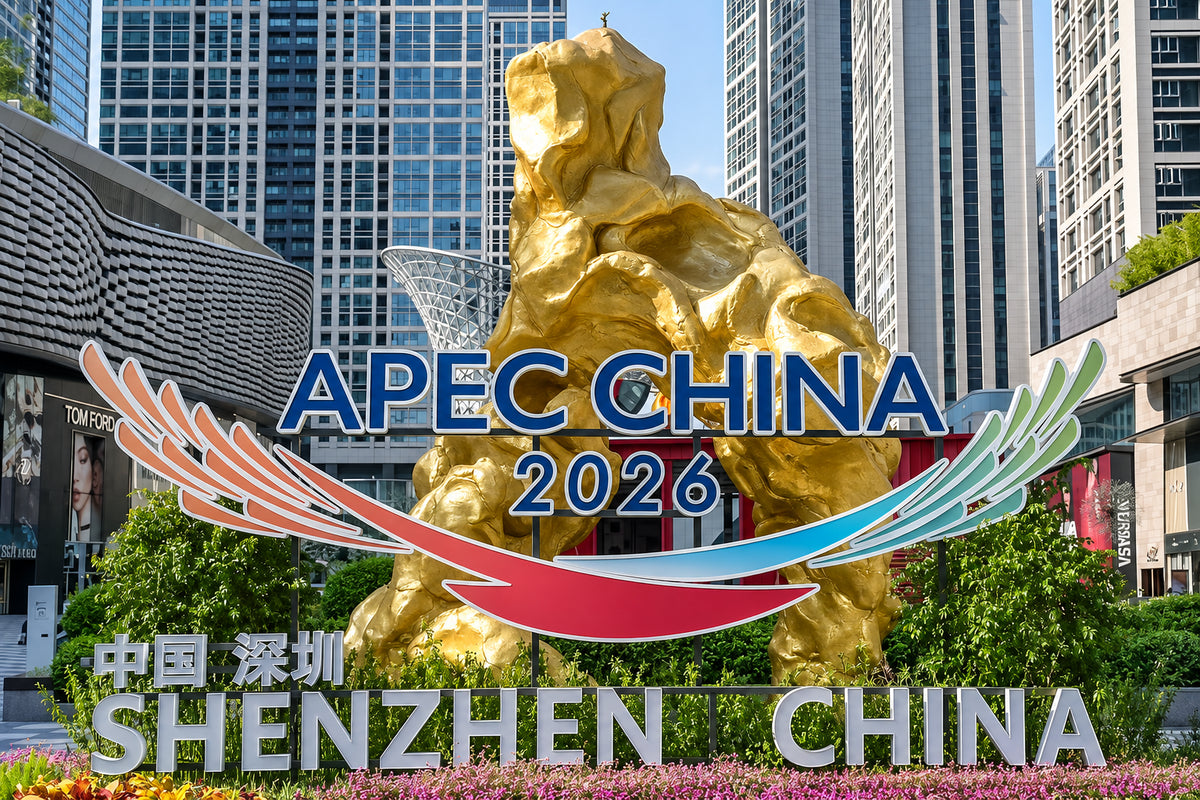
As Shenzhen hosts APEC meetings in November 2026, regional connectivity has a practical meaning for businesses: people, goods and information need to move between locations, and employees need usable tools at each step.
For teams maintaining equipment, reviewing work orders or documenting conditions on site, mobile hardware is one part of that connection. Phonemax’s P20 Pro, R4 GT and T1 address different needs within these workflows, from portable thermal observation to larger-screen document handling.
The starting point is the work itself: what an employee needs to see, record and share.
APEC 2026 in Shenzhen: Dates, Theme and Business Priorities
The APEC CEO Summit takes place on November 17–18, 2026, followed by the APEC Economic Leaders’ Meeting on November 18–19, in Shenzhen. The meetings bring regional economic cooperation and business discussions into the city during APEC Economic Leaders’ Week. See the official APEC event calendar.
China’s APEC 2026 theme is “Building an Asia-Pacific Community to Prosper Together.” Its three priorities are openness, innovation and cooperation, with work covering regional economic integration, connectivity, the digital economy and artificial intelligence.
The CEO Summit’s business agenda includes Asia-Pacific free trade, connectivity, AI, the digital economy, the Guangdong–Hong Kong–Macao Greater Bay Area and sustainable development. These subjects connect regional policy with decisions about investment, technology and business operations.
For companies following APEC, an important question is how these discussions translate into practical capabilities: exchanging information across locations, introducing useful technology and helping employees work with consistent records.
Why Shenzhen Makes the Connection Relevant
Shenzhen brings international trade and technology development into the same setting. APEC’s introduction of the 2026 agenda described the city as a global innovation hub and linked its experience with opportunities for regional technological cooperation.
Phonemax also maintains an office in Shenzhen. That gives the brand a local perspective on a wider business question raised by the meetings: how can technology developed and supplied through an internationally connected city become useful in workplaces elsewhere?
For rugged mobile devices, the answer begins with specific tasks. An application must remain readable on the selected screen. A photograph needs an asset identifier and context. A record captured at one location needs to make sense to the colleague reviewing it at another.
This article considers those operational needs from Phonemax’s perspective as a device supplier.
What APEC’s Digital Agenda Means at the Workplace
Ahead of Leaders’ Week, APEC officials advanced discussions on trade integration, connectivity and AI. Their work included a proposed Trade Digitalization Cooperation Framework for 2027–2030, paperless trade initiatives and further regional connectivity work. These were reported as preparations and proposals ahead of the leaders’ meeting in APEC’s November 16 update.
These initiatives operate at a different scale from a company’s maintenance or logistics system. Still, they draw attention to a shared operational requirement: information must be accessible, understandable and transferable.
A paper form converted into an electronic form is useful only if employees can complete it at the work site. A digital inspection record becomes more useful when the next person can identify the equipment, understand the observation and determine the required follow-up.
Hardware selection should therefore follow the information the job requires.
A Connected Inspection Workflow: From Observation to Action
Consider a hypothetical equipment inspection at a warehouse or industrial facility. This example illustrates a possible workflow; it does not report a customer deployment or measured performance.
First, identify the asset.
The technician opens the work order and confirms which piece of equipment is being inspected. The asset identifier keeps subsequent photographs and notes connected to the right record.
Next, document the observation.
Where thermal observation is appropriate, the technician captures a thermal image and a corresponding visible-light photograph. Notes describe the location, operating context and reason for further attention.
Then, share a usable record.
The images and notes are attached to the work order through the company’s chosen application. A colleague can review the observation, request another check or assign a follow-up task.
Finally, record the outcome.
The follow-up findings remain associated with the original job, helping the team understand what happened and what was done.
Different employees may need different devices within this process. Frequent capture favors accessible, portable hardware. Reviewing diagrams or completing longer forms benefits from additional screen space. Each role can be evaluated separately.
P20 Pro: Thermal Imaging, a Larger Display and 5G
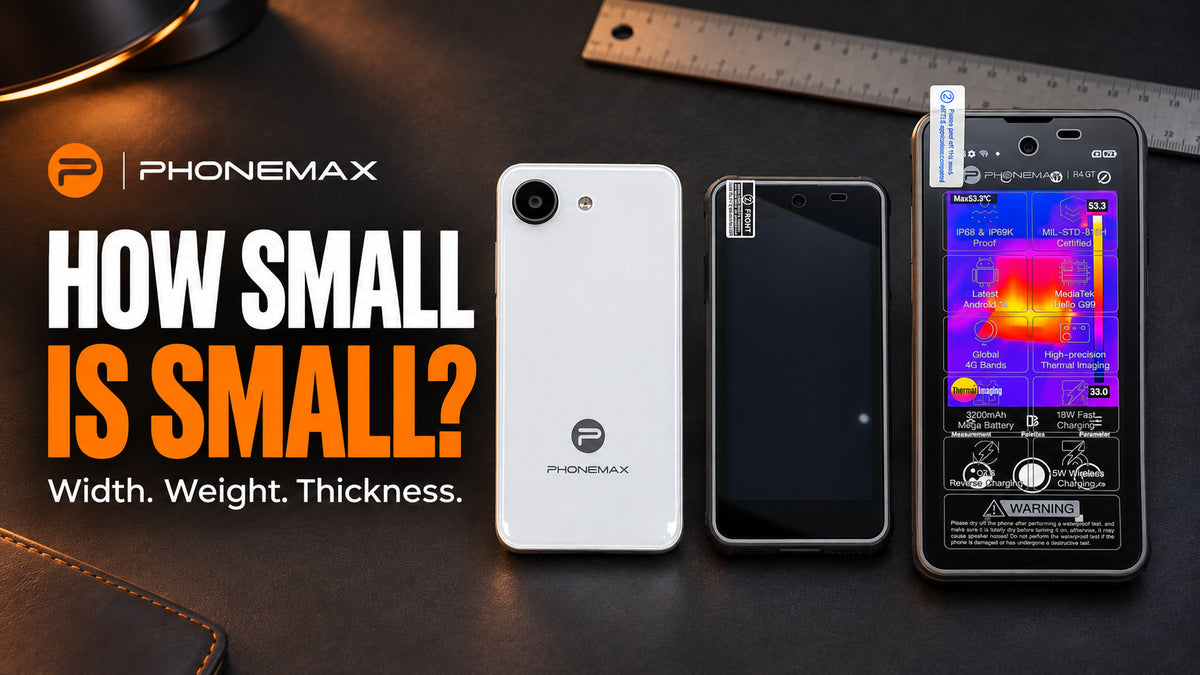
The Phonemax P20 Pro combines an integrated thermal camera with 5G connectivity. Its current listing specifies a 6.6-inch 120Hz display, 12GB physical RAM, 512GB storage and a 10,000mAh battery with 66W charging. The phone measures 172.6 × 81 × 17.8 mm and weighs 394g.

In the inspection example, its larger display offers more room for reviewing photographs, reading a work order and entering notes. Integrated thermal imaging adds another observation method within the same phone.
The P20 Pro is the relevant starting point when a buyer needs thermal imaging alongside a larger phone screen and supported 5G service. Its larger body and weight should be considered against the intended carrying arrangement.
Battery capacity provides a specification for comparison; actual runtime depends on camera use, screen settings, applications and network conditions.
R4 GT: Compact Carry for Frequent Observations
The Phonemax R4 GT takes a more compact approach. It measures 121 × 59.2 × 18.3 mm, weighs 190g and has a 4.3-inch display. Its current listing includes 4G connectivity, 256 × 192 thermal imaging and a separate 20MP infrared night-vision camera.

Based on the published weights, it is 204g lighter than the P20 Pro. That difference matters when evaluating a device that will be carried between work areas and retrieved repeatedly for brief observations.
The trade-off is screen space. A compact phone may fit a carrying routine well while being less comfortable for long forms or detailed document review.
Thermal imaging and infrared night vision also answer different questions. Thermal imaging shows temperature-related patterns; infrared night vision helps capture a scene in low light. Choose the imaging function around the evidence the task requires.
For a fuller comparison, read R4 GT vs P20 Pro: Compact Carry or a Larger 5G Phone?
T1: A Larger Working Area for Documents and Records
The Phonemax T1 provides an 8-inch display for field forms, maps, inspection photographs and work records. The current gray Android 16 configuration lists 6GB RAM, 128GB storage, a 12,000mAh battery and 18W charging.

Within the example workflow, the T1 could suit an employee reviewing a technical document alongside a work order or completing a detailed inspection checklist.
Its role is distinct from the two thermal-imaging phones: the reason to evaluate it here is the larger document and data-entry surface. The listed configuration does not include a Honeywell barcode scanner, so a scanning requirement needs separate confirmation.
Choose Around the Main Task
| Main requirement | Model to evaluate | Practical consideration |
|---|---|---|
| Thermal imaging with a larger phone display and 5G | P20 Pro — 6.6-inch display, 394g | Screen space versus carrying size and weight |
| Thermal imaging in a compact 4G phone | R4 GT — 4.3-inch display, 190g | Portability versus room for forms and documents |
| Document review and detailed data entry | T1 — 8-inch Android tablet | Application layout and the exact supplied configuration |
Before purchasing for a team, run one representative job using the intended application. Check that documents open correctly, records remain associated with the right asset and synchronization works under the expected connectivity conditions. Confirm the destination operator’s support for the selected configuration.
For thermal work, an image supports investigation but does not establish a fault’s cause on its own. Formal measurement and inspection requirements should determine the appropriate instrument and procedure.
From Shenzhen’s APEC Discussions to a Practical Device Decision
APEC 2026’s priorities of openness, innovation and cooperation invite businesses to examine how information and technology serve their operations.
For field teams, a useful result is concrete: an employee can retrieve the right document, capture an understandable observation and hand over a record that supports the next action.
Phonemax’s device options address different parts of that work. Evaluate the P20 Pro for thermal imaging with a larger phone screen and 5G, the R4 GT for compact thermal-imaging carry, and the T1 for a larger document and form interface.
To discuss a team purchase, contact Phonemax with your workflow and configuration requirements. Include the intended application, destination country and operator, preferred model and quantity so the discussion starts with the actual deployment needs.
Published by Phonemax, which sells the devices discussed. Sources and product specifications checked November 17, 2026. The workflow is illustrative. Supplied images have been lightly AI-retouched for editorial presentation; the thermal display photograph is not measurement evidence. Cover: Shenzhen APEC city display, retouched from a supplied photograph.
Further source: Shenzhen government announcement of the APEC CEO Summit agenda.

Leave a comment
All comments are moderated before being published.
This site is protected by hCaptcha and the hCaptcha Privacy Policy and Terms of Service apply.