
Short answer: A first-time rugged-phone buyer should check, in order: the real hazard, carrier compatibility, operating system and updates, physical size and weight, battery workflow, required apps, repair support and the limits of durability claims. Do not start with the biggest battery or highest-looking rating.
Commercial disclosure: Phonemax publishes this guide and sells the X5 and other rugged phones. Product references are clearly identified; readers should compare them with alternatives and verify their exact regional requirements.
For the closest comparison, see What Should Budget Rugged Phone Buyers Check Before Choosing a Rugged Phone?.
Step 1: What problem are you trying to solve?
Write one sentence: “My current phone fails because ___ during ___.” Examples include rain entering an exposed port, cracked screens after repeated drops, missed calls in noisy areas or insufficient power during navigation.
If the problem is only occasional cosmetic damage, a mainstream phone with a quality case may still be the better answer. If exposure is frequent, downtime is costly or the environment defeats ordinary accessories, a rugged phone becomes easier to justify. Our rugged phone versus protective case guide can help frame that decision.
Step 2: Do the ratings match the hazard?
An IP rating is not a general toughness score. The first numeral addresses solid-particle protection and the second addresses water ingress under defined tests. Read the IEC IP rating guide before treating a code as a promise about salt water, hot water, chemicals, long immersion or every kind of pressure.
Ask for the exact model’s documentation. Also check the warranty wording, because a device may have a resistance claim while liquid damage is handled separately under warranty terms.
Step 3: Will the exact version connect to your carrier?
Check the model variant, supported bands, SIM type, VoLTE requirements and carrier acceptance. “Unlocked” does not mean “works everywhere.” The FCC unlocking guide explicitly ties use to compatible networks.
For example, the Phonemax X5 has a T615 full-band version and a G81 Europe-and-Asia version. The page warns that full-band does not guarantee compatibility with every carrier. That variant-level check should happen before payment, not after delivery.
Step 4: Can you live with the size every day?
Rugged construction can add thickness and weight. Compare dimensions with your pocket, gloves, vehicle mount and existing work pouch. Hold a cardboard mock-up if you cannot handle the phone first.
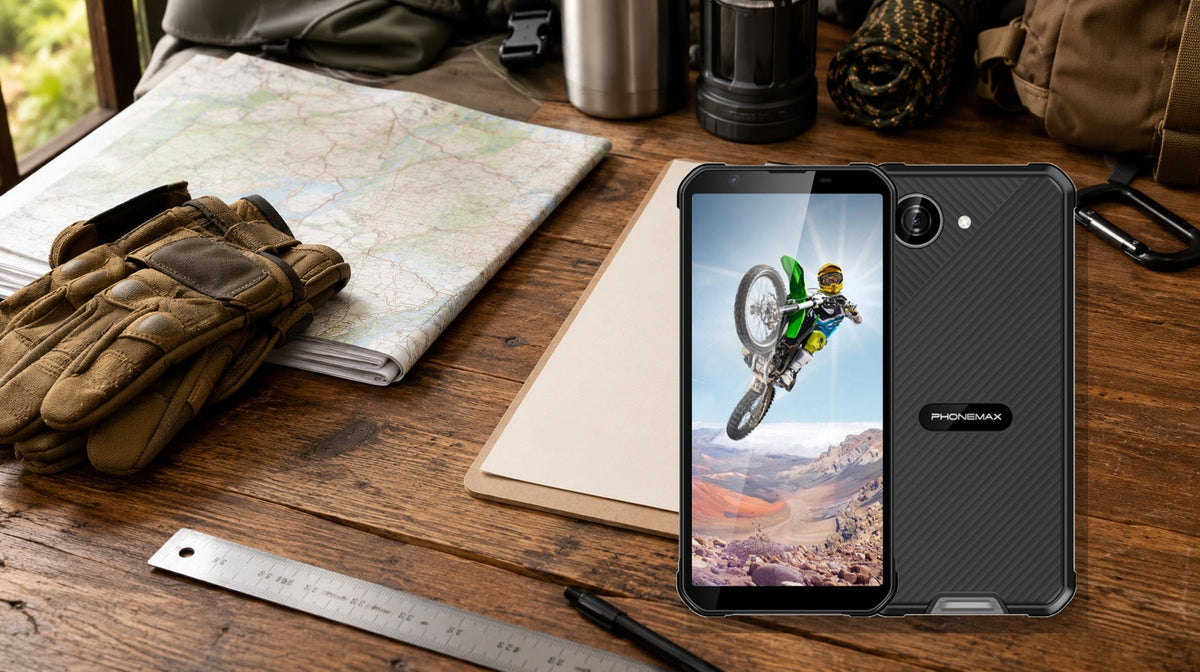
The X5’s current page lists a 5.3-inch display, 146.0 × 71.7 × 15.5 mm dimensions and 238 g weight. That makes it a useful compact reference, not automatic proof of comfort. Hand size, gloves and carrying method still matter.
Step 5: Is the software suitable for the ownership period?
Verify the shipped Android version, current security patch, required applications and any update commitment. Google’s Android update instructions show where to check Android, security and Google Play system update status.
If the phone will access company data, ask IT about VPN, authentication, encryption and device-management compatibility before purchase.
Step 6: Does the battery fit your workload?
Capacity is only a starting point. Navigation, poor signal, screen brightness, video, hotspots, thermal tools and cold weather can change runtime. Build a one-shift test plan and identify where charging is possible.
The X5 lists 5000mAh and states that actual life varies with network conditions, brightness and app use. That is the correct way to interpret any battery specification: capacity is not a guaranteed number of hours.
Step 7: Which everyday compromises are acceptable?
Check camera quality, display visibility, speaker performance, biometrics, NFC, storage, charging speed and accessory availability. First-time buyers often discover that the trade-off is not toughness but comfort. Review our analysis of rugged-phone downsides before deciding.
A 15-minute pre-purchase checklist
- Confirm the exact model and regional variant.
- Compare carrier bands with your operator.
- Read the limitations behind IP and drop claims.
- Record dimensions and weight.
- List five required apps and minimum Android version.
- Ask for security-update and warranty information.
- Estimate one real shift of battery demand.
- Check port type, charger and mount compatibility.
- Decide whether camera quality is “documentation” or “creative photography” level.
- Save the return and service terms.
Final recommendation
For a first purchase, choose a balanced device and run a short pilot before committing a team. The X5 is a relevant Phonemax example when compact size, Android 16 and 5000mAh capacity fit the brief, but its exact version and carrier fit still need verification.
Two related checks are What Should People Switching From Flagship Phones Check Before Choosing a Rugged Phone? and What Should Buyers Choosing a Second Phone Check Before Choosing a Rugged Phone?.
Buyer decision table
| Evidence | Accept when | Reject or verify when |
|---|---|---|
| Current model page | The exact configuration and required feature are stated | The claim applies only to a family or older version |
| Primary technical source | The method and limits match What Should First-Time Rugged Phone Buyers Check Before Choosing a Rugged Phone | The source addresses a different hazard or use case |
| Buyer trial | The real workflow finishes with the required reserve | A critical task fails or conditions were not recorded |
FAQ
Is IP69K always better than IP68?
They describe different test conditions. One should not be treated as a universal replacement for the other.
Do I need a huge battery for a rugged phone?
Not necessarily. Match capacity and charging access to your workload and acceptable weight.
Can a rugged phone replace my flagship immediately?
It can, but test camera expectations, display, performance, app support and carry comfort first.
What is the biggest first-time buyer mistake?
Buying a specification headline before checking the exact regional variant and daily-use compromises.
Editorial method: Ordered risk checklist based on standards interpretation, compatibility and ownership workflow. No independent device testing was performed.

Efterlad en kommentar
Alle kommentarer er modereres, før de bliver offentliggjort.
'Denne side er beskyttet af hCaptcha, og hCaptchas Politik om beskyttelse af persondata og Servicevilkår er gældende.