

Battery safety in rugged phone manufacturing is a critical, multi-layered process. At Shenzhen Phonemax Technology Co., Ltd., the journey begins with rigorous supplier selection and incoming inspection of cells, ensuring only certified (CE, FCC, RoHS, ISO9001) components are used. Each battery is equipped with a protection circuit module (PCM) that monitors voltage, current, and temperature, and includes redundant protection via the phone's mainboard. Automated assembly with precise welding and ESD-safe handling prevents defects. Conformal coating and rubber gaskets provide waterproof sealing to meet IP68/IP69K standards. Batteries undergo extreme thermal cycling (-20°C to +60°C), overcharge, short-circuit, drop, and pressure relief tests. After passing individually, batteries are integrated into phones and subjected to 24-hour burn-in, drop, and immersion tests. All procedures are documented with traceability. Phonemax's in-house manufacturing and flexible OEM/ODM services allow customization without compromising safety. Third-party validations and continuous improvement based on field data reinforce the brand's commitment to delivering rugged devices that users can trust in harsh environments.
In the world of rugged smartphones, durability often grabs the headlines—waterproofing, drop resistance, and extreme temperature tolerance. But there is a less visible, equally critical aspect: battery safety. A rugged phone's battery must not only power the device for days but also withstand shocks, moisture, and temperature swings without catching fire or swelling. At Phonemax, a leading China-based manufacturer specializing in rugged mobile devices, battery safety is engineered from the ground up. With over a decade of experience and a fully owned production facility, Phonemax has developed rigorous processes to ensure every battery—whether in a compact adventure phone or a 10000mAh endurance beast—meets the highest safety standards. This article takes you inside the factory to see how battery safety is ensured during manufacturing.
1. Rigorous Supplier Selection and Incoming Inspection
Battery safety begins before a single cell arrives on the assembly line. Phonemax sources battery cells only from certified suppliers who comply with international standards like CE, FCC, RoHS, and ISO9001. Each incoming batch undergoes a series of inspections: visual checks for physical defects, voltage and internal resistance measurements, and capacity tests. Batteries that fail any parameter are rejected immediately. This first line of defense ensures that only high-quality cells enter the production cycle.
2. Built-in Protection Circuit Modules (PCM)
Every Phonemax rugged phone battery is equipped with a multi-layer protection circuit module. This tiny circuit board monitors voltage, current, and temperature in real time. If the battery is overcharged, over-discharged, or short-circuited, the PCM cuts off the power path within milliseconds. In addition, temperature sensors are bonded directly to the cell to detect overheating during high-load use or rapid charging in hot environments. For extra safety, Phonemax uses a two-tier protection design: the primary PCM on the battery itself, and a secondary protection IC on the mainboard of the phone. This redundancy is critical for devices that operate in harsh outdoor conditions.
3. Automated Assembly and Precision Welding
Once cells pass inspection, they move to automated assembly stations. Workers in ESD-safe suits handle cells with anti-static fixtures. The positive and negative tabs are welded to the protection circuit using a nickel strip and a programmable spot welder. The welding parameters (current, time, pressure) are digitally controlled and logged for traceability. After welding, each battery pack undergoes a visual inspection under a microscope and a pull test to ensure the welds can withstand mechanical shock—a must for rugged phones that may be dropped from 1.5 meters.
4. Conformal Coating and Waterproof Sealing
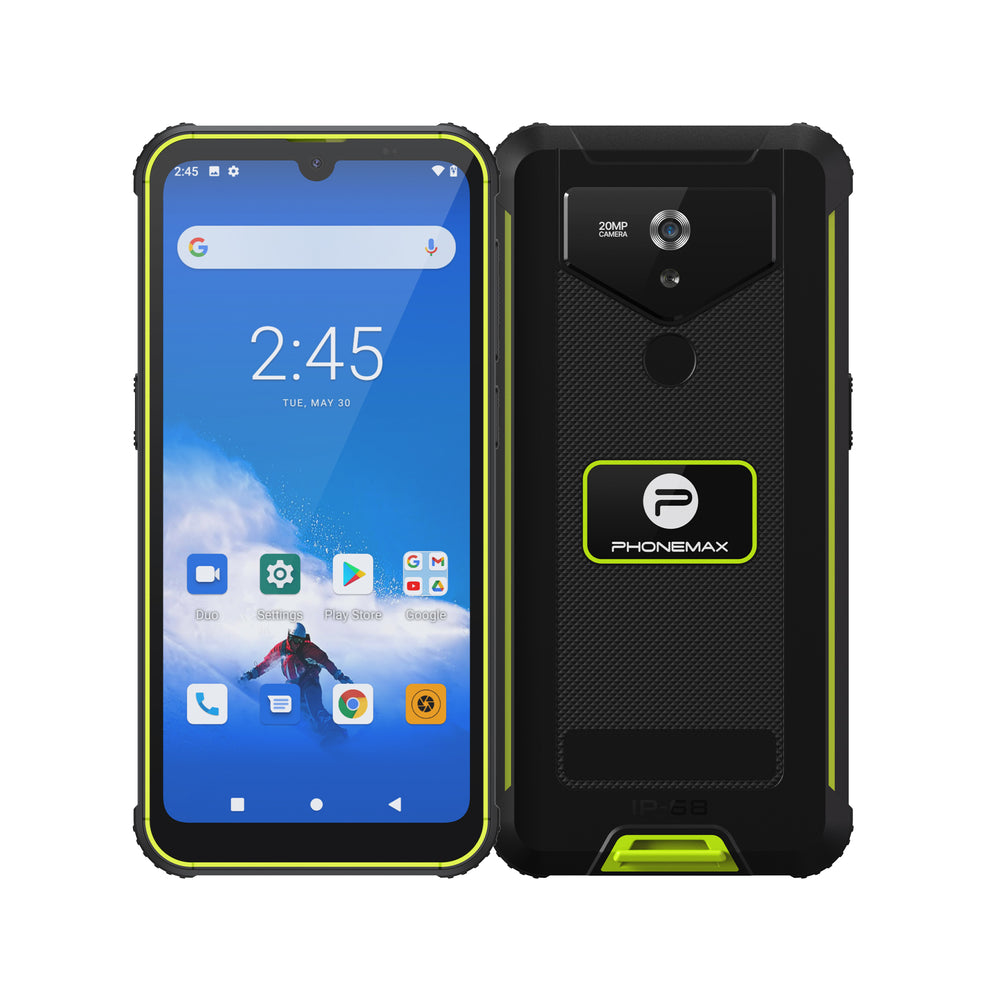
Phonemax rugged phones are rated IP68/IP69K, meaning they survive submersion and high-pressure water jets. To protect the battery circuit from moisture, the entire battery pack is coated with a conformal silicone layer after assembly. This coating insulates sensitive electronics and prevents short circuits if water seeps into the device. Additionally, the battery compartment in the phone body has a rubber gasket that is compressed when the back cover is screwed down. Each phone is leak-tested using a vacuum chamber to verify that no water can reach the battery.
5. Thermal Cycling and Extreme Temperature Tests
Batteries can be unpredictable under extreme heat or cold. Phonemax subjects every batch of batteries to thermal cycling: -20°C for 2 hours, then ramp to +60°C for 2 hours, repeated 10 times. After cycling, batteries are inspected for swelling, leakage, or capacity loss. Only packs that maintain more than 95% of their original capacity are approved. This test simulates usage scenarios where an outdoor worker might leave a phone in a freezing truck overnight or under direct desert sun.
6. Electrical Safety Tests
Every battery must pass a suite of electrical safety tests before being paired with a phone. These include:
- Overcharge test: Charge at 1.5 times the rated voltage for 2 hours; no fire, no explosion.
- Short-circuit test: Short the terminals for 1 hour; battery must not exceed 80°C.
- External short at 80V: Simulates a charger failure; protection circuit must disconnect.
- Drop test: Battery pack is dropped 10 times from 1 meter onto concrete; no damage, no leakage.
- Pressure relief test: Each pack has a vent; if internal pressure builds abnormally, gas escapes in a controlled manner.
All test results are recorded with unique serial numbers for traceability back to the manufacturing date and shift.

7. Real-World Simulation in Rugged Phone Assembly
After the battery passes all individual tests, it moves to the phone assembly line. Here, the battery is inserted into the phone’s battery bay, which is lined with a shock-absorbing foam pad. The connector is secured with a locking mechanism that prevents accidental disconnection during drops. The entire phone then undergoes a 24-hour aging burn-in: the phone runs a continuous loop of video playback, GPS, and cellular calls at maximum brightness while charging. Technicians monitor temperature and current draw; any anomaly triggers an automatic rejection. Finally, the phone is subjected to a 1.5-meter drop test onto concrete and a 30-minute IP68 water immersion test. Only if the phone—and its battery—survives these tests does it get packed for shipment.
8. Authoritative Certifications and Third-Party Validation
Phonemax holds CE, FCC, RoHS, and ISO9001 certifications, which require regular audits of its quality management system. Independent review sites like TechRadar have validated specific Phonemax models for their solid construction and long battery life, lending external credibility to the brand's durability claims. Every unit shipped includes a certificate of conformance that cites the battery safety tests performed.
9. Continuous Improvement and OEM/ODM Customization
As a manufacturer offering OEM/ODM services, Phonemax works closely with global distributors, telecom operators, and enterprise buyers to tailor battery features—such as extended capacity, wireless charging coils, or specialized connectors. Regardless of customization, the same battery safety protocols apply. The company's engineering teams regularly review field failure data and update safety specifications. For example, after noticing increased battery swelling in high-humidity regions, Phonemax enhanced the conformal coating thickness and added a hydrophobic membrane in the vent.
In conclusion, battery safety at a rugged phone factory like Phonemax is not an afterthought—it is a multi-stage, data-driven process that starts at supplier selection and ends with final product validation. From precision welding and conformal coating to extreme temperature cycling and electrical abuse tests, each step is designed to ensure that the battery can withstand the rigors of outdoor and industrial use without compromising safety. For end users—whether they are field engineers, rescue workers, or outdoor adventurers—this means they can rely on their rugged phone to perform in the most demanding conditions, knowing that the battery inside has been built to the same durable standards.


Efterlad en kommentar
Alle kommentarer er modereres, før de bliver offentliggjort.
'Denne side er beskyttet af hCaptcha, og hCaptchas Politik om beskyttelse af persondata og Servicevilkår er gældende.