
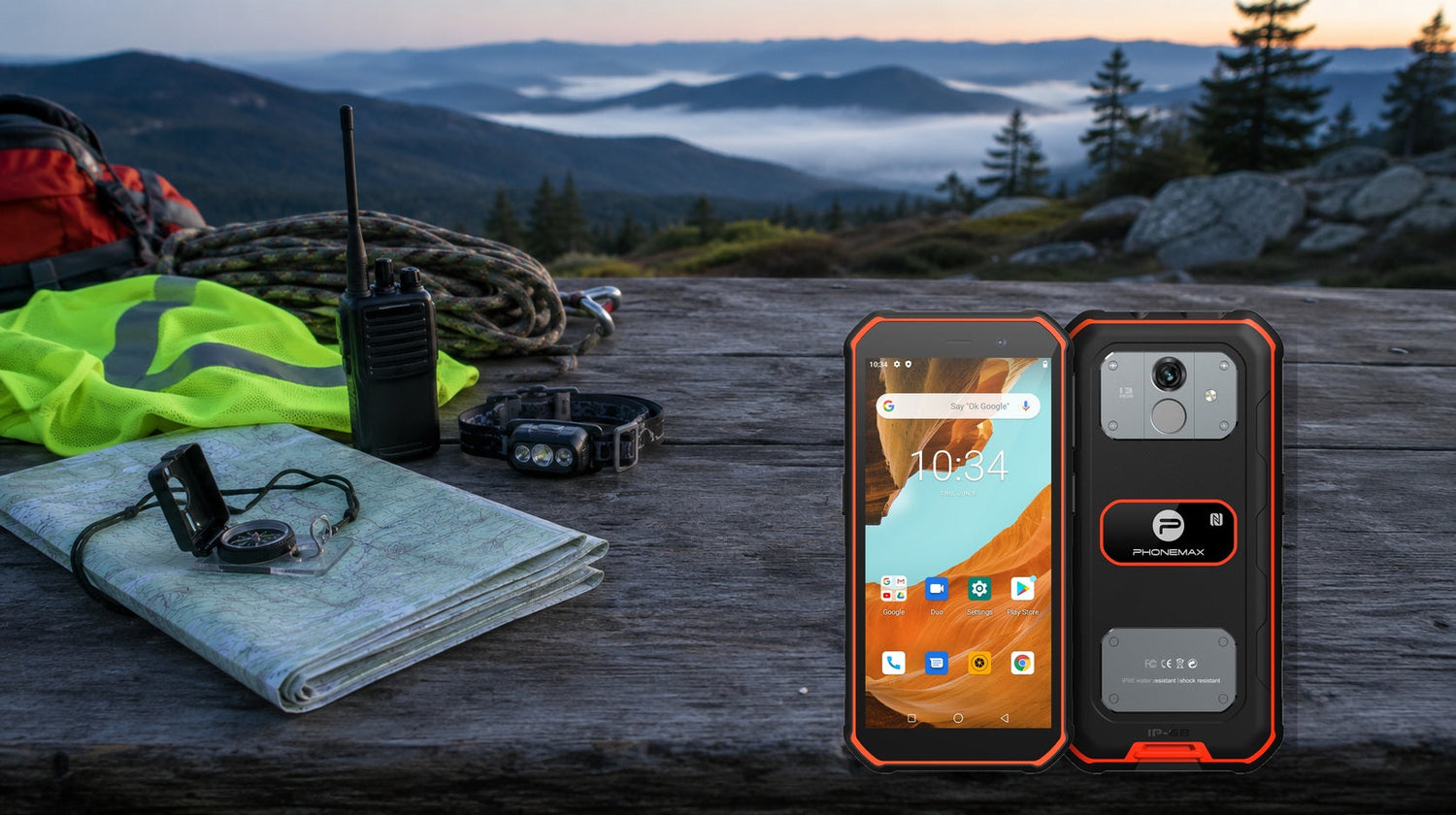
Search-and-rescue teams should prioritize interoperable communications, offline navigation, dependable power, glove-operable controls, visible audio/alerts, attachment security and a documented decontamination process. A rugged smartphone should support the communications plan, not replace radios, satellite devices, beacons or paper navigation where those are required.
For the closest comparison, see What Should You Check Before Using a Rugged Phone for Multi-Day Hiking?.
Begin with the mission, not the handset
Urban collapse, wilderness search, flood response and mine rescue impose different requirements. Define terrain, duration, temperature, water exposure, contamination, coverage gaps, PPE, mapping system and evidence workflow. Then decide what the phone is allowed to do.
The FEMA resource typing definition for a land SAR team lists portable/mobile communications, a charger, handheld GPS, two-way radio and mobile phone as separate equipment items. That separation is important: one multifunction phone can reduce carried equipment, but concentrating every function in one battery and one screen also creates a single point of failure.
Selection decision tree
- Will the team operate without reliable cellular coverage? If yes, require offline maps and a separate approved communications path.
- Must the device operate with gloves? If yes, test the actual glove and app; consider programmable or physical controls only when documented.
- Will the device enter water, hazardous atmospheres or contaminated areas? If yes, verify mission-specific approval. A consumer IP code alone is insufficient.
- Is the phone a navigation aid or the primary navigation instrument? If primary, require accuracy testing, redundancy and operational approval.
- Will missions exceed one shift? If yes, define chargers, power banks, vehicle power, battery allocation and cold-weather storage.
Reproducible mission drill
Build a 60-minute route with an open-sky segment, dense cover or urban canyon, a wet-hand station and a simulated loss of cellular service. Load the real mapping and reporting apps. Each operator must unlock the phone, find a grid reference, send or queue a report, capture an image, acknowledge an alert and return to navigation while wearing normal PPE.
Record completion time, wrong inputs, GPS drift, audio audibility, battery change and recovery after the screen is wet. Repeat with two users and two devices. A device that passes only in the hands of the evaluator is not deployment-ready.
Stop conditions
| Finding | Decision |
|---|---|
| Critical app fails offline | Stop; redesign workflow or reject device |
| Carrier bands or agency SIM not verified | Stop procurement |
| Phone is proposed as sole communications path | Add radio/satellite/beacon redundancy |
| Glove use causes false acknowledgements | Reject or change UI/control method |
| Decontamination chemical compatibility unknown | Keep out of contaminated zone |
| Battery plan cannot cover mission plus reserve | Add power or change device |
| Hazardous-location certification required but absent | Do not deploy there |
Phonemax X2 as a first-party example
Phonemax publishes this article. The current Phonemax X2 page lists a 5100mAh battery and 5.5-inch HD+ display. It offers different variants, including an Unisoc T606/Android 13/4GB+64GB configuration and an older MTK 6739/Android 10/3GB+32GB configuration. Procurement must specify the exact variant; they should not be treated as interchangeable.
The product name highlights a “Super Torch,” which could be useful for close-range illumination, but the public page does not provide luminous flux, beam distance, runtime, hazardous-location approval or SAR validation. It must not replace an approved primary light. The page also does not establish satellite communication, two-way radio interoperability, glove performance, GNSS accuracy or chemical decontamination compatibility.
Evidence and operational limits
FEMA describes Urban Search & Rescue as multidisciplinary work involving search, rescue, medicine, hazardous materials, logistics and planning. Device selection must therefore be approved across operations, communications, safety and IT—not chosen by a single attractive specification.
For wilderness response, do not assume cell coverage. The National Park Service advises hikers not to rely solely on a cell phone and suggests a personal locator beacon where appropriate. Professional teams should apply even stronger redundancy.
Two related checks are Which Rugged Phone Features Matter Most for Plumbers? and Do Delivery Drivers Really Need Rugged Phones?.
FAQ
Can an IP68/IP69K phone be used in every rescue environment?
No. Water/dust ratings do not establish suitability for hazardous atmospheres, contamination, extreme temperature or every cleaning chemical.
Is a bright built-in torch enough for SAR?
No. Treat it as a secondary convenience unless output, runtime and mission approval are documented.
Should the phone replace a handheld GPS?
Only if the agency’s testing, policy and redundancy plan explicitly allow it.
What is the most important procurement question?
Ask what happens when the phone, network or battery fails during the mission. The answer reveals whether the system is resilient.
Why specify the exact X2 variant?
Because processor, Android version and memory differ. App compatibility and support can therefore differ as well.
Sources:
Next step: Convert the decision tree into an agency-approved mission drill before adding any handset to the equipment cache.

Efterlad en kommentar
Alle kommentarer er modereres, før de bliver offentliggjort.
'Denne side er beskyttet af hCaptcha, og hCaptchas Politik om beskyttelse af persondata og Servicevilkår er gældende.