
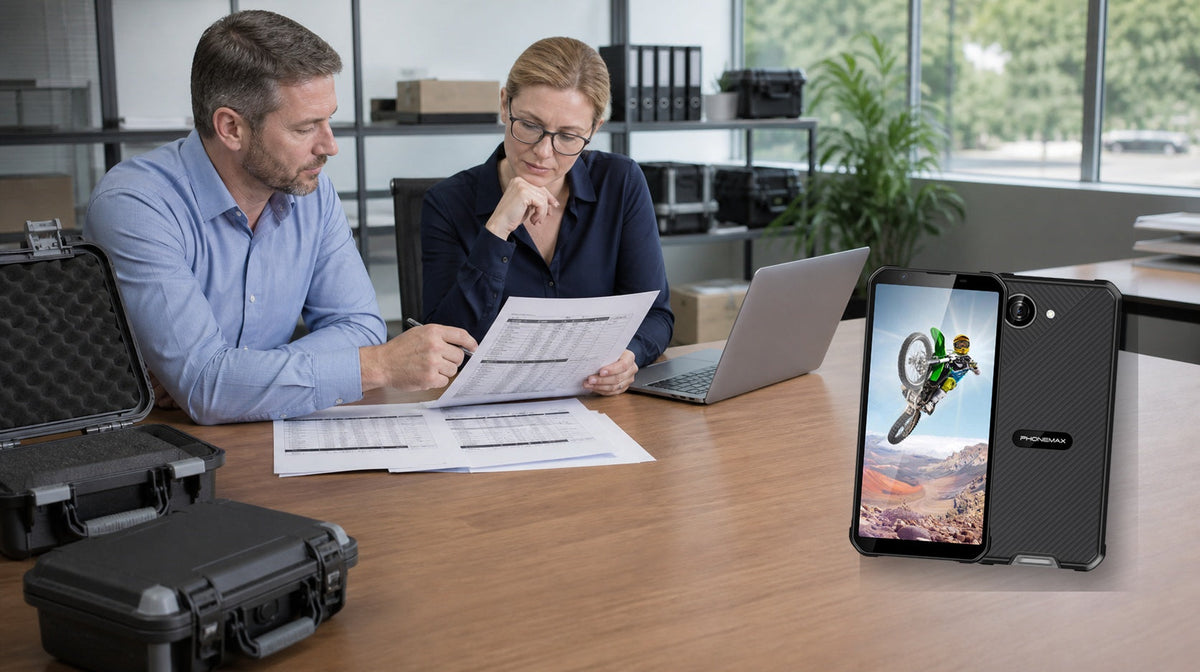
The best way to compare rugged-phone quotations is to convert every offer into the same operating scenario and calculate total cost of ownership over a defined period. Unit price is only the first line of that calculation.
A quote can look inexpensive because it excludes charging accessories, regional configuration, enrollment work, freight, taxes, spare devices, repair shipping or software support. Another quote may appear more expensive because several of those costs are already included.
The correct question is therefore not “Which phone costs less?” It is “What will each usable device cost over the period in which our team depends on it?”
Start with one common operating scenario
Before comparing suppliers, create a one-page requirements sheet. Every supplier should quote against the same assumptions:
- Number of active users and devices
- Countries and mobile networks
- Expected deployment date
- Shift length and charging pattern
- Required applications and device-management method
- Environmental conditions
- Planned service life
- Spare-device policy
- Repair turnaround requirement
- Required accessories
- Expected annual damage or failure volume
If one supplier assumes a 12-month deployment and another assumes three years, their prices are not directly comparable. The same applies when one quote includes accessories and another lists only bare devices.
Build a landed hardware-cost column
- Device price
- Required charger and cable
- Screen protector, mount, cradle or carrying accessory
- Freight and insurance
- Import duties and local taxes
- Regional or network-version surcharge
- Inspection or acceptance-testing cost
- Spare-device purchase cost
Use the exact regional variant needed by the deployment. A low quote for an incompatible network version is not a saving. Procurement teams should confirm the selected configuration and supported bands before treating any price as final.
Add deployment and administration costs
A phone does not become operational simply because it arrives. Deployment work may include asset labeling, SIM installation, application installation, security configuration, account creation, device-management enrollment, kiosk configuration, user testing, training and handover documentation.
Convert staff time into a per-device amount. If one configuration takes 15 minutes to enroll and another takes 45 minutes, the difference becomes material across hundreds of devices. Automated enrollment can reduce repeated setup work, but buyers should verify that the selected device, reseller and management platform support the intended route.

Calculate downtime instead of counting repairs alone
Two suppliers may report the same repair rate while producing very different operational costs.
Downtime cost = unavailable hours × affected workers × loaded hourly cost × productivity-loss factor
The productivity-loss factor prevents overstatement. A worker may lose only part of a shift if a spare device is immediately available, but almost the whole shift if navigation, scanning or job reporting depends on the phone.
Track diagnosis time, supervisor time, lost field work, replacement setup, shipping time, repair administration and missed project commitments separately.
Normalize warranty and repair terms
A warranty duration is not enough. Ask which parts and failure types are covered, whether labor and return freight are included, who decides whether damage is accidental, where devices must be shipped, what evidence is required, whether advance replacement is available, and what turnaround target applies.
Also clarify whether batteries, port covers and accessories are covered, whether repairs preserve the same regional configuration, and what happens when a model or part is discontinued.
Use a three-scenario model
| Scenario | Assumption |
|---|---|
| Expected | Most likely damage, repair and downtime rates |
| Low-cost | Fewer failures and shorter support delays |
| High-cost | More failures, longer repair time and higher spare usage |
If Supplier A wins only in the low-cost scenario while Supplier B wins in expected and high-cost scenarios, Supplier B may offer the safer commercial decision.
Use a pilot to replace assumptions with evidence
Before a large order, run a controlled pilot using representative users, networks, applications and job conditions. Record battery remaining at shift end, failed application sessions, connectivity interruptions, charging incidents, device swaps, damage events and the time required to restore a replacement.
A pilot should test the proposed regional version and accessories, not a demonstration sample with a different configuration.
Final decision rule
Three-year TCO = landed hardware + deployment + accessories + support + repairs + downtime + replacements − residual value
Document every assumption beside the number. If a supplier cannot confirm an input, mark it as unknown rather than entering zero. The winning quote should meet the mandatory requirements and produce the strongest risk-adjusted cost—not simply the lowest unit price.


Dejar un comentario
Todos los comentarios se revisan antes de su publicación.
Este sitio está protegido por hCaptcha y se aplican la Política de privacidad de hCaptcha y los Términos del servicio.