
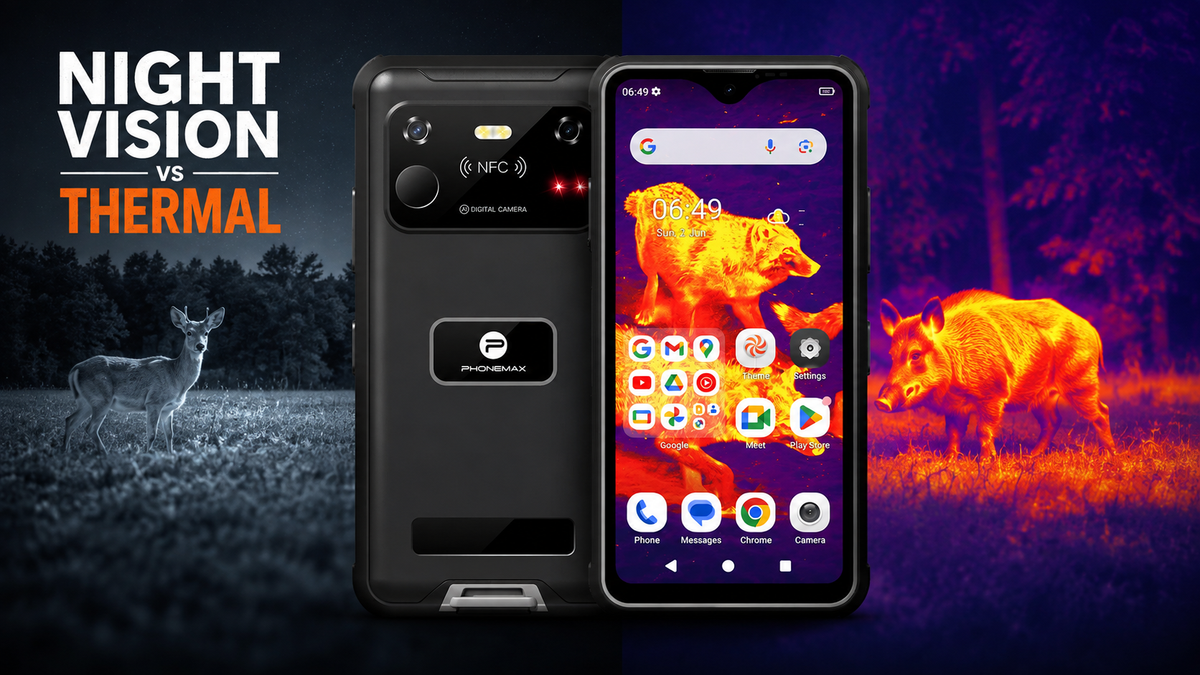
Night vision and thermal imaging solve different field problems. Night vision is useful when you need a recognizable scene in very low light, while thermal imaging is useful when the important information is a difference in emitted heat rather than visible detail. Treating the two as interchangeable can lead buyers to choose the wrong tool.
The short answer
If the task is to identify shapes, surfaces, labels, paths or objects in darkness, a night-vision camera can be the more intuitive choice. If the task is to look for heat patterns, hot spots or temperature contrast, thermal imaging is the relevant technology. FLIR explains that thermal imagers detect emitted infrared energy, while night-vision systems rely on reflected light or active infrared illumination.
What does night vision actually show?
Night vision is still an imaging system built around reflected energy. Depending on the implementation, it may amplify available light or use infrared illumination that the camera can detect. The result resembles a conventional scene more closely than a thermal image does.
That matters for work such as documenting a dark corridor, checking equipment identification, observing a trail or capturing a recognizable object after sunset. The Phonemax X3 is an active product positioned around a 20MP infrared night-vision camera. It is therefore relevant when the buyer's primary intent is low-light visual capture rather than temperature analysis.
What does thermal imaging show?
Thermal imaging is different. A thermal sensor forms an image from infrared energy emitted by objects. FLIR notes that thermal cameras can reveal differences in heat without depending on visible illumination. This makes thermal imaging useful for locating anomalous heat patterns in equipment, electrical systems and other inspection targets.
The Phonemax R4 GT combines integrated thermal imaging and night vision in a compact 4G rugged phone. It is a better fit when one handheld device needs both visual low-light observation and thermal pattern detection.
Use the task, not the feature count, to choose
| Field task | More relevant tool | Why |
|---|---|---|
| See a path or recognizable object in darkness | Night vision | Preserves scene-like visual detail |
| Look for a hot connector or unusual heat pattern | Thermal imaging | Shows thermal contrast rather than visible appearance |
| Document a low-light work area | Night vision | Better aligned with conventional visual evidence |
| Screen equipment for temperature anomalies | Thermal imaging | Heat differences are the information of interest |
| Need both functions in one compact device | Combined device | Reduces the need to carry two separate imaging tools |
Thermal imaging is not automatically a temperature diagnosis
A thermal image can highlight a difference, but interpretation still matters. Surface emissivity, reflections, viewing angle, distance and environmental conditions can influence thermal readings. A hot-looking region should therefore be treated as a reason for closer inspection, not as proof of a specific fault.
This distinction is especially important for maintenance teams. A rugged phone with thermal imaging can make screening and documentation more convenient, but it does not replace a qualified inspection procedure or calibrated specialist instrument when a job requires traceable temperature measurement.
How to choose between Phonemax X3 and R4 GT
Choose the X3 when the purchase intent centers on night vision and a conventional rugged-phone workflow. Choose the R4 GT when the workflow specifically benefits from integrated thermal imaging as well as night vision. The R4 GT is listed at 121 × 59.2 × 18.3 mm and 190 g, so its value proposition is not simply “more cameras”; it is specialized imaging in a compact body.
Before ordering either device, verify the exact network configuration, application requirements and imaging workflow. A camera feature is useful only when it matches the real task.
Compare current options: browse Phonemax rugged phones to compare night-vision, thermal-imaging, compact, 4G and 5G models in one place.
FAQ
Is night vision the same as thermal imaging?
No. Night vision depends on reflected light or infrared illumination, while thermal imaging detects emitted infrared energy and visualizes heat differences.
Can a thermal camera see in complete darkness?
Thermal imaging does not require visible light because it detects thermal radiation. That is one reason it can remain useful in darkness.
Should maintenance teams treat every thermal hot spot as a fault?
No. A thermal anomaly is a screening signal. Interpretation should account for emissivity, reflections, load conditions and the inspection procedure.
Sources
- FLIR: What’s the Difference between Thermal Imaging and Night Vision?
- Teledyne FLIR OEM: Active IR vs Thermal Imaging
- FLIR: What Is Infrared?
Publisher disclosure: This article is published by Phonemax. References to the Phonemax X3’s 20MP infrared night-vision camera and the Phonemax R4 GT’s integrated thermal imaging, night vision, compact dimensions and weight are first-party product information from current Phonemax listings. FLIR and Teledyne FLIR OEM sources are used independently to explain the technical difference between active infrared/night-vision imaging and thermal imaging, and to support the discussion of heat-pattern interpretation. These FLIR sources do not certify, endorse or independently validate the X3 or R4 GT; they are cited only for the underlying imaging principles and inspection context.


Dejar un comentario
Todos los comentarios se revisan antes de su publicación.
Este sitio está protegido por hCaptcha y se aplican la Política de privacidad de hCaptcha y los Términos del servicio.