
Last reviewed: August 7, 2026 · Editorial disclosure: This article is published by Phonemax, a rugged-device manufacturer. A Phonemax model is used below as a catalog example and is clearly identified. Standards are linked to official sources. This article does not substitute for a model-specific test report.
Quick answer
IP68, IP69K and MIL-STD-810H are not three levels on one durability scale. IP codes describe enclosure protection against solids and water under defined conditions; IP69K-type testing addresses a particular high-pressure/high-temperature water-jet exposure; MIL-STD-810H is an environmental engineering and test-method framework that can cover many different stresses. Buyers should ask which exact tests were performed, under what conditions, and whether those tests match the real environment.
Key takeaways
- IP ratings do not prove drop or vibration resistance.
- “MIL-STD-810H” alone does not tell you which methods a commercial phone actually underwent.
- IP68 and IP69K address different water exposures, so one is not simply a universal upgrade over the other.
- Test conditions matter more than the number of badges on a product page.
- For work-critical use, ask for the method, conditions and report instead of relying on “military grade” language.
What does an IP rating actually tell you?
The IP Code is a system for classifying the protection provided by an enclosure. The official IEC 60529 publication covers degrees of protection provided by enclosures for electrical equipment.
An IP code uses characteristic digits. Broadly, the first digit relates to protection against access and solid foreign objects; the second relates to water ingress. The important point for buyers is that each rating is tied to defined test procedures and conditions.
That means an IP rating should not be translated into “waterproof in every real-world situation.” Salt water, detergents, hot liquids, damaged seals, worn port covers, repairs and impacts can create conditions that differ from a laboratory test.
What does IP68 mean for a rugged phone?
For phones, IP68 is commonly used to communicate a high level of dust protection plus immersion testing. However, the exact immersion conditions are not something buyers should infer from the two digits alone. The product maker should state the applicable standard and the conditions used for the specific device.
Practical questions include:
- What water depth and duration were used?
- Were all port covers installed and undamaged?
- Was the device new at the time of testing?
- Are salt water, chemicals or hot water excluded from the warranty?
- Does the manufacturer provide model-specific test documentation?
Water resistance is also not necessarily permanent. Damage, aging, repairs and seal wear can change enclosure performance over time.
What does IP69K add?
IP69K is associated with resistance to a high-pressure, high-temperature water-jet test rather than immersion. ISO 20653:2023 applies to degrees of protection for enclosures of electrical equipment on road vehicles and specifies requirements and tests for protection against foreign objects, access and water.
This is a different exposure from dropping a phone into water. A device may therefore have claims related to both immersion and high-pressure spray because those are different failure mechanisms.
High-pressure water resistance can be relevant for agriculture, muddy vehicle work or industrial wash-down. It may add little value to an office user whose main water risk is ordinary rain.
Is IP69K automatically “better” than IP68?
No. “Better” depends on the hazard. If accidental immersion is the main risk, the relevant immersion test matters. If high-pressure cleaning is the real exposure, a water-jet test may matter more. A buyer should match the test to the use case rather than rank the labels as if they were processor speeds.
What does MIL-STD-810H mean?
MIL-STD-810 is a U.S. Department of Defense environmental engineering standard. The official DoD ASSIST record describes it as guidance for considering environmental stresses throughout a product’s service life and explicitly notes that the document does not impose one universal design or test specification. Instead, it describes an environmental tailoring process that produces relevant test methods.
That distinction is critical for commercial rugged phones. A product can reference MIL-STD-810H without having undergone every method in the standard.
Depending on the program and intended environment, methods can address stresses such as shock, vibration, high and low temperature, humidity, rain, sand and dust, altitude and solar radiation. The useful question is therefore not merely “Does it say MIL-STD-810H?” but “Which methods and conditions were used for this exact model?”
Questions to ask about a MIL-STD-810H claim
- Which method and procedure were used?
- What drop height, orientation and surface were used if drop testing is claimed?
- How many impacts or cycles were performed?
- Which vibration profile was used?
- What temperature and duration were used?
- Was the phone operating during the test?
- Was the test performed by an internal or third-party laboratory?
- Is a report or test summary available?
A specific answer to those questions is more informative than the phrase “military grade.”
IP ratings do not prove drop resistance
A phone can have excellent ingress protection and still crack after a severe impact. Likewise, a device can survive repeated drops but perform poorly around water. Durability has multiple dimensions:
- water and dust ingress,
- impact resistance,
- vibration resistance,
- temperature tolerance,
- screen and camera protection,
- port and button design,
- seal durability,
- battery and software longevity.
No single badge proves all of these.
Which rating matters for different users?
| User / environment | What deserves priority | Why |
|---|---|---|
| Construction | Dust, repeated drops, ports, screen edges, gloves | Impact and contamination may occur more often than high-pressure wash-down |
| Motorcycle / overlanding | Vibration, mounting, rain, charging, temperature, GPS | Continuous vibration is a different stress from one drop |
| Warehouse | Grip, repeated drops, battery, scanning workflow | Daily handling and uptime may dominate |
| Agriculture / wash-down | Dust, mud, water jets, controls, seals | High-pressure water exposure may be relevant |
| Outdoor travel | Rain, immersion risk, battery, temperature, navigation | Mobility and weather exposure matter more than collecting every certification |
A Phonemax example: what a product-page rating does and does not prove
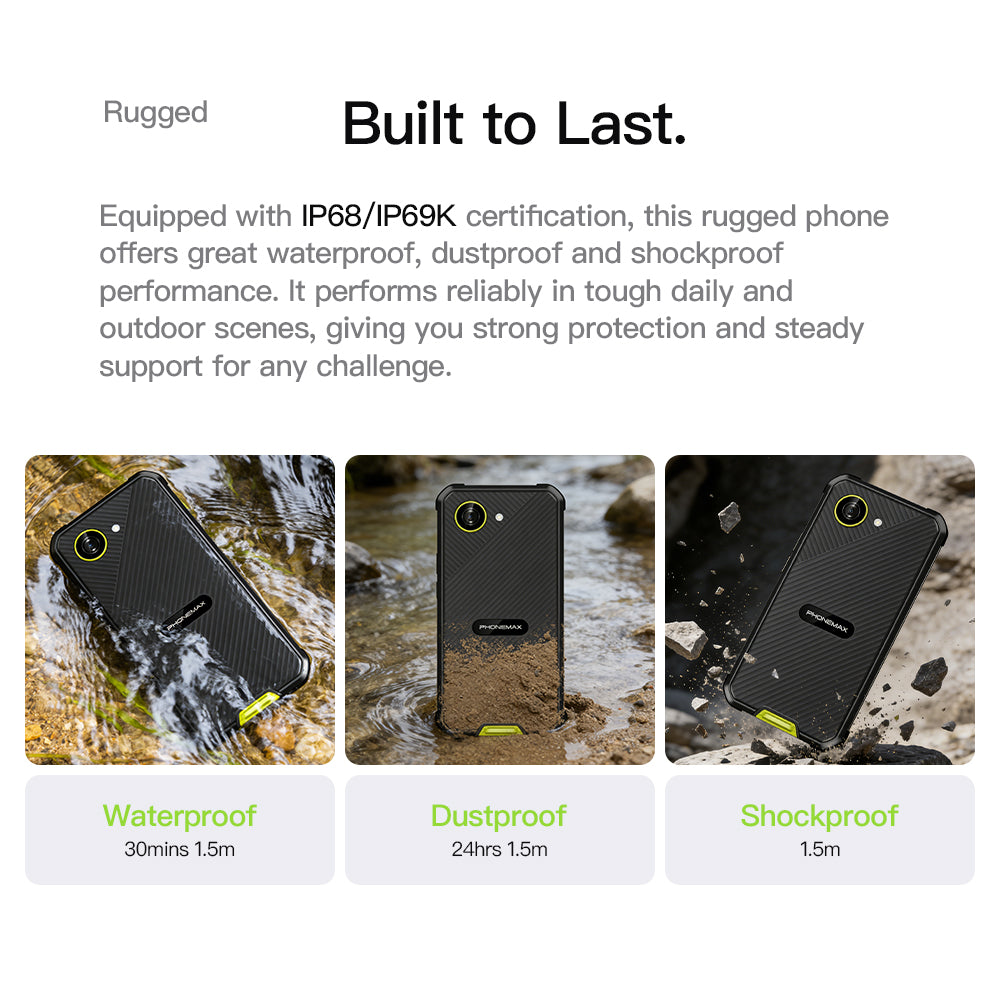
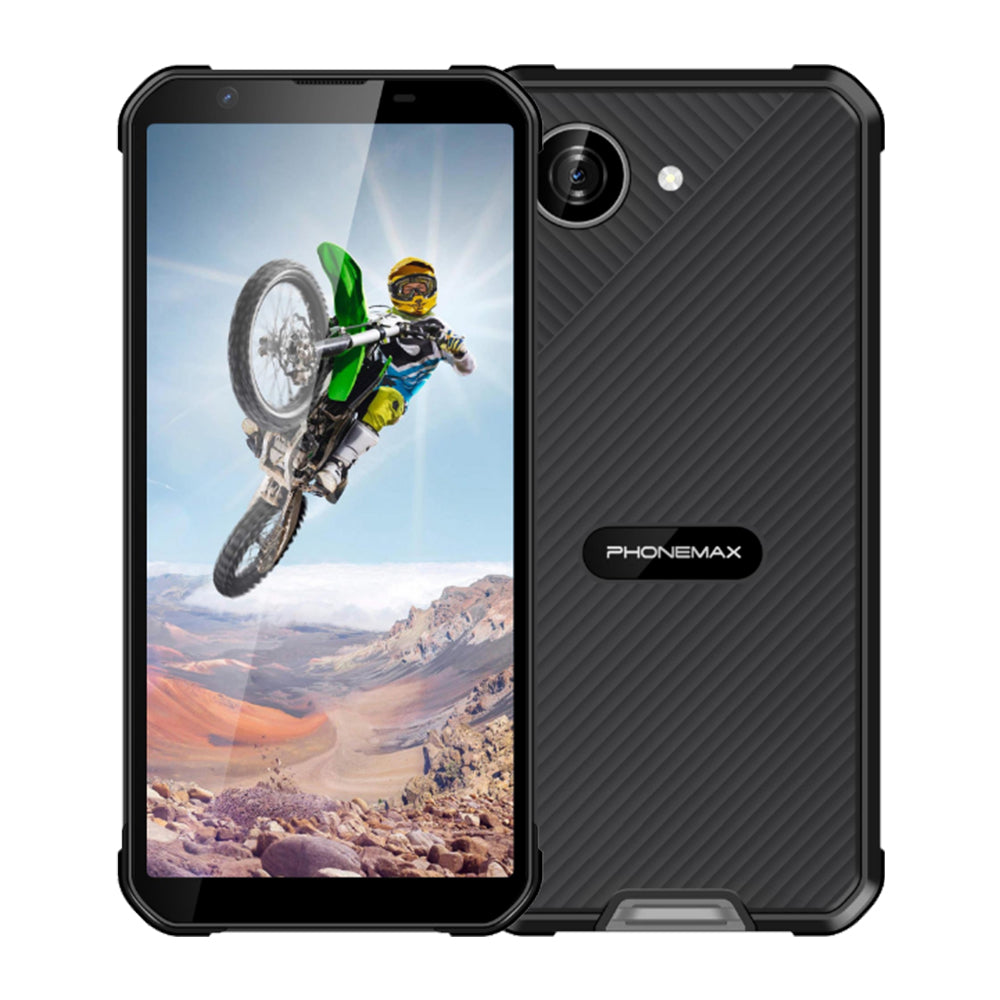
The current product title for our Phonemax X5 includes IP68 and IP69K claims. Because Phonemax publishes this article, that link should be treated as a manufacturer example rather than independent evidence.
The useful buying principle is the same for our own products as for any other brand: a rating in a title is only the starting point. Buyers with a work-critical requirement should verify the model-specific standard, test conditions and any available test documentation before assuming that the phone is suitable for a particular industrial process.
A four-step verification method
- Name the hazard. Immersion, pressure washing, dust, drop, vibration and temperature are different risks.
- Match the hazard to a test. Do not use an unrelated badge as a substitute.
- Check the conditions. Depth, duration, pressure, temperature, surface and operating state can change what a result means.
- Check the rest of the phone. Network compatibility, battery, screen, software support and ergonomics still determine whether the device works for the job.
Limitations and common misunderstandings
A laboratory result does not mean a device is indestructible. It also does not guarantee that protection remains unchanged after years of wear, a damaged port cover or a repair. Standards can also have different scopes, revisions and test procedures, so a product page should identify the actual basis of the claim.
For safety-critical or regulated environments, use the relevant workplace requirements and certified equipment rather than relying on a general consumer rugged-phone claim.
Bottom line
IP68, IP69K and MIL-STD-810H are useful only when you know what they mean and whether they match the real hazard. The most informed buyer does not count logos. They ask what was tested, how it was tested, under which standard, and whether that test is relevant to the job.
FAQ
Is IP69K better than IP68?
Not universally. They address different water exposures. The relevant rating depends on whether your real risk is immersion, high-pressure spray or something else.
Does MIL-STD-810H mean a phone is military equipment?
No. Commercial products can use methods from the standard. The key information is which methods and conditions were used for the exact product.
Is “military grade” a formal certification?
The phrase by itself is too vague to evaluate. Ask for the standard, method, conditions and test documentation.
Does IP68 mean salt-water proof?
Do not assume so. IP testing is performed under defined conditions, and manufacturer warranties may exclude salt water, chemicals or other liquids.
Can a phone lose water resistance after repair?
Yes. Opening, damage or incorrect reassembly can affect seals. Follow the manufacturer’s service guidance and do not assume an older or repaired phone performs exactly like a new test sample.
Sources and verification
- IEC 60529 — Degrees of protection provided by enclosures (IP Code)
- ISO 20653:2023 — Road vehicles, degrees of protection (IP code)
- U.S. DoD ASSIST — MIL-STD-810 Environmental Engineering Considerations and Laboratory Tests
Next step: before buying any rugged phone for a defined work environment, write down the exposure you need to survive and ask the seller for the exact test basis that addresses it.

Leave a comment
All comments are moderated before being published.
Ezt a webhelyet a hCaptcha rendszer védi, és a hCaptcha adatvédelmi szabályzata, valamint szolgáltatási feltételei vonatkoznak rá.