
Price update — October 9, 2026: Prices in this guide were rechecked in USD against the listed product configurations. Prices and availability may change; confirm the selected configuration on its product page before ordering.
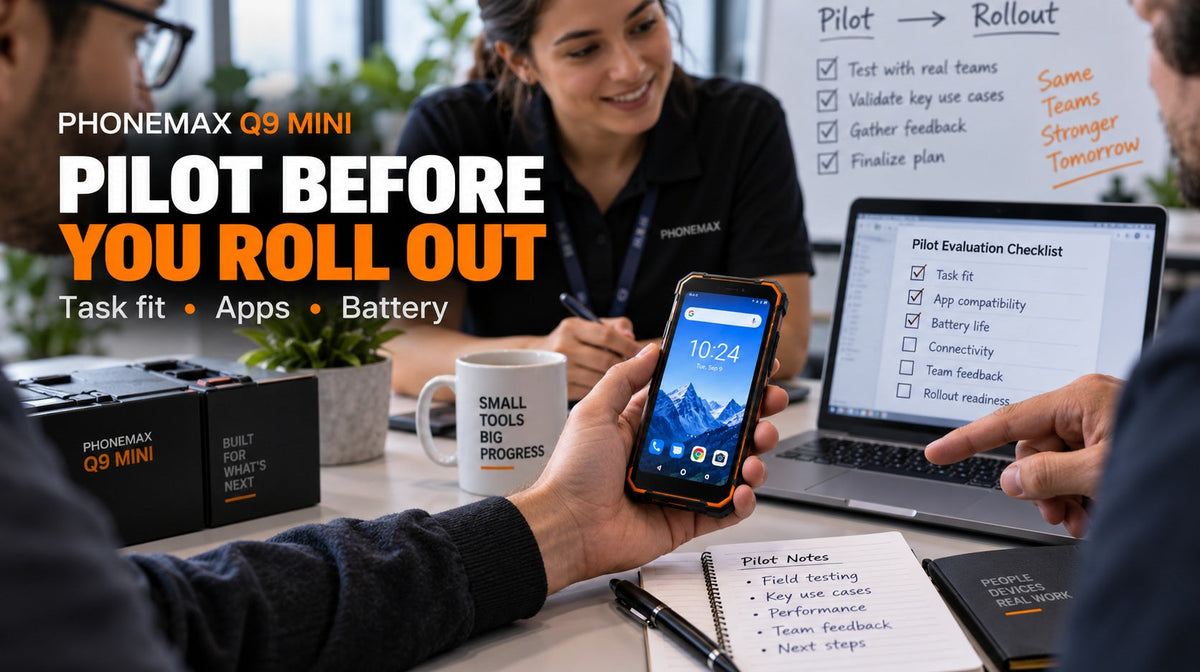
Test whether people can complete a real task on the screen, not whether they like the phone. Everyone likes a 109 g phone for the first two days. The rollout question is different and much narrower: can a staff member read the roster, respond to the message, check the address and log the job — on a 114 x 53.3 mm device — without it costing them time every single day. Run a two-week task-completion pilot and you will have the answer. Skip it and you will find out in month two, at scale.
Key facts
| Specification | Phonemax Q9 Mini |
|---|---|
| Product type | Compact Android 14 smartphone |
| Dimensions | 114 x 53.3 x 12.4 mm |
| Weight | 109 g |
| Memory | 4GB RAM + 64GB storage |
| Operating system | Android 14 |
| Battery capacity | 2,000 mAh |
| Network versions | Separate EU/Asia and US/Americas band versions |
| Price | $119 (bundle of two with a smartwatch listed at $238) |
At the time of writing the US/Americas version is out of stock in both Black and White. Only the EU/Asia version is available. For a rollout, confirm volume availability of the version matching your carriers before planning anything.
Where a mini phone rollout genuinely makes sense
Be clear about the use case before evaluating, because the Q9 Mini is a poor general-purpose fleet phone and a strong fit for three specific patterns.
The secondary work phone. Staff carry their own phone plus a company device. The company device handles calls, messaging, rostering and simple job logging. Its virtue is that it is small enough that people actually carry it rather than leaving it in a drawer. This is the strongest case.
Roles where carrying is the constraint. Hospitality, events, retail floor, healthcare support — people moving constantly, often in uniforms without useful pockets, where a 200 g phone genuinely does not get carried.
High-turnover or shared-pool devices. At $119, replacing a lost unit is a manageable cost rather than an incident. For seasonal staff or shared-pool allocation the economics are different from a $500 handset.
Where it does not fit: as the primary device for anyone who writes at length, works from documents, uses a demanding line-of-business application, or needs rugged protection. If your evaluation is drifting toward those, the conclusion is that you need a different device, not a better pilot.
The evaluation, stage by stage
Stage 1: Write down the tasks, then time them
List the five things a staff member will actually do on this device every day. Be concrete — "check tomorrow's shift and confirm it", not "use the rostering app".
Then have pilot users perform each task on the Q9 Mini and on whatever they use today, and record how long it takes. You are not looking for the mini phone to win; you are looking for whether it loses by an amount that matters. Ten seconds longer to confirm a shift is irrelevant. Two minutes longer to log a job, forty times a week, is a rollout that will be abandoned.
This single test is worth more than every other stage combined, because screen size is the one variable a specification sheet cannot translate into your workflow.
Stage 2: Verify the applications actually work
Install every line-of-business app on the actual 4GB/64GB Android 14 configuration and use them in anger. Watch specifically for:
- Interfaces that assume a larger screen. Some business apps place controls off-screen or overlap them on narrow displays.
- Forms with many fields, where a small screen forces constant scrolling.
- Anything requiring signature capture or drawing, which is genuinely difficult at this size.
- Storage growth over time. 64GB is adequate but not generous; check what your app set consumes after a fortnight of real use.
An app that renders badly on a narrow screen is a hard stop and is not fixable by training.
Stage 3: Bands and regional versions
The Q9 Mini ships in separate published band versions for EU/Asia and the Americas. Compile the carriers your teams use, compare against the published bands for the version you intend to buy, and test on real SIMs before ordering.
For a rollout this is more consequential than usual, because the US/Americas version is currently out of stock. A deployment plan that assumes availability of a version you cannot buy is not a plan. Confirm in writing.
Stage 4: Battery, honestly
The current product page lists a 2,000 mAh battery. That capacity fits the compact format, but whether it lasts a full shift depends on signal quality, screen time and the applications your team uses.
So measure it. Have pilot users record battery percentage at shift start, midday and shift end for two weeks. What you need to know is not a number in mAh but whether a shift ends with usable charge under your actual usage.
If it does not, the answer is not a power bank for everyone — that adds weight and cost and defeats the purpose. The answer is either a charging point at the workplace, or a different device.
Stage 5: Loss, damage and the replacement path
Small phones get lost and dropped. That is not a criticism of this model; it is the format.
- What is your replacement process and how fast is it?
- Are you issuing screen protectors? At $119, a cracked screen is close to a total loss, so a protector is cheap insurance across a fleet.
- Do you need lanyards for roles where the device is handled constantly?
- The Q9 Mini is not a rugged phone. If your environment breaks phones, see the alternatives below.
Stage 6: IT and lifecycle
- MDM enrolment and management on Android 14, verified before ordering.
- Bulk provisioning method for the fleet size.
- Android security update expectations across your deployment life — ask for this in writing.
- RMA process, turnaround and geographic coverage.
- Spares ratio, and whether spares remain purchasable at equivalent terms.
Comparison: what else to pilot alongside
Running a comparative pilot costs little more and produces a far stronger decision.
If the environment is at all demanding, pilot the Phonemax R4 Mini at $138 alongside. It is a compact Android 14 rugged phone at 121 x 59.5 x 15.5 mm and 150 g — 41 g heavier and slightly larger, but ruggedness engineered in rather than added with a case. For most workplaces that break phones, this is the better trade. Note it has the same regional-version consideration, and its US/Americas version is also currently out of stock.
If some roles need a usable screen and rugged protection, the Phonemax X5 from $129 offers Android 16, a 5.3-inch display and a 5000 mAh battery at 238 g — the battery question largely disappears at that capacity, at the cost of pocketability.
If the team's real need is loud, simple and durable rather than small and smart, the Phonemax F3 T at $69.90 is an Android touchscreen feature phone with a 2500 mAh battery and a 3W speaker rated up to approximately 120 dB under test conditions. Half the price, and for roles that mostly make calls it may be the honest answer.
Mixed fleets by role are normal and usually cheaper than standardising on one compromise device. Compare within the Mini Phones and Rugged Phones collections.
Limitations and what to know
- The Q9 Mini is not a rugged phone. No IP rating is published for it. Do not deploy it into an environment that requires ingress protection.
- The battery is listed at 2,000 mAh. Treat that as capacity, not a runtime promise, and measure shift endurance in your pilot.
- US/Americas stock is currently unavailable. This materially affects rollout planning in those regions.
- Screen size is the binding constraint and it cannot be trained around. If the task-completion test fails, the device fails.
- 4GB RAM and 64GB storage is a modest configuration. Adequate for communication and light app use; verify with your specific applications.
- Accessory ecosystem is thinner than for mainstream phones, though model-specific screen protectors do exist from third-party makers.
- No major professional laboratory review was found in our 8 September 2026 check. Independent owner reports and specification listings exist, but they are not controlled testing.
- The two-for-$238 bundle with a smartwatch is not a fleet purchasing mechanism. Price it as individual units for a rollout.
FAQ
How many pilot units do we need for a team rollout? Three to five for a team under fifty, covering the different roles that would receive the device. The value is in task-completion data from real users, not in unit count.
How long should the pilot run? Two weeks minimum. The first few days are dominated by novelty; the friction that kills a rollout shows up in week two.
Is the Q9 Mini suitable as a primary work phone? For roles centred on calls, messaging, rostering and light app use, potentially yes. For anyone writing at length, working from documents or using demanding applications, no — the screen is the limit.
Is it rugged? No. No IP rating is published. For demanding environments, evaluate the R4 Mini or X5 instead.
Can we order the US/Americas version for a rollout? It is currently out of stock in both colours. Confirm current availability and volume lead time before building a deployment plan around it.
What happens if the task-completion test is borderline? Treat borderline as a fail for a large rollout, or restrict deployment to the specific roles where it passed clearly. A device that costs each user two minutes a day will be quietly abandoned.
Editorial disclosure
Phonemax publishes and sells the Q9 Mini. Specifications and variant availability were checked against the current product page on 8 September 2026. The recommended two-week pilot is an evaluation method, not a claimed customer case study or guaranteed deployment outcome.
Sources and references
- Phonemax Q9 Mini product page — manufacturer specifications and current variants
- Phonemax R4 Mini product page — rugged compact comparison
- DeviceSpecifications Q9 Mini specification entry (independent aggregator)
- ProductReview Q9 Mini owner reports (independent user reviews)
- Reddit r/smallphones discussion of compact models (independent user discussion)
Evidence boundaries: device specifications and stock status are first-party manufacturer data verified on 8 September 2026. DeviceSpecifications republishes specifications; ProductReview and Reddit contain owner reports. None is controlled laboratory testing or a documented fleet deployment.
Related guides
- Phonemax Q9 Mini vs R4 Mini: Which Small Android Phone Fits You?
- Is a Mini Android Phone Easy to Use? A One-Handed Test for the Phonemax Q9 Mini
- Small Backup Phone for Travel: What Should It Actually Be Able to Do?

コメントを書く
全てのコメントは、掲載前にモデレートされます
このサイトはhCaptchaによって保護されており、hCaptchaプライバシーポリシーおよび利用規約が適用されます。