
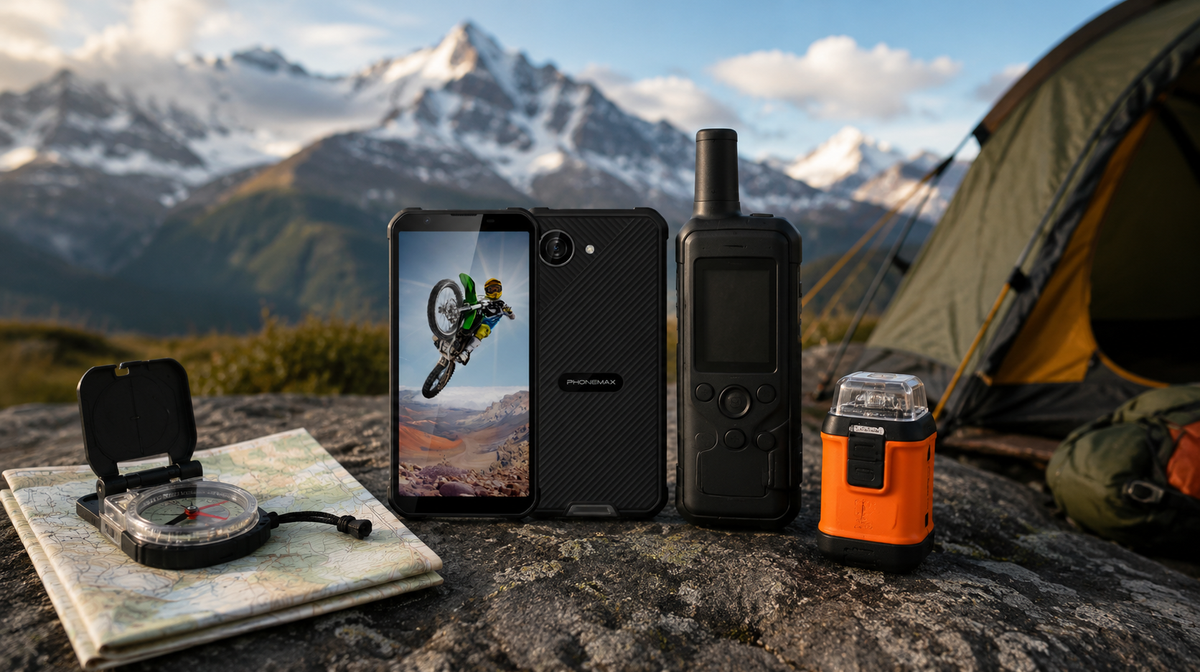
A rugged phone and a satellite communicator solve different problems. The phone provides apps, offline maps, camera, local records and cellular communication where service exists. A satellite communicator or registered 406 MHz personal locator beacon provides a separate remote-communication or distress path. High-consequence trips may need both, not a forced either/or choice.
Separate navigation, messaging and rescue
| Capability | Rugged phone | Satellite communicator | 406 MHz PLB |
|---|---|---|---|
| Offline maps | Strong with downloaded maps | Varies by model/app | No |
| Cellular calls/data | Yes, where supported | Not its primary network | No |
| Two-way satellite messaging | Only on specifically supported hardware/service | Often, with plan and sky view | Generally no |
| Direct distress alert to SAR network | Not from ordinary cellular/GPS alone | Depends on service and emergency center | Core purpose when activated and registered |
| Everyday apps/camera | Yes | Limited | No |
NOAA describes 406 MHz PLBs as portable devices intended for individuals in remote wilderness activities. Its guidance emphasizes that a 406 beacon places distress information into the national search-and-rescue network. That role should not be inferred from a phone’s ruggedness or GPS capability.
Build a layered remote-trip plan
- Map cellular coverage and identify where it ends.
- Download maps, routes, contacts and emergency instructions to the phone.
- Choose a satellite communicator or PLB appropriate to the trip and jurisdiction.
- Register and activate the service; send a non-emergency test through the approved process.
- Give a trusted contact the route, return time and escalation plan.
- Carry power and protect devices from loss. Keep one emergency tool physically independent of the phone.
Phonemax X5 is not advertised as a satellite phone
The current X5 listing describes a 4G rugged smartphone with GPS, GLONASS, BeiDou and Galileo support, plus Wi-Fi and Bluetooth. It does not list satellite messaging, satellite calling or 406 MHz beacon functionality. Do not interpret the word “rugged,” multi-GNSS positioning or offline maps as satellite communication.
For trip preparation, pair this page with the multi-day hiking checklist. The correct redundancy depends on remoteness, terrain, rescue response, group skills, legal requirements and the consequences of one device failing.
Frequently asked questions
Can GPS work when there is no cellular service?
Positioning can work without cellular data, but maps, messaging and emergency delivery may still require downloaded data or another communication system.
Is a satellite communicator the same as a PLB?
No. Subscription communicators and 406 MHz PLBs have different networks, features, registration and emergency workflows.
Can a rugged phone replace a PLB?
Not for trips where the safety plan requires coverage-independent distress alerting. A rugged phone’s durability and GPS do not create a 406 MHz beacon.
What must be tested before departure?
Activation, subscription, registration, battery, sky view, message delivery, emergency procedure and offline maps for the exact region.
Sources and verification links
Editorial method
Prepared by the Phonemax Editorial Team on 22 August 2026. We checked the current product listing, separated published specifications from field-test requirements, and linked primary sources beside the claims they support. To request a correction, contact Phonemax through the official website.


Deixar comentário
Os comentários precisam ser aprovados antes da publicação.
Este site é protegido por hCaptcha e a Política de privacidade e os Termos de serviço do hCaptcha se aplicam.