
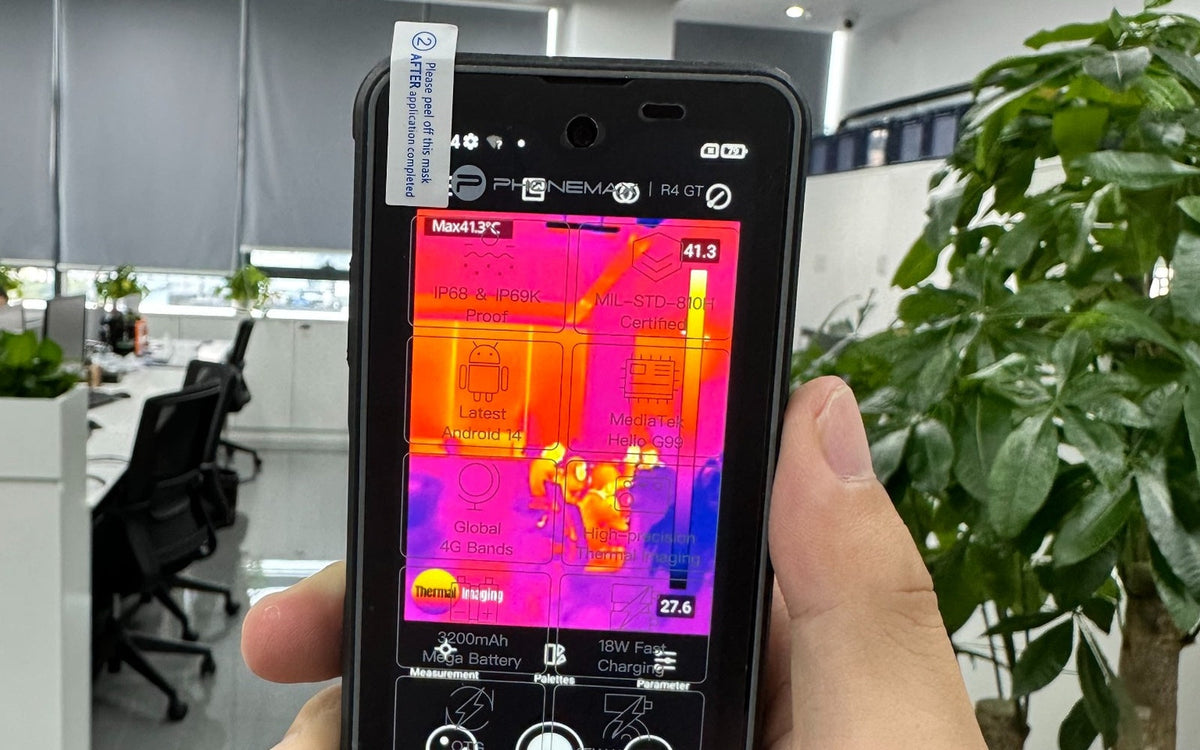
An adapter seems unusually warm. Where is the heat concentrated? A room feels cold near a window. Which part of the frame deserves a closer look?
A normal photograph cannot show those temperature patterns. The Phonemax R4 GT adds a thermal view, helping you locate differences and decide what to investigate next.
It combines thermal imaging, night vision and everyday smartphone functions in a compact rugged body. For property owners, outdoor enthusiasts and people making preliminary equipment checks, that means keeping another observation tool close at hand.
What Does the R4 GT’s Thermal Camera Do?
Thermal imaging detects infrared radiation and converts it into an image showing thermal patterns. Colours or shades distinguish warmer and cooler areas across the surfaces in view.
As Testo explains in its guide to thermal imaging, surface properties, reflections and measurement conditions influence how the image should be interpreted.
The R4 GT’s 256 × 192 thermal camera shows a pattern across an area. A spot infrared thermometer checks a selected location; a thermal image helps you identify which location deserves attention.
That is useful when you notice warmth but do not yet know where it is concentrated.

R4 GT Features and Their Practical Benefits
| Feature | Specification or coverage | Practical benefit |
|---|---|---|
| Thermal camera | 256 × 192 | Reveals thermal patterns across a scene |
| Night vision camera | 20MP | Provides a separate view of surroundings in dark conditions |
| Main camera | 64MP autofocus | Records visible detail and identifies the object being examined |
| Display | 4.3-inch, 540 × 1200 | Supports a compact handheld format |
| Dimensions and weight | 121 × 59.2 × 18.3 mm; 190 g | Combines specialised imaging with a portable smartphone |
| Protection | IP68/IP69K | Provides dust and water protection within stated conditions |
| Battery | 3200mAh | Powers the phone and its integrated imaging functions |
| Charging | 18W wired; 15W wireless | Provides wired and wireless charging options |
| Manufacturer warranty | 12-month limited warranty | Covers eligible manufacturing defects under the warranty terms |
For measurement-dependent applications, confirm the thermal measurement range, accuracy and frame rate with Phonemax before selecting a device. Thermal resolution alone does not establish measurement accuracy.
Explore the R4 GT product specifications and available configurations for further details.
Thermal Imaging and Night Vision Serve Different Purposes
The R4 GT provides three complementary views.
Thermal imaging shows thermal patterns. It distinguishes warmer and cooler surfaces without relying on visible light.
Infrared night vision captures scene detail using infrared illumination. Think of a camera using an infrared light source that human eyes cannot see.
The main camera records conventional photographs. These provide visible colour, detail and context.
A thermal image can highlight a warm area on an adapter. A normal photograph identifies the adapter, its connections and its location. Together, they make the observation easier to understand.
Why Combine Thermal Imaging with a Rugged Phone?
Thermal checks often happen during another activity: walking around a property, handling equipment or spending time outdoors.
A rugged smartphone is built for more demanding physical conditions. Its construction and protection address the environment in which the device is used. The thermal camera adds information about the surroundings.
The R4 GT’s IP68/IP69K protection supports this combination within specified limits. Follow the device’s instructions for exposure, care and maintenance.
Integration also simplifies preparation. Open the built-in thermal interface instead of retrieving a separate imager or connecting an external thermal module.
| Option | Main advantage | Main trade-off |
|---|---|---|
| R4 GT with integrated thermal imaging | Thermal imaging and communication in one compact device | The thermal camera remains part of the phone’s hardware |
| Phone with an external thermal module | The module can be replaced or upgraded independently, subject to compatibility | Requires a compatible phone, connection and accessory |
| Dedicated thermal camera | Can be selected around specialist measurement and reporting requirements | Adds another device to carry and maintain |
For preliminary checks, immediate availability is valuable. For specialist inspection, measurement performance and reporting requirements remain central to the equipment choice.
Explore the R4 GT’s imaging features and configurations.
Practical Uses for the R4 GT
Checking Warmth Around Electronics
Chargers and adapters normally produce heat during operation. The R4 GT’s thermal camera shows how that warmth is distributed across accessible external surfaces.
For example, you can examine whether warmth is spread across an adapter’s casing or concentrated around one area. Comparing observations under similar operating loads makes the pattern more meaningful.
A thermal pattern alone does not establish a fault. It provides a location or difference to investigate further.
Exploring Temperature Differences at Home
Around windows, doors and heating systems, thermal imaging can highlight surface temperature differences that are difficult to judge visually.
A cool patch near a window can focus attention on a particular section of the frame or adjoining wall. Air movement, insulation, moisture and sunlight can all influence the pattern.
The image gives you a location to examine more closely. Further checks establish the cause.
Adding Another View Outdoors
Exposed warm objects can stand out against cooler surroundings when sufficient temperature contrast exists.
The R4 GT provides thermal imaging and separate night vision, allowing you to choose between thermal patterns and scene detail in dark conditions.
Distance, obstructions and background conditions affect what is visible. An open view of an object provides different information from a scene where branches, walls or other surfaces block it.
Making Preliminary Maintenance Checks
Comparing similar accessible components under similar operating conditions can reveal a difference worth investigating.
If one component appears warmer than its neighbours, record its location and workload. That context makes the observation easier to discuss with a colleague or technician.
Maintain appropriate distances from hot, moving or electrically hazardous equipment and follow relevant procedures.
A Simple Process for Useful Thermal Records
- Identify the object. Take a normal photograph showing its location and surroundings.
- Record the conditions. Note running time, workload and relevant environmental details.
- Read the scale. Examine the displayed temperature values alongside the colours.
- Keep comparisons consistent. Use similar distances, angles and operating conditions.
- Choose the next step. Decide whether to observe again, investigate further or consult a qualified person.
This turns an isolated image into information someone else can interpret.
How to Interpret Thermal Images Correctly
Read the Temperature Scale
A bright colour represents a position within the selected palette. It does not automatically indicate a dangerous temperature.
When the camera adjusts its scale, similar colours in separate images can represent different temperatures. Check the displayed values before comparing images.
Account for Reflective Surfaces
Shiny metal can reflect infrared radiation from surrounding objects. An apparent warm area can therefore partly reflect something nearby.
FLIR’s explanation of emissivity describes why surface properties matter when interpreting thermal measurements.
Understand What the Camera Can See
Thermal imaging observes surface patterns. It cannot provide a direct view through walls.
Heat behind a wall can sometimes affect its surface temperature, creating an indirect pattern. Ordinary window glass also prevents a direct view through it in the long-wave infrared band commonly used by thermal cameras.
FLIR’s guide to thermal imaging limitations explains these distinctions.
Is the R4 GT Right for You?
The R4 GT is a practical option if you want thermal imaging alongside everyday phone functions and value a compact rugged format.
Its main benefits are straightforward:
- Integrated thermal imaging: open the camera without connecting a separate module.
- Multiple imaging options: choose thermal imaging, night vision or conventional photography according to the task.
- Portable construction: carry the combined capabilities in a 190 g smartphone.
- Connected documentation: record observations and communicate through the same device.
- Manufacturer warranty: a 12-month limited manufacturer warranty covering eligible manufacturing defects, subject to the warranty terms.
Consider the format alongside those benefits. The compact display offers less viewing area than a larger phone or tablet. Battery runtime varies with imaging use, screen settings and connectivity.
For specialist inspection work, select equipment around the required measurement performance, calibration and reporting process.
View the Phonemax R4 GT and choose your configuration.
For sample enquiries or team purchases, email marketing@phonemax.com with your application, destination country and quantity.
Frequently Asked Questions
Does the R4 GT Need an External Thermal Camera?
No. Its thermal camera is integrated into the phone, so a separate thermal attachment is not required.
What Is the R4 GT’s Thermal Resolution?
The thermal resolution is 256 × 192 pixels. This is separate from the megapixel specifications of its main and night vision cameras.
Does Thermal Imaging Work in Darkness?
Yes. Thermal imaging does not depend on visible light. Useful image detail still depends on temperature contrast, the target and camera performance.
Can the R4 GT Identify a Faulty Charger?
It can reveal thermal patterns across the charger’s accessible casing. Determining whether a pattern indicates a fault requires operating context and further checks.
Can the R4 GT See Through Walls?
No. Its thermal camera observes surface patterns. Heat behind a wall can influence the surface temperature, but the camera does not show a direct view through it.
What Warranty Does the R4 GT Include?
The R4 GT includes a 12-month limited manufacturer warranty covering eligible manufacturing defects, subject to the warranty terms. Retain your proof of purchase for warranty service.



Залишити коментар
Усі коментарі модеруються перед публікацією.
Цей сайт захищено за допомогою hCaptcha. Застосовуються Політика конфіденційності та Умови надання послуг hCaptcha.