
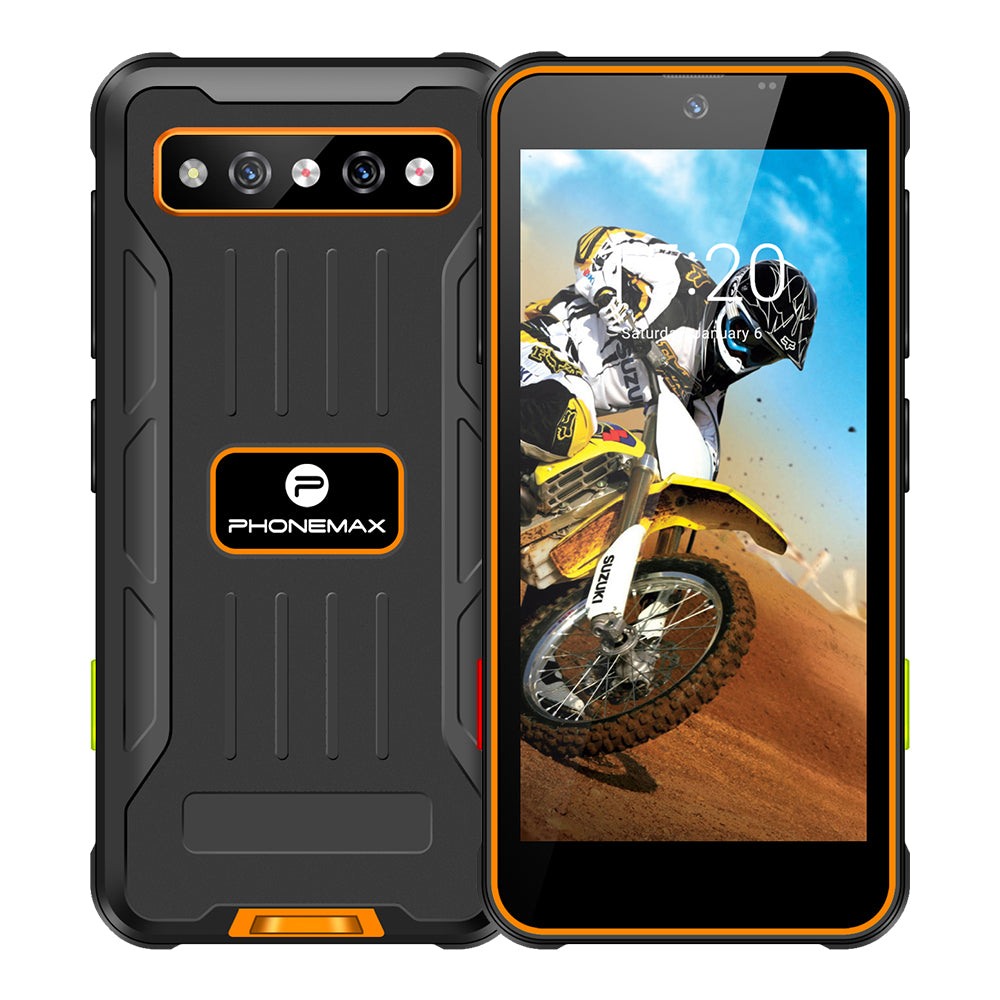
The best small rugged phone is the one that fits your actual carry routine and work requirements. Start with four questions: how small must it be, do you need thermal imaging or night vision, how long will it stay away from a charger, and which network version works with your carrier?

The Phonemax range offers different answers. The R4 Mini prioritizes low weight and compact everyday handling. The R4 GT adds thermal imaging and night vision to a similarly compact body. The P2 is the battery- and storage-focused option, with a listed 6,100mAh battery, 8GB RAM, 128GB storage and IP68 protection.
What if you need a rear display or a newer X5 configuration?
The R4-T adds a rear information screen and a listed 20MP night-vision camera. Read the R4-T feature guide if quick status checks and night vision matter; compare the R4 GT separately when thermal imaging is required.
The X5 offers a 5.3-inch display and a listed 5000mAh battery. Use the X5 T615 vs G81 guide to check the version-specific differences. Compare all current mini phones by dimensions, weight and carrier requirements rather than screen diagonal alone.
Quick answer: which model fits which user?
- Choose the Phonemax R4 Mini if you want a compact Android phone for one-handed use, travel, communication and everyday carry.
- Choose the Phonemax R4 GT if you want a compact rugged phone with integrated thermal imaging and night vision for field work or outdoor observation.
- Choose the Phonemax P2 if you value a larger battery, more storage and a rugged work-oriented configuration more than a mini form factor.
The R4 GT is the specialist choice, not automatically the best choice for every buyer. An independent Root-Nation review found its compact body comfortable to hold, while also noting that the small display can make icons and keyboard input harder to use at first. Those comments apply to the reviewed R4GT sample, not every rugged phone.
What counts as a small rugged phone?
“Small” and “rugged” describe different things. Small usually means a shorter, narrower or lighter body that is easier to pocket and hold. Rugged describes a design intended for more demanding use than a typical consumer handset. Small plus rugged often requires a compromise in screen size, battery capacity, camera hardware or typing comfort.
Do not judge a compact phone only by its height. Thickness and weight affect whether it is comfortable in a pocket, tool pouch or hand during a full workday.
1. Choose the body size before choosing the feature list
The Phonemax R4 Mini measures 121 × 59.5 × 15.5 mm and weighs 150 g. Its published Android 14 configuration makes it the portability-focused option in this comparison.
The R4 GT measures 121 × 59.2 × 18.3 mm and weighs 190 g. It is only slightly different in height and width, but it is thicker and heavier because it includes additional imaging hardware.
- Measure the pocket or pouch where the phone will be carried.
- Add the thickness of any case or protective accessory you plan to use.
- Consider whether you will operate it with gloves or one hand.
- Decide whether a smaller display will make typing, maps or work forms slower.
2. Decide whether specialist imaging is part of the job
Thermal imaging helps reveal temperature differences and heat patterns. Night vision helps provide visible scene detail in low-light conditions. A conventional camera is usually sufficient for ordinary photos, documents and daylight records.

The R4 GT combines thermal imaging and night vision in a compact 4G rugged phone. A GSMaholic R4GT video review visibly demonstrates the phone’s compact body and imaging functions. Treat the video as third-party sample coverage; it does not establish universal performance, calibration or suitability for safety-critical measurements.
For regulated, calibrated or safety-critical measurement, use equipment that meets the requirements of the application. A phone-integrated thermal camera is best treated as a convenient screening and documentation tool unless a qualified professional process says otherwise.
3. Match battery capacity to the way you work
Battery capacity matters when charging opportunities are limited, but capacity is not the same as guaranteed runtime. Signal strength, screen brightness, navigation, camera use, background apps, temperature and network activity all change actual battery life.
The Phonemax P2 is listed with a 6,100mAh battery, 8GB RAM and 128GB storage. That makes it the clearest fit of the three for users who prioritize longer off-grid use, work applications and local file storage.

4. Check memory and storage against your apps
List the apps and files you will actually use before deciding: navigation and offline maps, messaging, inspection or work-order applications, photos, offline manuals and access apps.
The P2’s listed 8GB RAM and 128GB storage are suited to buyers who expect more local files and multitasking. The R4 Mini is more appropriate when compact communication, navigation and everyday apps are the priority.
5. Verify the regional network version before purchase
A phone can be the right physical size and still be the wrong purchase if its network bands do not match your carrier. The R4 Mini has separate published Europe and US/Americas configurations. The R4 GT also publishes its supported 4G, 3G and 2G bands.
- Country and carrier
- Exact model and regional version
- LTE or 5G bands used where the phone will operate
- Voice and VoLTE requirements
- SIM, activation and device-approval requirements
Comparison table
| Model | Best fit | Officially listed facts | Main trade-off |
|---|---|---|---|
| Phonemax R4 Mini | One-handed use, travel and everyday carry | Android 14; 121 × 59.5 × 15.5 mm; 150 g | Smaller screen and fewer specialist tools |
| Phonemax R4 GT | Compact field communication plus thermal imaging and night vision | 4G; 121 × 59.2 × 18.3 mm; 190 g | Heavier and thicker than the R4 Mini |
| Phonemax P2 | Battery-focused outdoor and demanding work | 6,100mAh; 8GB + 128GB; IP68/IP69K listed | Less focused on mini-phone portability |
When a small rugged phone is the wrong choice
- You spend most of the day typing long documents.
- You need a large map or detailed work-order interface.
- You require calibrated thermal measurements.
- Your carrier has not confirmed the exact regional version.
- You are buying a device only because it looks durable, without a real outdoor or field-use requirement.
Final recommendation
Choose the R4 Mini for the lowest weight and simplest compact carry experience. Choose the R4 GT when thermal imaging and night vision are central to your field routine. Choose the P2 when battery, memory, storage and listed environmental protection matter more than a mini form factor.
Before ordering, review the current configuration and confirm carrier compatibility for your location.
Related guides
- Check rugged phone carrier compatibility before choosing a regional version.
- Compare thermal imaging and night vision if specialist imaging is part of your work.
Frequently asked questions
What is the best small rugged phone for one-handed use?
The Phonemax R4 Mini is the portability-focused option. It measures 121 × 59.5 × 15.5 mm and weighs 150 g. Its smaller display may require more adjustment for dense typing or long forms.
Should I choose the R4 Mini or R4 GT?
Choose the R4 Mini for lower weight and everyday portability. Choose the R4 GT if you will use integrated thermal imaging and night vision for field or outdoor tasks.
Is the Phonemax P2 a mini rugged phone?
The P2 is better described as a battery- and storage-focused rugged phone. Its listed strengths are a 6,100mAh battery, 8GB RAM, 128GB storage and IP68/IP69K protection.
Can a phone thermal camera replace professional inspection equipment?
Not automatically. It can support screening and field documentation, but regulated, calibrated or safety-critical applications may require certified professional equipment.
Does a compact rugged phone work with every carrier?
No. Verify the exact regional version, network bands, voice requirements and carrier approval process before purchase.


Efterlad en kommentar
Alle kommentarer er modereres, før de bliver offentliggjort.
'Denne side er beskyttet af hCaptcha, og hCaptchas Politik om beskyttelse af persondata og Servicevilkår er gældende.