
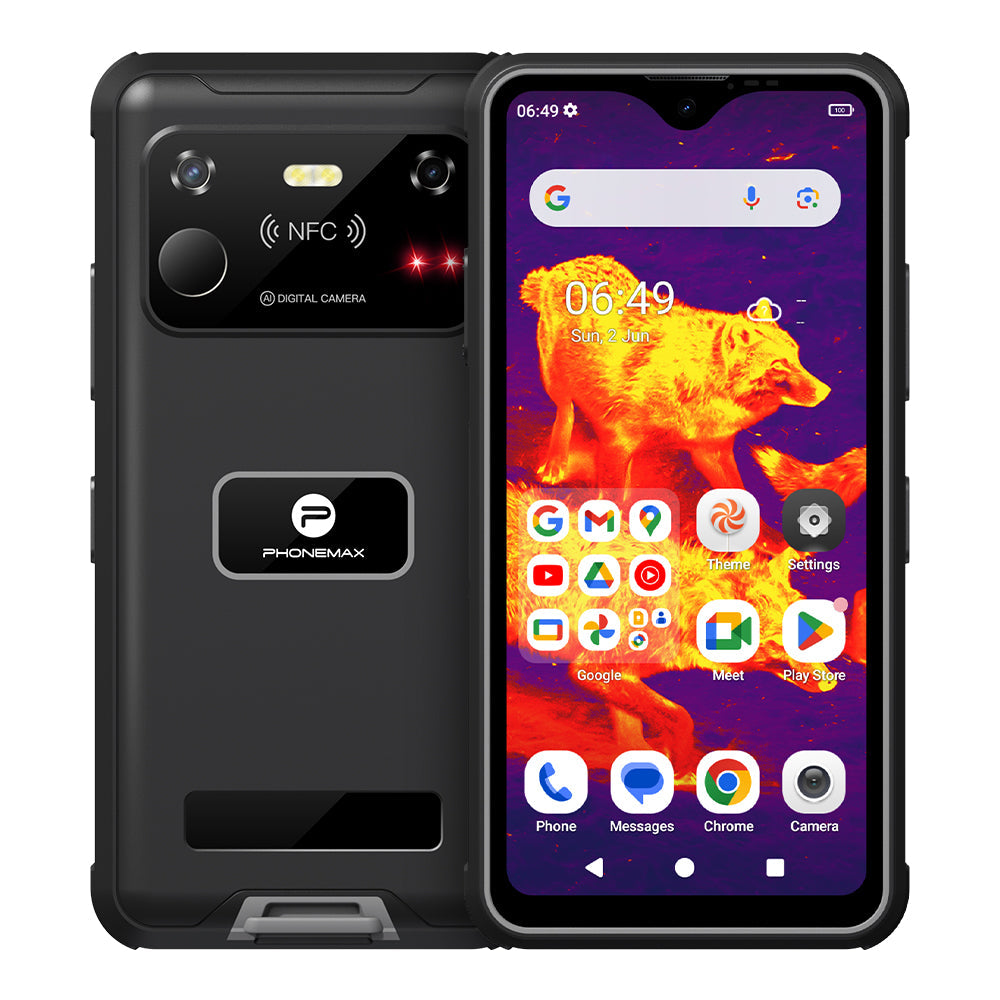
Short answer: choose the Phonemax R4 GT when compact size, lower carry weight, thermal imaging and night vision are the priority. Choose the Phonemax P20 Pro when you want a larger full-size rugged phone with 5G support and integrated thermal imaging.
The two products can serve overlapping inspection jobs, but their physical and connectivity profiles are very different. The right choice depends less on the phrase “thermal phone” and more on how the device will be carried, connected and used during a shift.
R4 GT vs P20 Pro at a glance
| Specification | R4 GT | P20 Pro |
|---|---|---|
| Dimensions | 121 × 59.2 × 18.3 mm | 172.6 × 81 × 17.8 mm |
| Weight | 190 g | 394 g |
| Cellular positioning | 4G rugged phone | 5G rugged phone |
| Thermal imaging | Integrated | Integrated |
| Night vision | Listed | Not the defining feature of the current listing |
| Best fit | Compact inspection carry | Full-size 5G thermal workflow |
The size difference is operational, not cosmetic
At 190 g, R4 GT is less than half the listed weight of the 394 g P20 Pro. Its 121 mm height and 59.2 mm width also place it in a much smaller physical class. That matters when the phone lives in a pocket, vest, tool pouch, climbing harness, or crowded equipment kit.
P20 Pro’s larger body is the tradeoff buyers make for a full-size smartphone platform and 5G connectivity. For workers who spend more time viewing maps, reports, photographs, messages or thermal scenes on the handset itself, a larger device can be more comfortable. For a technician who wants a compact inspection tool that is carried all day and pulled out briefly, R4 GT may fit better.
Do not confuse thermal detection with guaranteed temperature accuracy
A thermal image is extremely useful for finding patterns and anomalies—hot connections, uneven heating, insulation differences or unexpected thermal zones—but accurate temperature measurement depends on more than pointing the camera at a surface.
FLIR’s thermography documentation explains that emissivity, reflected temperature, object distance, ambient conditions and other factors can influence temperature measurement. Reflective metals are a classic challenge because they can reflect thermal radiation from surrounding objects. That means a thermal rugged phone should be treated as an inspection and screening tool whose readings must be interpreted within a proper measurement method.
Choose R4 GT for compact dual-vision field work
R4 GT combines thermal imaging with night vision in a compact 4G rugged-phone format. That combination can be valuable when inspection work moves between dark environments and thermal checks, or when a worker wants one small device instead of carrying a large phone plus additional viewing tools.
The deciding question should be whether 4G coverage and the R4 GT’s regional bands meet the deployment area. A compact device is only useful if it can connect reliably where the team works.
Choose P20 Pro when 5G and a full-size platform matter
P20 Pro is the stronger starting point when the buyer explicitly requires 5G and wants thermal imaging integrated into a larger rugged smartphone. Its current product listing includes 5G NR bands N1, N3, N7, N28, N38, N41, N77, N78 and N79. Carrier compatibility still needs to be checked by country and operator; a list of bands is not a universal guarantee of service.
For teams that use the phone for communication, forms, image review and general smartphone tasks as heavily as they use thermal imaging, the larger platform may justify the extra size and weight.
A thermal-phone selection test
- List the actual inspection targets. Electrical panels, motors, HVAC, pipes and building surfaces create different thermal challenges.
- Identify reflective surfaces. If polished metal is common, train users on emissivity and reflections instead of trusting every displayed number.
- Test viewing distance. Reproduce how close the worker can safely approach the target.
- Compare carry burden. Wear the device for a realistic shift, not a five-minute demo.
- Verify network bands. Match the exact phone version to the intended carrier and country.
- Document escalation rules. Decide which thermal anomaly triggers a second instrument, shutdown, or specialist inspection.
Compare the wider range: visit the Phonemax rugged phones collection to compare R4 GT and P20 Pro with other compact, 4G, 5G, night-vision and battery-focused rugged smartphones.
FAQ
Which is smaller, R4 GT or P20 Pro?
R4 GT is substantially smaller and lighter based on current listings: 121 × 59.2 × 18.3 mm and 190 g, versus 172.6 × 81 × 17.8 mm and 394 g for P20 Pro.
Which one supports 5G?
P20 Pro is the 5G model. R4 GT is positioned as a 4G compact thermal rugged phone.
Does R4 GT have night vision?
Yes. The current R4 GT listing combines thermal imaging and night vision.
Can a thermal phone replace a calibrated professional instrument?
Not automatically. Measurement accuracy depends on the target and measurement conditions. For safety-critical or precision work, use the required professional procedure and calibrated equipment.
Sources
- Phonemax R4 GT official product page
- Phonemax P20 Pro official product page
- FLIR — How emissivity affects thermal imaging
- FLIR documentation — Thermal camera measurement factors
Publisher disclosure: This comparison is published by Phonemax and evaluates two Phonemax products, R4 GT and P20 Pro. Device dimensions, weight, network support and listed thermal/night-vision features come from current Phonemax product listings and are first-party product information. The discussion of emissivity, reflections and thermal-measurement limitations is based on independent FLIR documentation. The article does not treat Phonemax product claims as independent proof of measurement accuracy and does not replace calibrated instruments, professional thermography procedures or safety requirements where those are required.


Dejar un comentario
Todos los comentarios se revisan antes de su publicación.
Este sitio está protegido por hCaptcha y se aplican la Política de privacidad de hCaptcha y los Términos del servicio.