
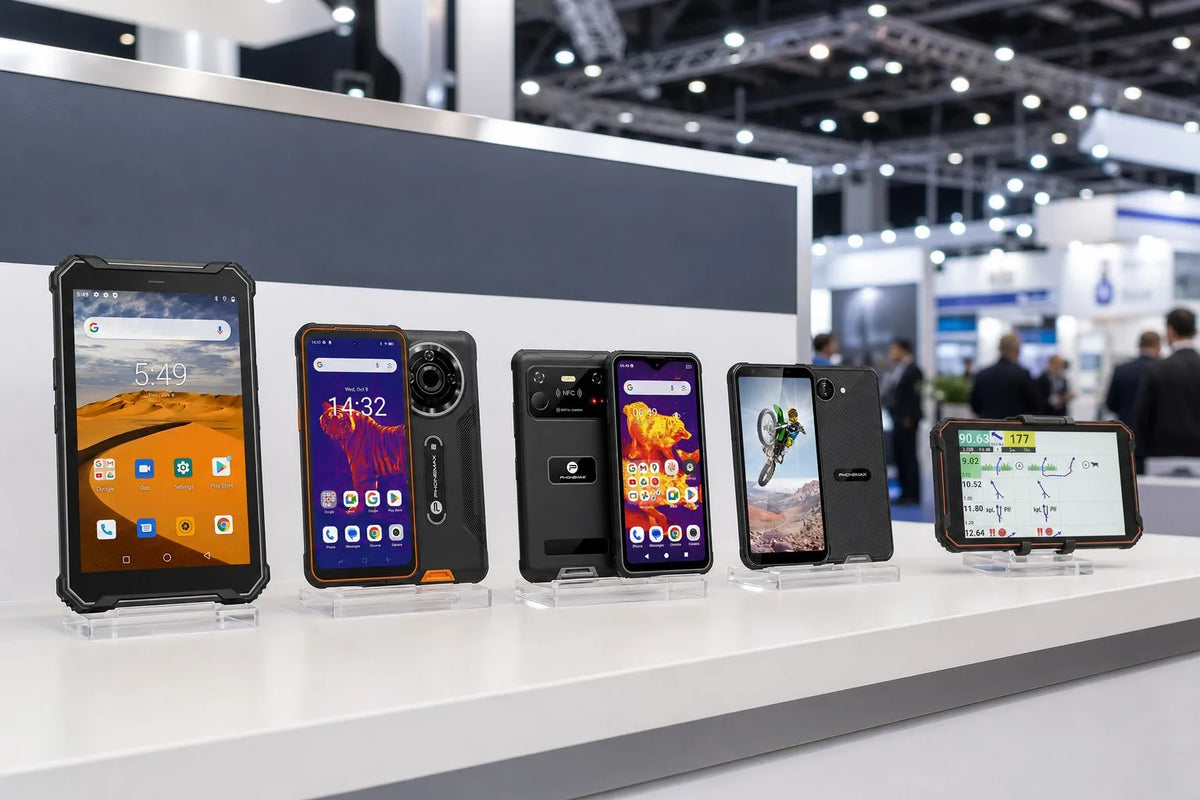
Guangzhou, April 2026. The Canton Fair has run every spring and autumn in Guangzhou since 1957. Ahead of the 139th session, the organiser announced a planned exhibition area of about 1.55 million square metres and more than 30,000 expected exhibitors. Final attendance figures are published by the organiser after each session. At that scale, a buyer walking the electronics halls has minutes per booth, not hours.
So we built our stand around one question, and it is the question this article answers: not which rugged phone is toughest, but which device actually fits your job.
What Phonemax showed at the Canton Fair

Visitors rarely arrive with a model number in mind. They arrive with a problem. Technicians keep breaking phones on site. Warehouse tablets die mid-shift. A rally team needs roadbook navigation that survives dust and vibration. A distributor needs a keypad phone that still runs Android apps.
Our display covered six device roles rather than one flagship:
- 5G and thermal rugged phones — P20 5G and P20 Pro
- Thermal and night vision — R4 GT and X3
- Compact rugged phones — X5 and R4 Mini
- Large battery rugged phones — P1, P2 and X2
- Feature phones with physical keys — F2, F3 T and F4 T
- Tablets — N1 rally navigation tablet and T1 industrial tablet
Why device role matters more than toughness
"Rugged" describes construction, not suitability. Two devices can share the same protection rating and still fail completely different jobs.
A thermal inspection technician needs an imaging sensor and a reporting workflow. A warehouse supervisor needs screen area and a shared-device charging routine. A rally navigator needs mounting, power and a roadbook display, not a pocket phone. A night patrol officer needs light output or night vision, not a 6.8-inch tablet.
That is why our catalogue separates thermal imaging phones from mini phones, feature phones and industrial tablets. Choosing the wrong category is a far more expensive mistake than choosing the wrong model inside the right category.
Thermal imaging and night vision are not the same thing
This was the single most common point of confusion at the booth, so it is worth being precise.
Thermal imaging detects heat. It works in total darkness, through smoke, and it will show you a hot electrical joint, a failing bearing or missing insulation. This is what the P20 Pro and the R4 GT are built for.
Night vision amplifies available and infrared light to produce a recognisable image. It shows you shapes, faces, terrain and detail in darkness — but it will not reveal a heat fault. This is what the X3 is built for.
A simple test: if the job is "find the hot spot", you need thermal. If the job is "see what is out there", you need night vision.
Battery capacity only means something against shift length
Comparing mAh figures across brands is close to meaningless without context. Before comparing numbers, answer three questions:
- How long is the shift or route?
- Is charging available mid-shift?
- Will GPS, thermal imaging, 5G or maximum screen brightness run continuously?
Our range is built around those answers rather than a single headline number. The P1 and P2 carry a 6100mAh battery for long shifts away from a charger. The X5 balances 5000mAh against a genuinely compact body. The N1 carries a much larger cell because navigation runs GPS and a bright screen continuously for hours.
When physical keys beat a touchscreen
Touchscreens underperform in specific conditions: thick gloves, heavy rain, vibration, and any job where the user needs to dial or answer without looking.
The F2 is a straightforward IP68 outdoor feature phone. The F3 T and F4 T combine physical keys with an Android touchscreen and a 3W high-volume speaker — rated up to approximately 120dB under test conditions — for calls and alerts on noisy sites. Both use removable batteries (2500mAh on the F3 T), so a handset can be handed straight to the next shift with a fresh cell.
For fleets running two shifts on one device, a removable battery is often worth more than a larger fixed one.
Navigation is a system, not a chipset
Buyers frequently ask which device has "the best GPS". The receiver is only one part of the answer — mounting, power supply, screen visibility in sunlight and offline map availability decide whether navigation actually works in the field.
The N1 is purpose-built for rally, motorcycle and overland roadbook navigation: Android 16, GPS/GLONASS/Galileo positioning, a 12,000mAh battery with 18W and reverse charging, and IP68/IP69K plus MIL-STD-810H construction for vibration and weather exposure. The X3 offers L1/L5 dual-band positioning in a phone form factor, which is the better choice when the device must also work as a normal handset.
One caveat worth stating plainly: mounting hardware, vehicle power accessories and supported cellular bands are configuration-dependent, and roadbook application compatibility varies by software and region. Confirm those before committing to a rally season.
Which device fits which job
Electrical, HVAC and facility inspection. Choose thermal. The P20 Pro adds 5G for uploading reports from site; the R4 GT is the compact option for a device that lives in a tool belt.
Warehouse, logistics and inventory. Choose the T1 industrial tablet — Android 16, 12,000mAh and IP68/IP69K protection, built for documentation, inspection forms and shared field use. Note that the currently listed T1 configuration ships without the Honeywell barcode scanner; if your workflow depends on integrated scanning, talk to us about the scanner-equipped T1 Pro configuration before ordering. The full range is in industrial tablets.
Rally, motorcycle and overland navigation. Choose the N1.
Construction, utilities and long outdoor shifts. Choose a large battery model — P1 or P2 — or the X2 when a built-in super torch can replace a separate flashlight.
Travel, backup and one-handed use. Choose the X5 for a current-generation compact rugged phone — 5.3-inch display, 238g, Android 16 and 5000mAh. It ships in two versions: the T615 Full-Band version adds a large speaker, fingerprint unlock and a 6GB+128GB option, while the G81 version targets supported European and Asian networks in a 4GB+64GB configuration. Choose the R4 Mini for the smallest rugged option, or the Q9 Mini when the priority is a genuinely pocketable Android phone rather than rugged construction.
Multi-region fleet rollout. Choose the M10 for broad 4G band support and fast charging across markets.
Wearable companion. For teams already carrying a rugged handset, the Watch 1 adds heart-rate and sleep monitoring as an activity companion rather than a standalone work device.
Quick reference table
| Your job | Model | Why |
|---|---|---|
| Thermal inspection with site reporting | P20 Pro | 5G plus integrated thermal imaging |
| Thermal work in a compact body | R4 GT | Thermal and night vision, smaller footprint |
| Night documentation and precise GPS | X3 | Infrared night vision, L1/L5 GPS |
| 5G ruggedness without thermal | P20 | 5G rugged phone, no thermal camera |
| Long shifts, no midday charging | P1 / P2 | 6100mAh battery |
| Night work needing strong light | X2 | Built-in super torch |
| Warehouse and inspection forms | T1 | Android 16 industrial tablet, 12,000mAh (scanner not included in listed config) |
| Rally and roadbook navigation | N1 | Purpose-built navigation tablet |
| Work calls with physical keys | F3 T / F4 T | Keys plus Android touchscreen, 3W speaker, removable battery |
| Simple waterproof outdoor phone | F2 | IP68 feature phone |
| Compact modern rugged phone | X5 | Android 16, 5000mAh, compact |
| Smallest rugged phone | R4 Mini | Minimal carry size |
| Pocketable everyday Android | Q9 Mini | Compact Android smartphone |
| Multi-region fleet rollout | M10 | Broad 4G bands, fast charging |
| Activity and sleep tracking companion | Watch 1 | Heart rate and sleep monitoring, pairs with a rugged handset |
Talking to us after the fair
A Canton Fair conversation usually ends with a shortlist, not an order. To move from shortlist to deployment, the information that actually speeds things up is:
- Target market and network bands — this determines model configuration
- Users and environment — glove use, temperature, water, vibration, drop risk
- Applications — thermal reporting, scanning, navigation, calling, forms
- Shift pattern — decides battery capacity and whether removable batteries matter
- Purchase model — retail distribution, project procurement, or fleet rollout
If you would rather start from the category, begin here: Rugged Phones · Thermal Imaging Rugged Phones · Rugged Tablets · Mini Phones · Feature Phones
Limitations and what to know before you buy
Protection ratings describe laboratory tests, not immunity. IP68, IP69K and MIL-STD-810H are measured under defined conditions. Real-world durability depends on impact history, seal condition, port covers, temperature, chemical exposure and maintenance. No rugged phone is indestructible.
Thermal imaging has limits. It detects surface heat. It cannot see through walls, it is not an X-ray, and accuracy depends on distance, resolution, emissivity and environment. Night vision needs some ambient or infrared light and does not replace thermal for finding heat faults.
Battery figures are capacity, not guaranteed runtime. Continuous GPS, thermal imaging, 5G, high brightness and cold weather all shorten real usage time significantly.
Network band support varies by regional configuration. Confirm the exact variant for your target country before committing to a fleet order. "Global version" is not a substitute for checking the band list.
This article documents the 139th Canton Fair, held in April and May 2026. Please do not treat it as an invitation to a future session — dates, halls and participation change every year.
FAQ
Which Phonemax phone has thermal imaging? The P20 Pro combines 5G with integrated thermal imaging, and the R4 GT offers thermal imaging plus night vision in a compact body. The standard P20 does not include a thermal camera.
What is the difference between the P20 and the P20 Pro? Both are 5G rugged phones. The P20 Pro adds integrated thermal imaging. The P20 is the choice for teams that need 5G and rugged construction but not thermal inspection.
Which Phonemax device is best for warehouse work? The T1 industrial rugged tablet, designed for logistics, inspections and shared field operations. The currently listed configuration is the 6GB+128GB version without the Honeywell barcode scanner — contact us first if your project requires integrated scanning.
Does Phonemax make phones with physical keypads? Yes. The F2 is an IP68 outdoor feature phone, while the F3 T and F4 T combine physical controls with an Android touchscreen, a 3W high-volume speaker and removable batteries.
What is the smallest Phonemax rugged phone? The R4 Mini. For a small non-rugged Android phone, the Q9 Mini is the alternative.
Which device suits motorcycle rally navigation? The N1 Rugged Rally Navigation Tablet, built for roadbook and overland navigation with multi-constellation satellite support.
Sources
- Introduction of the 139th Canton Fair — China Foreign Trade Centre briefing published via the Ministry of Commerce of the PRC. Published 17 March 2026, before the fair opened. Source for the 1957 founding date, the announced 1.55 million m² exhibition area, the 30,000+ expected exhibitor figure and the three-phase schedule. These are pre-fair planned figures, not audited post-event results.
- Canton Fair official schedule and venue — organiser's schedule page, used to cross-check phase dates and venue address.
- Phonemax product documentation and catalogue — source for all model names and specifications. First-party.
- Booth photograph (shown in the article body) — an unretouched photograph taken at the Phonemax booth during the fair. Not a rendering, composite or staged studio image.
- Header image — a digitally composed product visual, not a photograph of the stand. The five devices are rendered from Phonemax's own product photography; the display counter and exhibition hall behind them are generated set dressing, and on-screen contents are illustrative. Treat it as an illustration rather than documentary evidence of the booth.
Evidence boundaries. Device specifications in this article — battery capacities, Android versions, GPS bands, thermal and night vision capability, IP and MIL-STD references — are manufacturer-stated figures from Phonemax's own documentation. They have not been independently laboratory-tested for this article. No paid review, sponsored test or third-party endorsement is cited, and none should be inferred. Canton Fair scale figures quoted above are the organiser's pre-fair announced plan, published before the session opened; they are not independently audited attendance results.
Publisher disclosure
This article is published by Phonemax. It covers Phonemax products and Phonemax's own participation in the 139th Canton Fair, and it is commercial content rather than independent journalism or an impartial product review.
The selection guidance here is written to help buyers match a device to a job, but every recommendation points to a Phonemax product and we have a direct commercial interest in the outcome. If you are evaluating rugged devices for fleet or project deployment, please request current technical documentation, verify the regional network configuration for your market, and where the application is safety-critical, obtain independent testing rather than relying on this article alone.
Explore the full range: All Products


コメントを書く
全てのコメントは、掲載前にモデレートされます
このサイトはhCaptchaによって保護されており、hCaptchaプライバシーポリシーおよび利用規約が適用されます。