
Answer first: Do not judge this from battery capacity or peak brightness alone. Run the exact phone at a fixed outdoor-readable brightness, with your real app and radios, for a timed shift; record percentage loss, temperature and any dimming.
A screen that is readable outdoors can become one of the largest sustained loads when it stays on for navigation, inspection forms or dispatch. Automatic brightness also makes informal comparisons unreliable.
For the closest comparison, see How Should You Evaluate 5G Battery Consumption Before Buying a Rugged Phone?.
Set the test conditions first
- Set brightness manually and record the slider position or measured luminance.
- Use the same app, screen content, network mode and ambient temperature on every phone.
- Keep the screen on for the real duty cycle instead of testing short bursts.
- Log battery percentage and device temperature every 30 minutes.
- Check whether brightness falls as the phone warms, because readable minutes matter more than a peak number.
Keep content, brightness, radios and temperature unchanged between runs; otherwise the screen comparison answers several questions at once.
Numbers that help—and numbers that do not
| Evidence | Useful for | Still unproven |
|---|---|---|
| Peak nits | Useful ceiling | Sustained outdoor brightness |
| Battery capacity | Stored charge | Display efficiency or thermal limits |
| Timed field test | Observed drain in your workflow | Every season and network condition |
Peak luminance describes a ceiling; the timed task reveals whether that ceiling remains usable and what it costs in battery energy.
Outdoor screen-drain protocol
- Charge to the same starting level and allow the phone to reach room temperature.
- Run a 60-minute indoor baseline at moderate brightness.
- Repeat outdoors at the lowest brightness that remains comfortably readable.
- Repeat with navigation or the main work app active.
- Compare percentage-per-hour, temperature rise and any visible dimming.
Repeat on a second sunny day and retain the worse normal result. Record any brightness reduction separately from battery loss.
Phonemax X5: documented fit and boundary
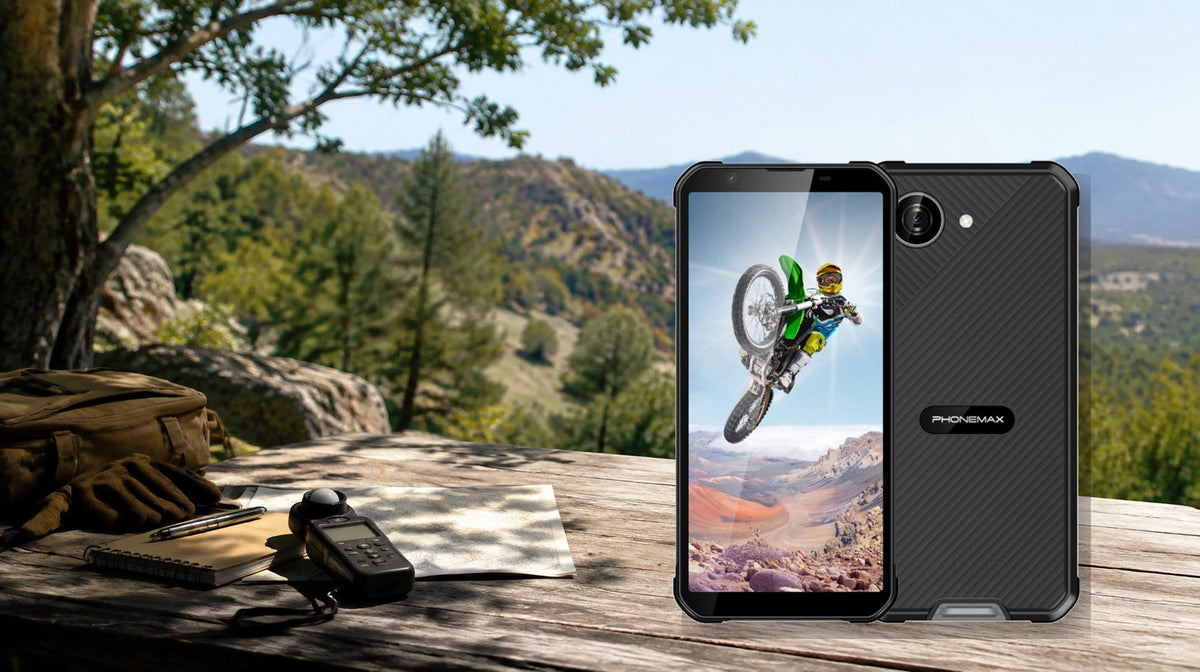
For a compact reference device, the current Phonemax X5 listing. Published evidence: The current X5 page confirms a 5.3-inch display, 5,000mAh battery, Android 16 and a compact 238g body.
Brightness evidence absent from that page: The page does not publish peak or sustained brightness, display power, an outdoor runtime result or a thermal-dimming curve.
Buying decision
Approve the phone when the outdoor task finishes with the required reserve and the display stays readable for the full interval.
Three questions for the supplier
- What brightness was sustained after 30 minutes?
- Which screen workload produced the runtime figure?
- Was thermal dimming recorded?
Two related checks are How Should You Evaluate Cold-Weather Battery Performance Before Buying a Rugged Phone? and How Should You Evaluate Fast Charging On Large Batteries Before Buying a Rugged Phone?.
FAQ
Does maximum brightness predict outdoor runtime?
No. Efficiency, content, ambient light, thermal control and the sustained level determine the result.
Should screen brightness be fixed or automatic during the test?
Use both. Manual brightness gives a repeatable comparison; automatic mode shows how the phone behaves in real changing light. Record the setting, ambient conditions and any later dimming.
What is a practical pass condition?
Define it before testing: the required outdoor task must remain readable for its full duration and finish with the battery reserve your shift plan requires.
Can a larger battery compensate for an inefficient display?
It may add runtime, but capacity alone cannot prove efficiency or sustained readability. A timed workload on the exact device is still required.
References and commercial disclosure
Android Battery Historian; EIZO on ambient light and contrast.
Phonemax prepared this buyer guide and offers X5 for sale. Screen-drain conclusions require the proposed field trial; none were independently measured here.
Library topic 174 · Sequence 33 · Editorial check: 2026-08-12


Deixar comentário
Os comentários precisam ser aprovados antes da publicação.
Este site é protegido por hCaptcha e a Política de privacidade e os Termos de serviço do hCaptcha se aplicam.